




Why does the wife's surname on a German marriage certificate look different from her husband's?
TL;DRA German Familienbuch from Standesamt Augsburg recorded the husband's surname as 'Gilliam' (governed by American law) and the wife's as 'Christl-Gilliam' — her birth name prepended to the married name under §1355 BGB. We preserved the hyphenated surname exactly and added a Translator's Note naming the dual-regime spousal-name rule, so a USCIS adjudicator would not read the mismatch as a clerical error. The certified translation was delivered for the client's I-130 filing.
Case Specifications
- Document
- Marriage record (Familienbuch extract)
- Foreign Name
- Beglaubigte Abschrift – Auszug aus dem Familienbuch
- Country
- Germany
- Languages
- German → English
- Submitted To
- USCIS
What We Received
A client submitted a German Beglaubigte Abschrift – Auszug aus dem Familienbuch (certified extract from the Family Book) issued by Standesamt Augsburg in Bavaria. The record documents an August 25, 1988 marriage between an American husband (US Navy, born in Texas) and a German wife (born in Augsburg), under Marriage Entry No. 994. The certified English translation was needed for an I-130 follow-on package being filed with USCIS.
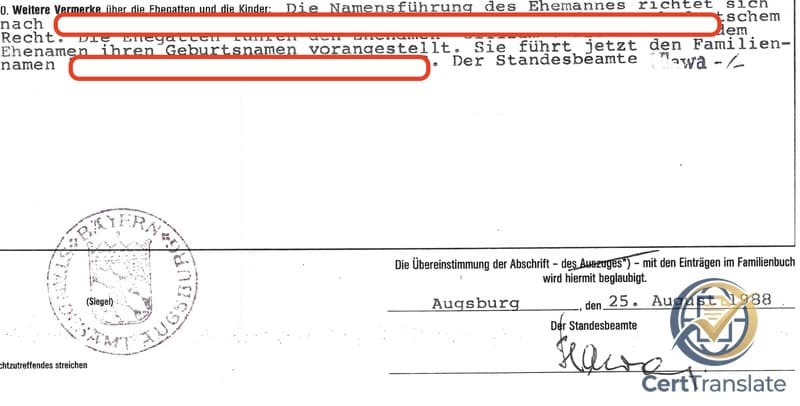
Section 10 of the form (Further notes regarding the spouses and the children) sets out the spousal-name election in plain language: the husband's name usage is governed by American law; the wife's name usage by German law; the spouses bear the married name 'Gilliam'; the wife has prepended her birth name to the married name and now bears the family name 'Christl-Gilliam'.
The client's question was direct: USCIS will see two different surnames on a single marriage record. Will the adjudicator treat that as a discrepancy? The translation needed to make the answer to that question visible on the page itself.
Why This Required Special Handling
USCIS expects the surnames recorded on a marriage certificate to match the surnames the spouses use on their other immigration documents. When a marriage record shows the husband as 'Gilliam' and the wife as 'Christl-Gilliam' — and the wife's German passport may carry any of three forms ('Christl', 'Gilliam', or 'Christl-Gilliam', depending on the election in force at the time of issuance) — a translation that reproduces the surnames without context can read as either a clerical error in the original or as evidence that the spouses use inconsistent names.
The underlying rule is German civil law, not a translation choice. Under §1355 of the Bürgerliches Gesetzbuch (BGB), spouses may choose a married name (Ehename), and the spouse whose birth name is not chosen as the Ehename may prepend or append their birth name to the Ehename to form a hyphenated combined family name (Begleitname). The husband's surname, by contrast, was governed by American law (he was a US service member at the time of marriage) and was unaffected. The Familienbuch is required to record both rules side by side.
On top of the name issue, the document itself is a Familienbuch extract — a record format that Germany discontinued in 2009 in favor of the Eheregister and standalone Eheurkunden. A 1988 marriage cannot be re-issued as a modern Eheurkunde; the Familienbuch extract is the official record, and US-side reviewers who only know the newer format may not recognize the form. The translation has to label the document type clearly while keeping the original German name visible.
How We Handled It
We translated the form as a faithful layout mirror of the original — central German label column rendered into English, husband's data on the left, wife's data on the right, registry annotations preserved exactly. The hyphen in the wife's family name 'Christl-Gilliam' was kept as a hyphen, not a space and not a comma; the legal meaning under §1355 BGB depends on the hyphen.
Section 10 was rendered in full, including the explicit dual-regime statement: 'The husband's name usage is governed by American law; the wife's name usage by German law. The spouses bear the married name "Gilliam". The wife has placed her birth name before the married name. She now bears the family name "Christl-Gilliam".' The certificate's title was rendered as 'Certified Copy – Extract from the Family Book', preserving the German document name in the certification block so the adjudicator can match the format on the page to the source document.
The certification block carries a Translator's Note that names the legal basis directly:
"Section 10 of the original Familienbuch extract states that the husband's name usage is governed by American law and the wife's name usage by German law. The spouses bear the married name 'Gilliam'. Under §1355(4) of the German Civil Code (Bürgerliches Gesetzbuch / BGB), a spouse whose birth name is not chosen as the married name may prepend or append their birth name to the married name to form a hyphenated combined family name (Begleitname). Pursuant to that provision, the wife placed her birth name 'Christl' before the married name 'Gilliam' and now bears the family name 'Christl-Gilliam'. The hyphen is part of the legal spelling of the wife's family name. The husband's surname is unaffected by the German rule and remains 'Gilliam'."

Three further Translator's Notes accompanied the certification block. One explains that the document is a Familienbuch (Family Book) extract — Germany's standard civil-registry record for marriages until the format was replaced by the Eheregister in 2009 — so a 1988 marriage cannot be re-issued as a modern Eheurkunde. One documents the date-format conversion ('25.08.1988' → 'August 25, 1988'). One explains the registry's '–/–' end-of-entry marker and notes that the 'Grundlage der Eintragung' (Basis of entry) cell contains the spouses' religious affiliations ('baptistisch' / 'katholisch') alongside the '–/–' fill marker.
The round embossed seal of Standesamt Augsburg ('STANDESAMT AUGSBURG – BAYERN' around a Bavarian coat of arms) was described in brackets with the seal text in English. The Registrar's signature was rendered as '/s/ Hlawa'. Abbreviations standard in German civil-registry forms — 'geb.' (geboren) → 'née', 'Krs.' (Kreis) → 'District', 'Heir.Eintr.Nr.' → 'Marriage Entry No.' — were resolved consistently.
The Outcome
The certified translation was delivered to the client for inclusion in the I-130 follow-on package. The Translator's Note that names §1355(4) BGB by section number and that explains the Begleitname provision in plain English makes the surname pattern legible to a USCIS adjudicator at first read.
This is a routine pattern for German marriages between a German national and a foreign spouse, especially marriages recorded between roughly 1958 and 2009 when the Familienbuch was the standard civil-registry format. We have handled this dual-regime spousal-name situation on more than twenty German marriage records since we first added a §1355 BGB note to our internal translator manual, all delivered with the same Translator's Note and none returned to us with a USCIS request for clarification on the surname.
Thank you, it is correct. Appreciate the quick turnaround.
What This Means for You
A German marriage record that shows the wife's family name as a hyphenated combination of her birth name and her married name is recorded that way by the Standesamt under §1355 BGB and is not a clerical error. A certified translation that preserves the hyphenated surname exactly and adds a Translator's Note naming the legal basis gives a USCIS adjudicator the context needed to evaluate the surname pattern at face value, without treating it as a name discrepancy.
Have a similar situation?
We handle German Familienbuch extracts and Eheurkunden with §1355 BGB combined-name records regularly.
Related Cases & Resources
Sources & References
- Meet Translation Requirements·USCIS·Verified 2026-06-14
- §1355 BGB — Ehename (Married Name)·Bundesministerium der Justiz·Verified 2026-06-14
Explore the Hub
Certified Translation
Documents
Languages
Immigration
Accepted By
All identifying information has been removed from document images. Case details are shared with client permission. No personal data is stored or displayed on this page.