




Is a German Abstammungsurkunde still a valid birth certificate if it is no longer issued?
TL;DRA client submitted a German Abstammungsurkunde (Certificate of Descent), a civil-status record that Germany stopped issuing in 2009. The document type has no modern equivalent, and its literal English name means nothing to a US reviewer. We translated the title literally and added a Translator’s Note explaining that the Abstammungsurkunde was Germany’s former birth-and-parentage record. The certified translation was delivered for the client’s USCIS filing.
Case Specifications
- Document
- Birth certificate (Abstammungsurkunde)
- Foreign Name
- Abstammungsurkunde
- Country
- Germany
- Languages
- German → English
- Submitted To
- USCIS
What We Received
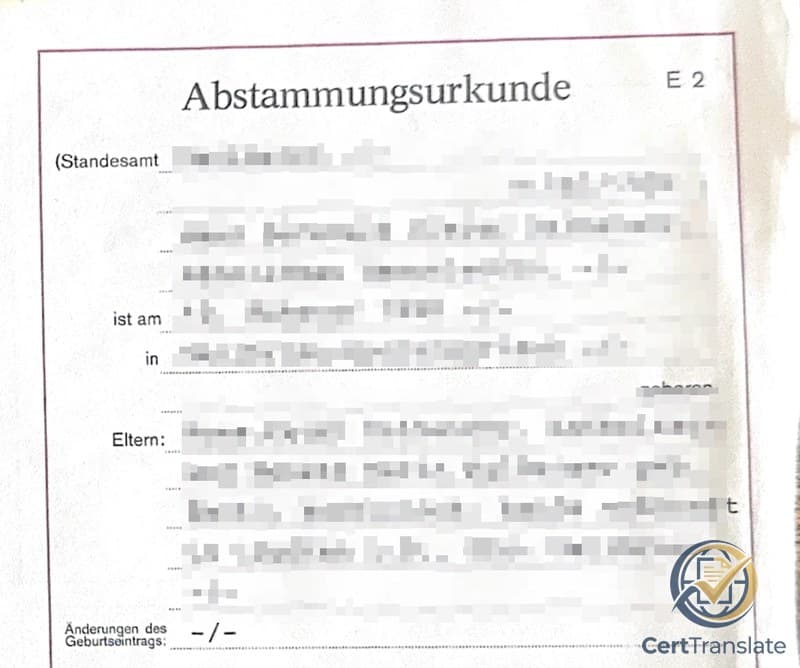
A client submitted a 1990 German Abstammungsurkunde (Certificate of Descent), issued by the Standesamt (Civil Registry Office) in Heilbronn. The document recorded both the holder’s birth and their parentage.
Germany stopped issuing this document type in 2009 and replaced it with the modern Geburtsurkunde. The client needed a German-to-English birth certificate translation for a USCIS filing.
Why This Required Special Handling
USCIS translation requirements call for a complete translation of every element on a civil document, including its title. The literal English name of an Abstammungsurkunde, “Certificate of Descent,” is accurate but opaque. A reviewer who sees “Certificate of Descent” has no easy way to know it is a birth certificate.
A translator also cannot simply relabel the document “Birth Certificate” in the body, because that wording is not in the original. The job was to keep the literal title and still make the document’s function clear on the same page.
The discontinuation adds a second layer: Germany no longer issues the Abstammungsurkunde at all. A person can request the current Geburtsurkunde instead, but that is a different document. The Abstammungsurkunde already in hand remains a valid record, so the translation has to present the older format on its own terms.
How We Handled It
We translated the title literally as “Certificate of Descent,” exactly as it reads in German. We did not substitute “Birth Certificate” in the translation body. Instead, we added a Translator’s Note that explains what the document is:
"“Abstammungsurkunde” (literally “Certificate of Descent”) is a former type of German civil-status record, issued until 2009, that documented a person’s birth together with their parentage. It served the function of a birth certificate."

We then classified the document as a birth certificate in the certification statement that accompanies the translation. That keeps the literal title on the page while telling the reviewer how to read it.
Several smaller German conventions also needed handling. The birth clause uses a split verb, “ist am … geboren,” and the second half of the verb sits at the end of the entry.
We rendered the split verb once in natural English as “was born on …,” rather than translating it twice. German dates in day-month-year order were converted to the US month-day-year format, with a Translator’s Note recording the change.
We resolved the registry abbreviations consistently: “geb.” (geborene) as “née,” “Krs.” (Kreis) as “District,” and “a.N.” (am Neckar) kept as written. The repeated “–/–” marks are civil-registry fill cancellations that show no further entry was made, and we preserved and explained them. The round seal around the city’s eagle coat of arms was described in brackets with its text translated into English, and the registrar’s handwritten signature was marked “[Illegible signature].”
The Outcome
The certified translation was delivered to the client for a USCIS filing. The Translator’s Note states plainly that the Abstammungsurkunde was Germany’s former birth-and-parentage record. A reviewer can therefore recognize the document, and its function, on the first read.
We use the same title-plus-note approach for other discontinued German civil records, such as the Familienbuch. The goal each time is simple: keep the original wording, and give the reviewer the one line of context the older format needs.
What This Means for You
An Abstammungsurkunde is a valid German birth record, even though Germany stopped issuing the form in 2009. If you have one, you do not need to obtain a new document. A certified birth certificate translation service that keeps the literal title and adds a short Translator’s Note lets a US reviewer recognize what the document is.
Have a similar situation?
We translate older and discontinued German civil records — Abstammungsurkunde, Familienbuch, and the modern Geburtsurkunde — for USCIS regularly.
Related Cases & Resources
Sources & References
- Meet Translation Requirements·USCIS·Verified 2026-07-21
- Personenstandsgesetz (PStG)·Bundesministerium der Justiz·Verified 2026-07-21
Explore the Hub
Certified Translation
Documents
Languages
Immigration
Accepted By
All identifying information has been removed. Case details are shared with client permission. No personal data is stored or displayed on this page.