CertTranslate
Sworn translation standardVerified June 2026

Switzerland Document Translation Requirements

Need your Swiss document translated for the U.S. — or a U.S. document accepted in Switzerland? Start with the direction: the translation, certification, and apostille rules are not the same.

USCIS accepted formatWES-ready package
Signed & stamped Certificate of AccuracyComplete, word-for-word translationExact structure preserved
Klaus Weber

Requirements reviewed by Klaus Weber

European Medical & Scientific Translator · Last verified June 2026

BBB business profileATA member directory listingU.S. Department of State directory listingGoogle Maps business profile
Verified requirements summary

Reviewed June 2026 · Klaus Weber

Switzerland document translation requirements — the short answer

Switzerland follows the sworn translation standard for official documents. Translator recognised by the relevant Swiss canton or authority. Often required for foreign documents, depending on country of origin.

01Submitting in Switzerland
Switzerland follows the sworn translation standard. Translator recognised by the relevant Swiss canton or authority.
02Submitting in the United States
Use a complete English translation with a signed Certificate of Accuracy for USCIS, universities, and credential evaluators. Cover every visible field, seal, stamp, signature, and note.
03Apostille
Often required for foreign documents, depending on country of origin

Confirm final requirements with the authority receiving the document.

Need a certified German → English translation?

From $24.95/page · signed certification included

Quick reference

What are Switzerland's document translation requirements?

Confirm final requirements with the authority receiving the document.

Translation standardSworn translation (Other)
Who can translateTranslator recognised by the relevant Swiss canton or authority
ApostilleOften required for foreign documents, depending on country of origin
Accepted languagesGerman, French, Italian, or Romansh (depending on canton)
Responsible authoritySwiss Federal Department of Foreign Affairs (FDFA)
Important: Translation requirements in Switzerland vary by canton and institution. Always confirm the specific requirements with the receiving authority before arranging a translation.

Official-use requirements

How do document translation rules work in Switzerland?

The local certification system, who may translate, and what gives the finished document legal effect.

01

Who can translate documents for use in Switzerland?

Switzerland does not operate a single nationwide sworn translator system. Translation requirements are determined at cantonal level. Some cantons maintain their own lists of court-recognised translators (traducteur juré / vereidigter Übersetzer / traduttore giurato), while others require notarisation or certification of the translator’s signature.
02

What makes a translation official in Switzerland?

Requirements vary depending on the canton and the type of authority involved. In many cases, an official translation must include:
  • A declaration confirming the translation is complete and accurate
  • The translator’s signature
  • In some cases, notarisation or court certification
  • Authorities may require the translation to be into one of Switzerland’s official languages: German, French, Italian, or Romansh.
    03

    How does Switzerland treat documents from abroad?

    Foreign documents generally need to be apostilled or legalised in the issuing country before submission to Swiss authorities. Depending on the canton, additional notarisation or confirmation of the translator’s signature may be required.
    04

    Legal basis

    Translation requirements in Switzerland are governed at cantonal level rather than federally. Each canton determines whether sworn translators are used or whether notarised certification is sufficient. Legalisation and apostille matters are handled by the Swiss Federal Department of Foreign Affairs (FDFA).

    Need the German translation service rather than the rules?

    Continue to the language hub or choose the exact document you have.

    Two directions, two rulebooks

    Which direction are your documents going?

    Choose the destination first. It determines the language, certification, and whether an apostille belongs in the packet.

    German → English

    Translating German documents for the U.S.?

    Swiss birth certificates, diplomas, transcripts, and other non-English records need a complete certified English translation for USCIS, U.S. universities, and credential evaluators.

    • Every field, seal, stamp, and annotation
    • Signed Certificate of Accuracy
    • Most 1–3 page orders in 24 hours
    U.S. → Switzerland

    Sending U.S. documents to Switzerland?

    Requirements depend on the receiving country and authority. Confirm whether the original needs an apostille or consular legalization before it is translated.

    Sequence matters: when the original needs an apostille, obtain it before translation so the complete packet can be translated together.
    Switzerland document guide

    Which Swiss documents are covered by these requirements?

    Choose the document you have for its format-specific translation guidance. These links cover the records most often submitted from Switzerland to USCIS, universities, and credential evaluators.

    USCIS accepted formatWES requirements includedSigned & stamped certificate
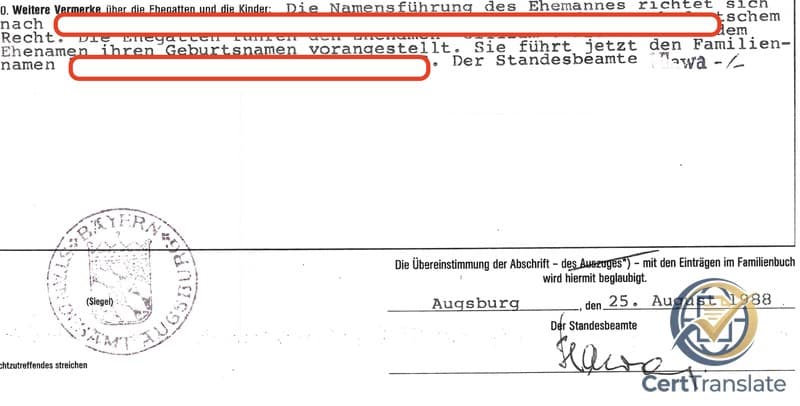
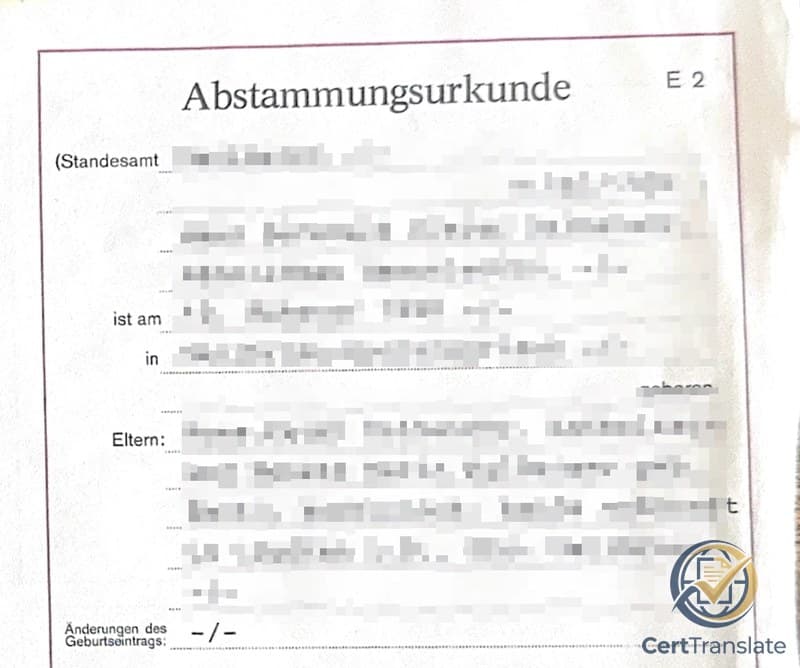
    Redacted 1990 German Abstammungsurkunde (Certificate of Descent) from Standesamt Heilbronn — a discontinued German birth record type; personal data blurred, title and form labels visible
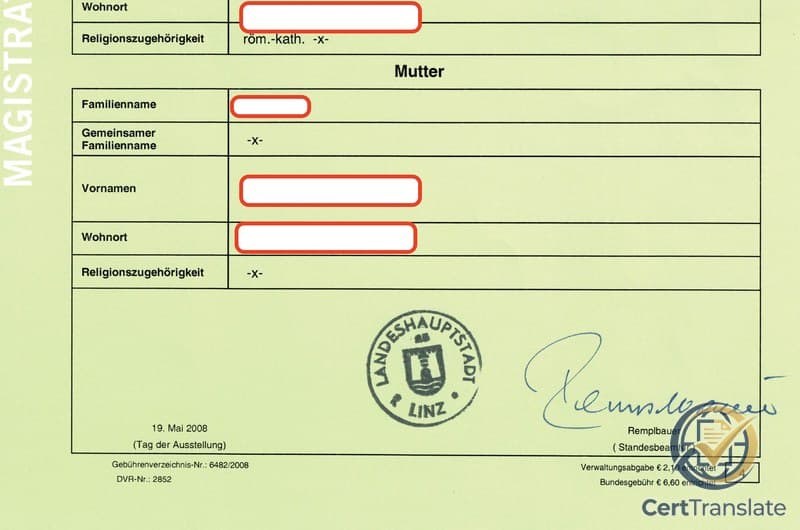
    Austrian Geburtsurkunde (birth certificate) issued by Landeshauptstadt Linz with redacted personal details — the left margin carries the vertical institutional label 'MAGISTRAT DER LANDESHAUPTSTADT LINZ' for the city's municipal administration, a Statutarstadt under Article 116(3) of the Austrian Federal Constitution
    2 published casesMost popular

    Birth certificate

    deGeburtsurkunde

    German birth certificate translation is one of the most common request types for USCIS petitions and identity verification workflows.

    Signed & stamped Certificate of Accuracy

    Word-for-word · exact structure preserved

    Diplom · Zeugnis · Urkunde

    Diploma and degree records

    German diploma translation is often required for admissions, licensing, and employment verification.

    Signed & stamped Certificate of Accuracy

    Word-for-word · exact structure preserved

    Notenspiegel · Transcript

    Academic transcript and grade records

    Academic supporting records require line-level translation of courses, grades, scales, and institutional headers.

    Signed & stamped Certificate of Accuracy

    Word-for-word · exact structure preserved

    Real casework

    Real German translation cases we've handled

    Anonymized German-to-English orders. Each case shows the exact translation problem and how we solved it for the receiving authority.

    Questions people ask before submitting

    What should I know about Switzerland document translation requirements?

    What type of translation does Switzerland require?

    Switzerland follows the sworn translation standard for official documents. Translations should be completed by: translator recognised by the relevant swiss canton or authority.

    Is an apostille required for foreign documents in Switzerland?

    Often required for foreign documents, depending on country of origin

    What languages do Swiss authorities accept?

    Official authorities in Switzerland accept documents in: German, French, Italian, or Romansh (depending on canton). Documents in any other language need a sworn translation before submission.

    Can CertTranslate help with documents for Switzerland?

    If you are submitting Swiss documents to U.S. authorities (USCIS, universities, credential evaluators), yes — our certified translations are accepted nationwide. For official use inside Switzerland, authorities usually require a translator sworn or registered locally — use the official registry linked on this page. We can also advise on apostille requirements for U.S.-issued documents.

    Official sources

    Information verified against official sources. Last verified June 2026.