
CertTranslateCertTranslate
Sworn translation standardVerified June 2026

Document Translation Requirements in Brazil

Official bodies in Brazil generally require a sworn translation of foreign-language documents, and many documents also need an apostille or legalization before they are translated. Below: who can translate, when an apostille is needed, and where the official rules are published.

Key facts

Brazil recognizes only a tradução juramentada — a sworn translation by a tradutor público e intérprete comercial appointed through a state Junta Comercial. For a Brazilian document used in the United States you instead need a certified English translation with a signed Certificate of Accuracy, accepted by USCIS, WES, and ECE. Brazil joined the Hague Apostille Convention in 2016, so a Brazilian certidão is apostilled at a cartório — not legalized at a consulate.

Reviewed by Natalia Vega, Senior Certified Translation Reviewer · ATA member since 2017· Last verified June 2026

Brazil requirements at a glance

Translation standardSworn translation · tradução juramentada
Who can translatePublic sworn translator registered with a Brazilian Junta Comercial
ApostilleRequired for foreign public documents before sworn translation
Apostille authorityAn authorized notary office (cartório) supervised by the National Council of Justice (CNJ), issued through the electronic SEI-Apostila system. Any qualified cartório can apostille a document, regardless of which state issued it.
Accepted languagesPortuguese
Responsible authorityMinistry of Foreign Affairs (Itamaraty)
Important: Foreign public documents must be apostilled or consularly legalised before being translated by a sworn translator in Brazil.

Who can translate documents for use in Brazil?

In Brazil, legally valid translations (traduções juramentadas) must be performed by a tradutor público juramentado, officially registered with the Junta Comercial of a Brazilian state. To become a sworn translator, individuals must pass a public examination (concurso público). Only natural persons—not companies—may be appointed.

What makes a translation official in Brazil?

A sworn translation must include:
  • The translator’s official stamp and registration number
  • Signature or initials on each page
  • A declaration of accuracy
  • Reference to the translator’s official record book maintained at the Junta Comercial
  • Although translators are registered at state level, sworn translations are valid nationwide across Brazil.

    How does Brazil treat documents from abroad?

    Public documents issued abroad must first be apostilled under the Hague Convention or consularly legalised before being translated in Brazil. The apostille or legalisation does not replace the requirement for sworn translation.

    Legal basis

    Sworn translators in Brazil are regulated by federal commercial registration rules administered through the Department of Business Registration and Integration (DREI) under the Ministry of Development, Industry, Commerce and Services. Registration is carried out at state level via the Juntas Comerciais.

    Apostille & legalization for Brazil

    Brazil is part of the Hague Apostille Convention (since 2016), so public documents are authenticated with a single apostille — no consular legalization.

    Documents from Brazil

    An authorized notary office (cartório) supervised by the National Council of Justice (CNJ), issued through the electronic SEI-Apostila system. Any qualified cartório can apostille a document, regardless of which state issued it.Brazil acceded on 2 December 2015; the Convention entered into force on 14 August 2016 (Decreto nº 8.660/2016).

    U.S. documents going to Brazil

    A U.S. document going to Brazil is apostilled in the United States — the state Secretary of State for state documents, the U.S. Department of State for federal ones — and then translated into Portuguese by a Brazilian tradutor juramentado.

    The apostille should be obtained before the translation, so the apostille certificate is translated too. See how apostilles work, or order a translation with e-apostille.

    How to get a Brazil document translation accepted

    1. 1

      Apostille the Brazilian original at a cartório

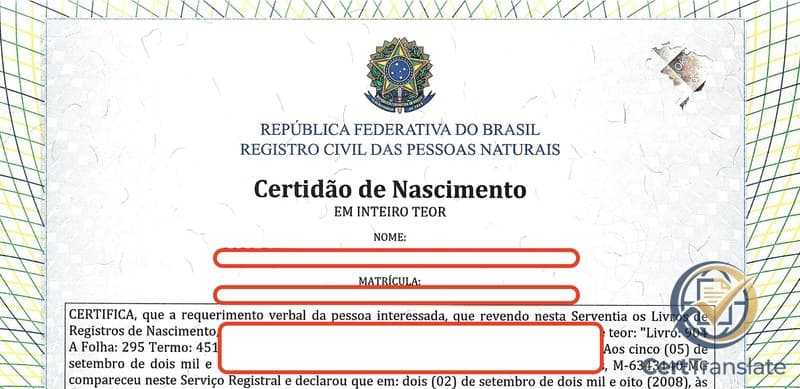
      A Brazilian certidão (de nascimento, de casamento) is apostilled at an authorized cartório under the CNJ system. Do it before translation so the apostille page is covered too.

    2. 2

      Order a certified English translation of the entire document

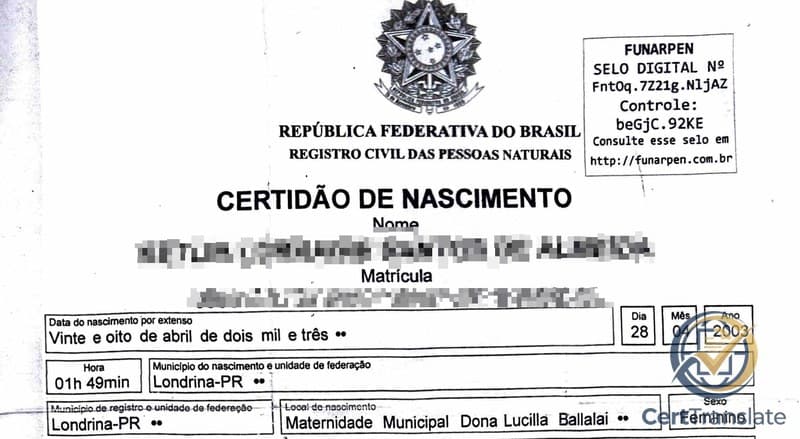
      Include the apostille, the cartório seals, the 32-digit matrícula, and any marginal annotations (averbações) — with a signed Certificate of Accuracy.

    3. 3

      Submit the original plus the certified translation

      File the apostilled original or certified copy with the certified translation to USCIS, the credential evaluator (WES/ECE), or the university.

    Ready to translate your Portuguese documents?

    Certified for USCIS, universities, and credential evaluators — from $24.95/page.

    Start my translation

    Which direction are your documents going?

    Translating Portuguese documents for the U.S.?

    Brazilian birth certificates, diplomas, and transcripts submitted to USCIS, universities, or credential evaluators need a certified English translation — that is exactly what we do, with a 100% USCIS acceptance guarantee.

    Sending U.S. documents to Brazil?

    U.S.-issued documents usually need an apostille before they can be used in Brazil — and the apostille should be obtained before the translation, so the certificate itself gets translated too. We offer e-apostille processing as an add-on to any order.

    Why Brazil document translations get rejected

    The mistakes we see most often on Brazilian documents — and what a correct certified translation does instead.

    CNJ electronic apostille separated from the document

    Brazil's SEI-Apostila apostille is a separate electronic page. It must be translated and kept with the certidão, or USCIS sees an unauthenticated document.

    Read the case

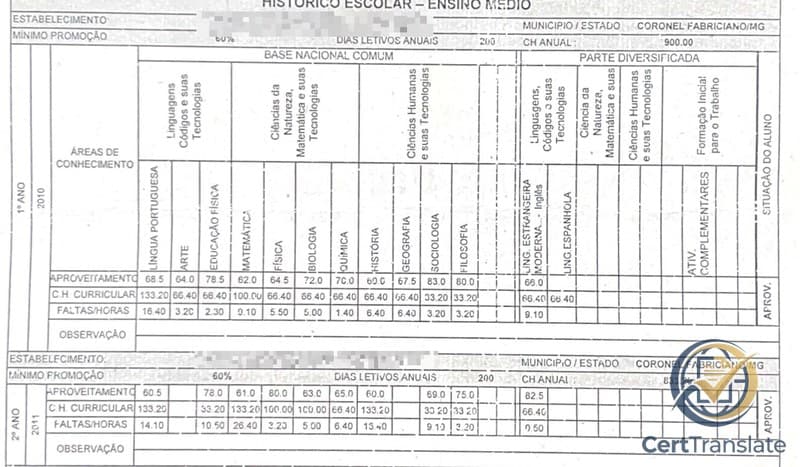
    Histórico escolar série/ano numbering flattened

    Brazilian transcripts number grades by both série and ano; collapsing them into one misstates the year of study a WES or ECE evaluator reads.

    Read the case

    APR read as a numeric grade

    On a histórico, "APR" means aprovado (passed), not a mark. Translating it as a grade distorts the GPA a credential evaluator computes.

    Real casework

    Real Portuguese translation cases we've handled

    Anonymized Portuguese-to-English orders. Each case shows the exact translation problem and how we solved it for the receiving authority.

    Cost & turnaround

    $24.95/ page

    A one-page certidão is priced as a single page; multi-page históricos escolares and court records are priced by their page count. Standard delivery is 24–48 hours, with notarization and e-apostille available as add-ons. See full pricing.

    Brazil translation requirements — FAQ

    What translation does Brazil require for foreign documents?

    Brazil accepts only a tradução juramentada — a sworn translation by a public translator appointed through a state Junta Comercial. The foreign document is apostilled or legalized first, then translated by the sworn translator.

    how apostilles work
    Do I need a sworn translator for a Brazilian document used in the U.S.?

    No. The U.S. does not use Brazil's tradução juramentada system. A Brazilian certidão or diploma needs a certified English translation with a signed Certificate of Accuracy, which USCIS, WES, and ECE accept.

    certified Portuguese translation
    Is Brazil in the Hague Apostille Convention?

    Yes, since 14 August 2016. A Brazilian public document used abroad is apostilled at an authorized cartório under the CNJ, not legalized at a consulate.

    requirements for other countries
    Who issues an apostille in Brazil?

    Authorized notary offices (cartórios) supervised by the National Council of Justice (CNJ), through the electronic SEI-Apostila system. Any qualified cartório can apostille, regardless of where the document was issued.

    certidão translation
    Should the translation use Brazilian or European Portuguese?

    For a Brazilian-issued document the translation works from Brazilian Portuguese conventions — cartório, certidão, comunhão de bens. The English target reads the same, but the source terminology and document structure are Brazilian, not European.

    Portuguese translation services
    Does WES accept a certified Brazilian transcript translation?

    Yes. WES and ECE accept a certified English translation submitted with the original histórico escolar and diploma. The translation must preserve série/ano numbering and APR status so the evaluator can map the credits.

    WES-accepted translation
    How much does a Brazilian document translation cost?

    Pricing is per page. A one-page certidão de nascimento is a single page; multi-page históricos are priced by page count. Notarization and e-apostille are optional add-ons.

    see live pricing
    Can I translate my own Brazilian documents?

    No. USCIS and credential evaluators reject self-translation. An independent qualified translator must complete and certify the translation with a statement of accuracy.

    what a certified translation is

    Requirements in related countries

    Neighbors and countries with a similar translation standard.

    Sources

    Information verified against official sources. Last verified June 2026.

    Need a certified Portuguese translation?

    Signed Certificate of Accuracy with every order, 100% USCIS acceptance guarantee, optional notarization and e-apostille — delivered in 24–48 hours.