
Certidão averbada
Marriage certificate carrying the divorce
For Brazil this is usually the document you need. One page is enough to start.
Certidão de casamento com averbação de divórcioSentença de divórcioEscritura pública de divórcio
Certified English translation for USCIS, spouse and fiancé(e) petitions, naturalization filings, courts, and other marital-history review.
Ready within 24 hours
Complete submitted record
Finality and court structure preserved
Case caption · ruling · finality · seals · registration notes
Certified package
Signed and Stamped Certificate of Accuracy
Company letterhead · translator signature · company stamp

We check your files and confirm the total before you pay




Your filing package
You get three files: a scan of your Portuguese record, the full English translation, and a signed and stamped Certificate of Translation Accuracy.
Files checked and total confirmed before payment
Documents we translate
Have one document? That is enough to start. Upload the record you want translated. We confirm the page count, the price, and the delivery time before you pay.
Certidão averbada
For Brazil this is usually the document you need. One page is enough to start.
Sentença / escritura
We translate short rulings and full multi-page decisions alike, property and custody parts included.
Related records
Apostilles, CNJ verification pages, older certidões, and Portuguese assentos with averbamentos.
Real Portuguese-language casework
The first case follows an averbação from the other direction, when a U.S. decree had to be written into a Brazilian record. The other two are the documents a divorce lands on: the marriage certificate and its property regime, and a certidão carrying margin entries.
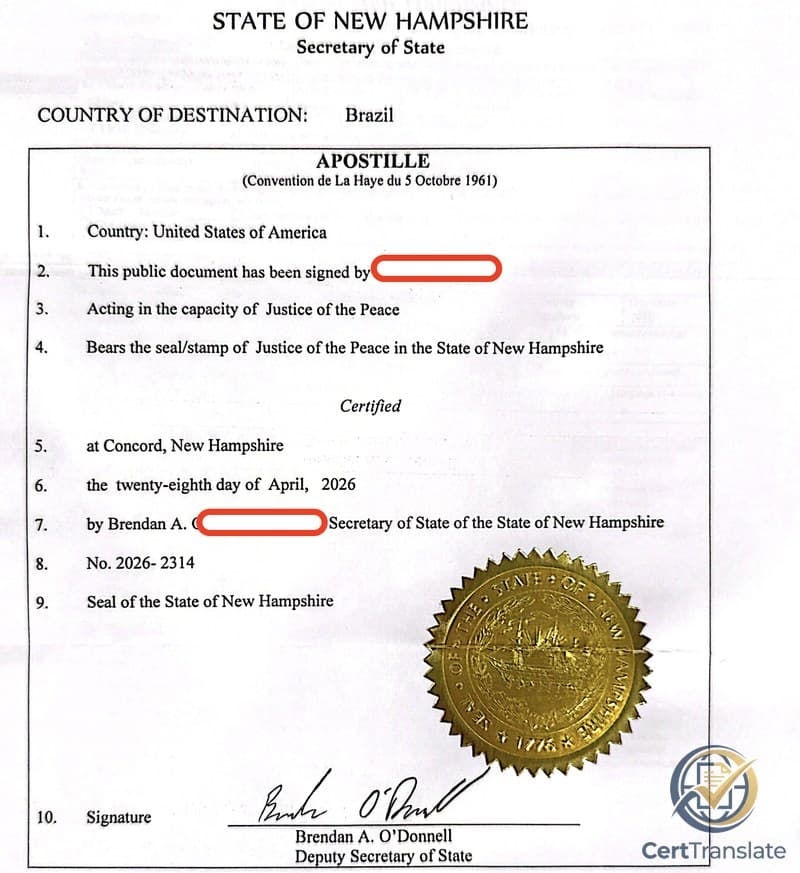
Brazil · averbação
We translated the decree and its apostille for the cartório, keeping the court, the case number, and the finality wording in the form the averbação needs.
Read the case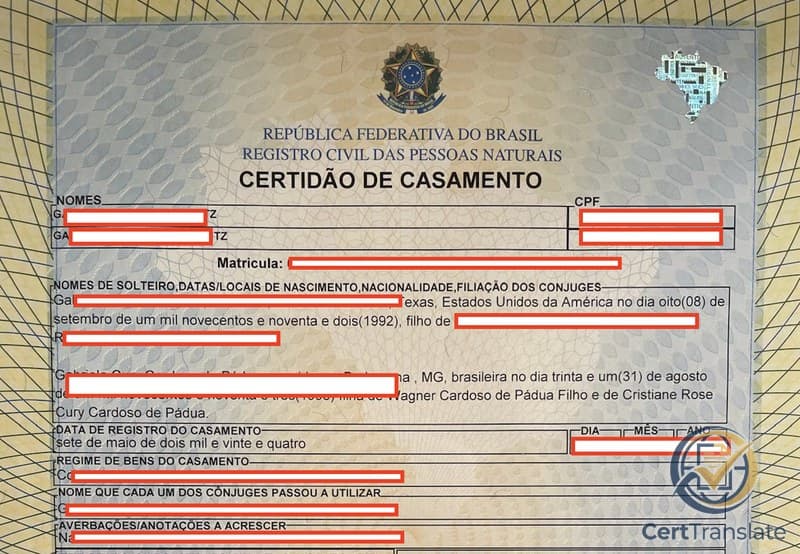
Brazil · property regime
We rendered comunhão parcial de bens as the regime it is rather than a loose phrase, because that line decides what a divorce actually divides.
Read the case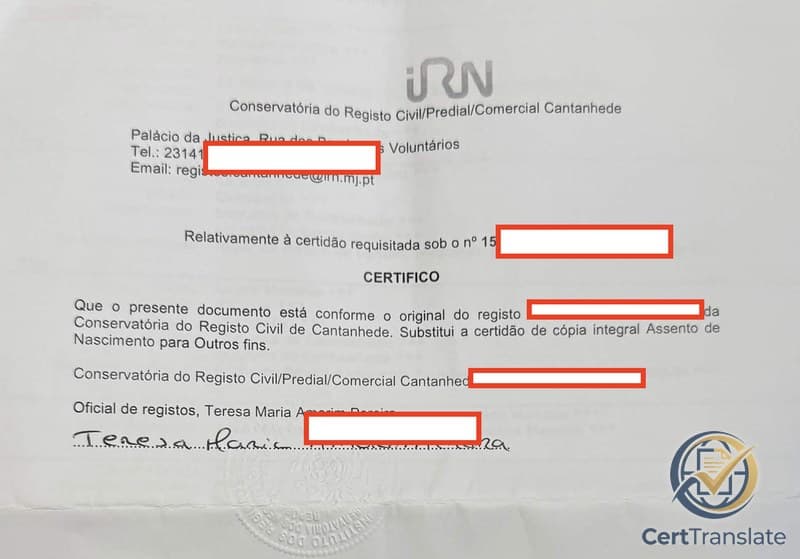
Portugal · averbamentos
We translated every averbamento in place and in order, so the name on the certificate and the name on the passport could be read as one person.
Read the caseWhich record proves the divorce
No, and that surprises most filers. Brazil writes the divorce into the marriage record instead of issuing a separate certificate. Portugal works the same way. We name the record you actually hold.
The proof is your marriage certificate, re-issued by the cartório after the divorce is written into it. That annotation is the averbação, and the updated certidão is what a Brazilian consulate accepts as proof.
This is why the copy in your drawer may not work. A certidão printed before the averbação still shows the marriage standing, however old the divorce is.
Check the issue date on your certidão before ordering. If it predates the averbação, ask the cartório for a fresh copy first, then send us that one.
A contested divorce ends in a judge’s sentença. A consensual one can be signed at a cartório as an escritura pública. That route has been open since 2007, where there are no minor or incapable children and both spouses have a lawyer.
Either document grants the divorce; the averbação records it. We translate whichever you hold and keep the route visible, because the two are not interchangeable.
A divorce by mutual consent is decided at the Conservatória do Registo Civil rather than in court. Once decreed, it is noted on the marriage entry automatically.
So the proof is again a certidão de casamento, this time carrying an averbamento. Ask for the cópia integral, which prints every margin entry rather than a summary.
A Brazilian certidão usually carries a matrícula number and a digital seal. Apostilles for Brazil are issued online through the CNJ. Portugal runs its own apostille system.
We reproduce the codes and translate the wording around them. What we do not do is certify that a code verifies; that check belongs to the office you file with.
How it works
Upload the record first. We name the document, confirm the full page set and the price, then translate, check, and certify it.
Send the certidão, the sentença or escritura, the apostille, and any back sides. Add the USCIS notice or checklist that names what they asked for.
A Portuguese specialist translates the registry or court text. A second reviewer checks the names, the dates, the property regime, and every margin entry.
Ask for fixes before we certify. You then get the source copy, the full English translation, and the signed and stamped Certificate of Translation Accuracy.
How much does a Portuguese divorce translation cost?
No 250-word cap on dense registry pages.
Certified price
$24.95/ page
No payment until file review
Client reviews
Fernanda L.
Deerfield Beach, FL
“My proof of divorce was the marriage certificate with the averbação written in the margin. They translated the whole annotation, not just a line saying I was divorced.”
Brazil · Certidão with averbação
Annotation translated in full
Pedro S.
Elizabeth, NJ
“Mine was a consensual divorce done at a cartório, not in court. The translation made clear it was a public deed, which is what my attorney wanted to see.”
Brazil · Escritura pública
Notarial route kept visible
Mariana R.
Framingham, MA
“The Portuguese certificate had several averbamentos added over the years. Each one was translated in place and in order, so the name history was easy to follow.”
Portugal · Cópia integral
Every margin entry in order
Questions before ordering
The translation rule is always the same: file the Portuguese-language evidence with a full certified English translation. Which record proves the divorce depends on the country and on how it was granted.
The price is $24.95 per physical page, with no word cap. A certidão is usually one page, even when the margin is dense. A court ruling can run several. We confirm the count before you pay.
Most one- to three-page orders arrive within 24 hours. For long rulings, and for older certidões with handwritten margins, we confirm a delivery time before we start.
Your package holds the source copy, a full English translation, and a signed and stamped Certificate of Translation Accuracy. If USCIS raises a translation issue, we revise it free. That does not replace holding the right record in the first place.
There is not one. Brazil writes the divorce into the marriage record as an averbação, so your proof is a certidão de casamento re-issued after that annotation was added.
Your copy was almost certainly printed before the averbação was made. Ask the cartório for a current certidão. Translating the old one will not make the divorce appear on it.
Often not, if the averbada certidão proves what you were asked to prove. Send both when you have them and we will name each before you pay, so you only translate what your filing needs.
Use the date the form asks for, if the record backs it up. The ruling, the deed, and the averbação can carry different dates. The translation labels each one instead of picking for you.
It is the property regime the marriage ran under, printed as its own field. It decides what a divorce divides, so we translate it as a named regime rather than a loose phrase.
USCIS generally asks for a certified English translation, not a notarized one and not an apostille. A court, consulate, or foreign office may set its own rules, so follow that recipient’s checklist.
Yes. Portuguese-language civil records from any country come through the same team. We name the issuing office as it appears rather than mapping it onto a Brazilian or Portuguese form.
What we check before certification
These issues come up again and again in Portuguese-language marital-history packets. The translation should show the annotation, the dates, and the record type, not leave the officer to work them out.
Our check: We translate the annotation in full, with its date, its office, and the ruling or deed it refers to. That block is the evidence, not a label.
Our check: We compare the issue date against the annotation and tell you before work starts, because no translation can add a divorce the record does not carry.
Our check: Comunhão parcial, comunhão universal, and separação de bens are distinct regimes. We name each one instead of writing around it.
Our check: We keep every averbamento in its own place and in the order the registry wrote it, so a name history reads as a sequence.
The standard behind these checks
AcceptReady™ is CertTranslate's published standard for certified translations: complete word-for-word translation, mirrored page layout, signed and stamped Certificate of Accuracy on letterhead, and matched to the receiver's published requirements.
How to check each one yourselfChecked before certification. If an authority later requests a translation-related correction, revisions remain free.
Start my translationCommon USCIS contexts
USCIS reads divorce evidence to see whether an earlier marriage ended lawfully, and whether both people were then free to marry again.
Send the Portuguese-language record together with its certified English translation. The translation must not replace the source, shorten it, or quietly fix it.
Proof that an earlier marriage ended supports the current marriage in a family-based case.
Both parties must show that prior marriages ended and that they are legally free to marry.
USCIS asks for records showing an earlier marriage ended lawfully. A name change on the form has to be evidenced too.
Which civil record counts, and whether it needs a stamp, follows the destination’s own checklist.
Document glossary
These terms often show up together, but they name different documents, offices, or stages of the divorce.
Reference library
Guidance and source links last rechecked .
Ready when you are
Send what you have: the averbada certidão, the sentença, the escritura, or an apostille. We confirm the record type, the page count, the price, and when it will be ready.
No payment until file review
