




How do you translate a Brazilian birth certificate bound to a CNJ digital apostille so USCIS can read both pages?
TL;DRA Brazilian Certidão de Nascimento arrived bound to a CNJ digital apostille on its second page. The Brazilian CNJ apostille birth certificate translation had to paginate the same way as the source. We kept page-1 stamps on page 1, page-2 apostille and matrícula explainer on page 2, and verified every FID security code digit by digit. The certified translation was delivered for the client's USCIS filing.
Case Specifications
- Document
- Birth certificate
- Foreign Name
- Certidão de Nascimento
- Country
- Brazil
- Languages
- Portuguese → English
- Submitted To
- USCIS
What We Received
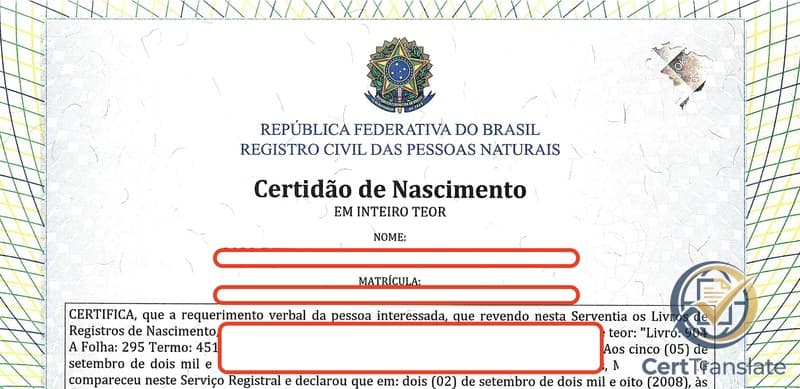
The client commissioned a Brazilian CNJ apostille birth certificate translation. The source is a Certidão de Nascimento (em inteiro teor) issued by the 1.º Subdistrito de Belo Horizonte cartório in Minas Gerais. The document arrived as a single PDF. Page 1 holds the certificate body. Page 2 holds the CNJ Apostila Eletrônica that authenticates it.
Page 1 carries four overlapping authentication elements at the foot of the page. A blue oval cartório stamp sits on the left. A round registry seal overlays the signature. A TJMG consultation seal with its FID identifier and 16-digit security code sits on the right. An embedded QR code joins it. A vertical RECIVIL security marker runs down the right margin.
Page 2 carries a second TJMG consultation seal across the top, then the CNJ apostille table. A matrícula explainer block runs along the right margin and decodes the 30-digit registration number. The certified Portuguese birth certificate translation for USCIS had to mirror this bound source — not flatten it into a single page.
Why This Required Special Handling
A Brazilian CNJ apostille birth certificate translation has to read as a layout-faithful mirror of the source. USCIS expects a certified translation that matches the source layout. An adjudicator should point at any element on the original and find the same element in the same position in the English. When the source is a two-page bound PDF, the translation has to paginate the same way. A flat reflow that collects every stamp into one English page breaks the visual map.
The page-1 and page-2 TJMG seals look almost identical. Both carry a 'CONSULTATION SEAL: FID-NNNNN' line. Both carry a 16-digit security code. Without an explicit page break separating them, a reviewer cannot tell which FID belongs to which page. The matrícula explainer block prints the standard 30-digit pattern with placeholder letters and an example number. Without context, it is easy to confuse with the actual matrícula on the cover page.
Two layout details on this document were not stamps. The Brazilian coat of arms at the top of page 1 is the document's masthead. It appears on every cartório certidão and is not an applied stamp. The trilingual PT/EN/FR labels on the CNJ apostille are field captions, not signature content. They need to be reproduced as captions rather than collapsed into one English label.
How We Handled It
We built the English translation as a multi-page document. It paginates the same way the source does. Page 1 of the translation carries the certificate body and the page-1 cartório and TJMG stamps. The vertical RECIVIL security marker stays on page 1. Page 2 begins with an explicit page break. It then carries the page-2 TJMG consultation seal and the CNJ apostille table.
Above the certificate title on page 1 we placed a `[LOGO at top of page: Coat of Arms of the Federative Republic of Brazil]` marker. This distinguishes the document masthead from applied stamps. Applied stamps go in `[STAMP: ...]` brackets. The CNJ apostille's trilingual field labels were reproduced as three stacked lines: Assinatura Eletrônica / Electronic Signature / Signature Électronique. This preserves the trilingual structure of the Hague-Convention form.
Every reference number was verified against a high-resolution crop digit by digit. The page-2 TJMG security code runs 16 digits with no separators. It is easy to miscount as 17. The verification pass was done from a tight crop of that single line. The apostille date '05/01/2022' was rendered as 'January 5, 2022' in the body. It was never rendered as numeric '01/05/2022', which would invert the day and month against the source. A Translator's Note documents the Brazilian DD/MM/YYYY to Month DD, YYYY convention.
"The Apostille date '05/01/2022' in the original is presented in DD/MM/YYYY format (Brazilian convention); it has been rendered as January 5, 2022 in this translation. Monetary values are shown in Brazilian Reais (R$). Tax abbreviations are preserved as in the source: TFJ (Judicial Fiscal Tax), ISSQN (Tax on Services of Any Nature), ISS (Service Tax), RECOMPE (Compensation Fund for Notarial Acts). CPF refers to the Brazilian individual taxpayer identification number; CNPJ refers to the Brazilian legal-entity taxpayer identification number; CEP refers to the Brazilian postal code. 'Matrícula' has been rendered as 'Registration Number'; 'Cartório' as 'Registry Office'; 'Escrevente' as 'Clerk'; 'Oficial' as 'Registrar/Registry Officer'. The declarant's surname on the original entry is noted as illegible in the source text ('sobrenome ilegível'). Reference numbers, document IDs, URLs, e-mail addresses, telephone numbers, and security codes have been preserved verbatim from the source."

The matrícula explainer block on the apostille page was translated as a standard-pattern key. The pattern reads `Standard: aaaaaabbcc dddd e ffff ggg hhhhhh ii`. Each placeholder letter is mapped to its meaning: CNS code of the registry, service type, year of registration, book type, book number, sheet number, entry number, verifier digit. The example matrícula printed inside the explainer was preserved as an example. It was not promoted to a second registration number competing with the actual matrícula on the cover page.
The Outcome
The certified translation was delivered for the client's USCIS filing. The preserved pagination, the LOGO/STAMP relabeling, and the digit-verified security codes give a USCIS adjudicator a one-to-one map. Every element on the source has its English equivalent in the same position.
We have handled the same bound-CNJ-apostille pattern on several other Brazilian birth, marriage, and naturalization certificates since 2024. Modern Brazilian cartórios deliver the underlying record and the apostille as a single signed PDF. The translation that paginates the same way the source does is the one that clears USCIS certified-translation review without follow-up questions.
What This Means for You
If your Brazilian cartório record arrived as a single PDF with the CNJ Apostila Eletrônica bound to the second page, the certified English translation should paginate the same way. It should not flatten both source pages into one. Each TJMG security seal stays on the page it actually appears on. The Brazilian coat of arms is labeled as a LOGO rather than a stamp. If you are commissioning a Brazilian CNJ apostille birth certificate translation for USCIS, expect the translator to confirm this layout choice up front.
Have a similar situation?
We translate Brazilian cartório records — birth, marriage, and naturalization certificates with the CNJ Apostila Eletrônica bound to the underlying document — regularly.
Related Cases & Resources
Sources & References
- Meet Translation Requirements·USCIS·Verified 2026-07-05
- Apostila da Haia — Conselho Nacional de Justiça (CNJ)·Conselho Nacional de Justiça·Verified 2026-07-05
Explore the Hub
Certified Translation
Documents
Languages
Immigration
Accepted By
All identifying information has been removed from document images. Case details are shared with client permission. No personal data is stored or displayed on this page.