
01
Where can I find a translator?
You can search for Ministry of Justice licensed translators using the official registry on the
UAE Ministry of Justice website
.
Need your Emirati document translated for the U.S. — or a U.S. document accepted in the United Arab Emirates? Start with the direction: the translation, certification, and apostille rules are not the same.

Requirements reviewed by Tariq Al-Hassan
Middle Eastern Legal & Academic Translator · Last verified June 2026



Reviewed June 2026 · Tariq Al-Hassan
The United Arab Emirates follows the sworn translation standard for official documents. Translator licensed by the UAE Ministry of Justice. Foreign documents generally require legalisation before translation.
Confirm final requirements with the authority receiving the document.
Need a certified Arabic → English translation?
From $24.95/page · signed certification included
Quick reference
Confirm final requirements with the authority receiving the document.
| Translation standard | Sworn translation (Sworn/Licensed) |
|---|---|
| Who can translate | Translator licensed by the UAE Ministry of Justice |
| Apostille | Foreign documents generally require legalisation before translation |
| Accepted languages | Arabic (official language) |
| Responsible authority | Ministry of Foreign Affairs & International Cooperation (MOFAIC) |
Official-use requirements
The local certification system, who may translate, and what gives the finished document legal effect.
Need the Arabic translation service rather than the rules?
Continue to the language hub or choose the exact document you have.
Two directions, two rulebooks
Choose the destination first. It determines the language, certification, and whether an apostille belongs in the packet.
Emirati birth certificates, diplomas, transcripts, and other non-English records need a complete certified English translation for USCIS, U.S. universities, and credential evaluators.
Requirements depend on the receiving country and authority. Confirm whether the original needs an apostille or consular legalization before it is translated.
Choose the document you have for its format-specific translation guidance. These links cover the records most often submitted from United Arab Emirates to USCIS, universities, and credential evaluators.
arشهادة الميلاد
Arabic birth certificate translation is among the highest-volume requests for USCIS filings, especially in family petitions and adjustment of status cases.
Signed & stamped Certificate of Accuracy
Word-for-word · exact structure preserved
Arabic diploma translation is often required for admissions, licensing, and employment verification.
Signed & stamped Certificate of Accuracy
Word-for-word · exact structure preserved
Transcripts require line-level accuracy for course names, grading scale language, and signatures.
Signed & stamped Certificate of Accuracy
Word-for-word · exact structure preserved
عقد الزواج
وثائق الطلاق · حكم الطلاق
جواز السفر · بطاقة الهوية
وثائق المحكمة

Arabic records reviewed by Tariq Al-Hassan — Arabic & French translator
Anonymized Arabic-to-English orders. Each case shows the exact translation problem and how we solved it for the receiving authority.
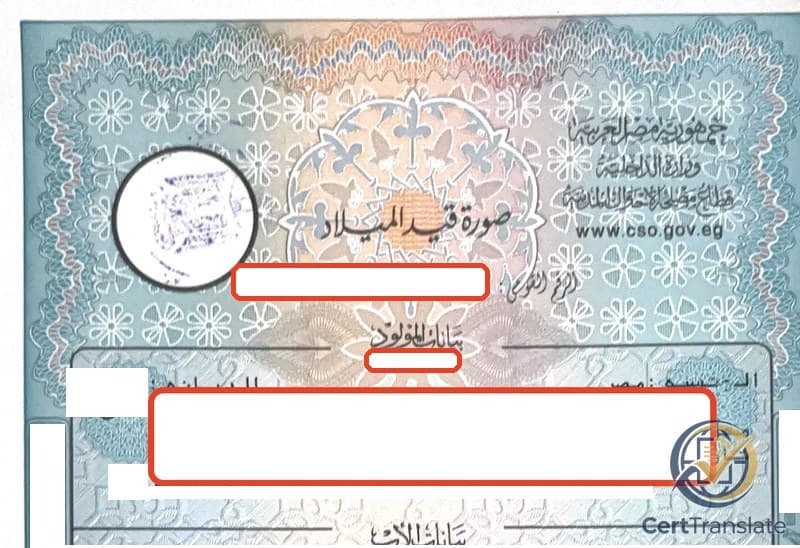
An Egyptian Copy of Birth Record (صورة قيد الميلاد) carried a prominent 14-digit number under the title that is easily misread as a reference code. It is the bearer's Egyptian National ID (الرقم القومي), and its digits structurally encode the bearer's date of birth, governorate of registration, and gender. We labeled the field correctly and added a Translator's Note explaining the encoding for the client's USCIS filing.
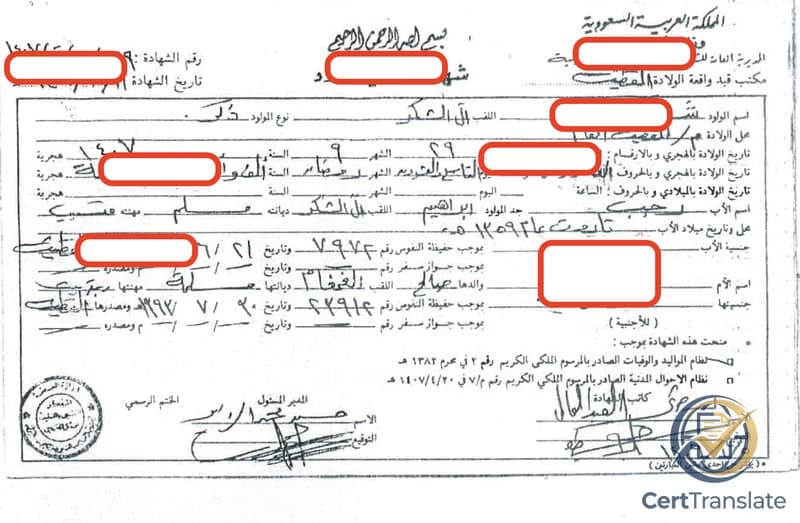
A handwritten Saudi Arabian birth certificate (شهادة ميلاد) from the Ministry of Health was submitted as a low-contrast multi-generation photocopy in which the mother's name, both parents' civil-register and passport numbers, the place of birth, the parents' occupations, the registration date written in Arabic words, and the issuing office could not be reliably read. After a clarification request did not produce either a higher-quality original or written confirmation of the unreadable values, we declined the order, refunded the client in full, and directed them to request a freshly issued certified extract from the Saudi civil-status office before resubmitting for USCIS.
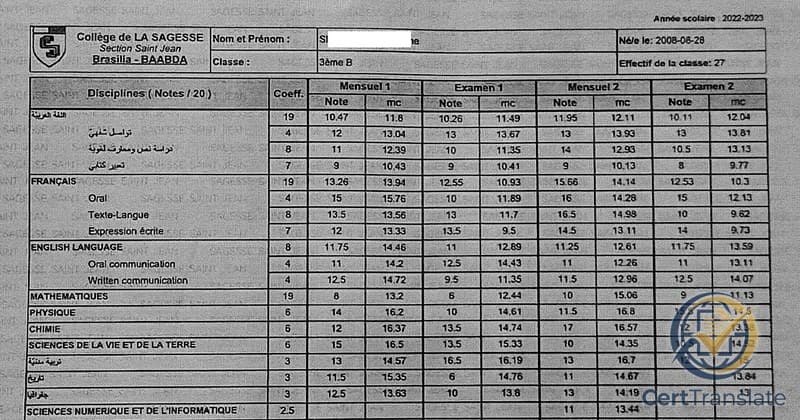
A Lebanese school report card from Collège de La Sagesse (Baabda) listed disciplines in two scripts on the same grade table: Arabic-script entries for Arabic Language, Civic Education, History, and Geography (taught under the Lebanese national curriculum), alongside French-script entries for French, English, Mathematics, the sciences, and Physical Education (taught under the French curriculum). Each subject had its own coefficient and grade. We translated every discipline into English, kept the Arabic original in brackets after each Arabic-script subject name, and preserved the French grade-level designations as credentials of the French educational system.
Questions people ask before submitting
The United Arab Emirates follows the sworn translation standard for official documents. Translations should be completed by: translator licensed by the uae ministry of justice.
Foreign documents generally require legalisation before translation
Official authorities in United Arab Emirates accept documents in: Arabic (official language). Documents in any other language need a sworn translation before submission.
If you are submitting Emirati documents to U.S. authorities (USCIS, universities, credential evaluators), yes — our certified translations are accepted nationwide. For official use inside United Arab Emirates, authorities usually require a translator sworn or registered locally — use the official registry linked on this page. We can also advise on apostille requirements for U.S.-issued documents.
Information verified against official sources. Last verified June 2026.