
CertTranslateCertTranslate
Notarized translation standardVerified June 2026

Document Translation Requirements in Turkey

Official bodies in Turkey generally require a notarized translation of foreign-language documents, and many documents also need an apostille or legalization before they are translated. Below: who can translate, when an apostille is needed, and where the official rules are published.

Key facts

Turkey uses a notarized-translation system: a sworn translator (yeminli tercüman) registered with a notary translates the document and the notary (noter) certifies it. For a Turkish document used in the United States, a certified English translation with a signed Certificate of Accuracy is what USCIS and universities accept. Turkey has been in the Hague Apostille Convention since 1985, so a Turkish document is apostilled by the Governorship (Valilik) — not consularized.

Reviewed by Natalia Vega, Senior Certified Translation Reviewer · Immigration quality-review lead· Last verified June 2026

Turkey requirements at a glance

Translation standardNotarized translation (Notarised) · yeminli tercüme + noter onayı
Who can translateTranslator registered with a Turkish notary (yeminli tercüman)
ApostilleYes, for foreign public documents issued in Hague Convention countries. Otherwise, consular legalisation is required.
Apostille authorityThe Governorship (Valilik) for administrative documents; the local Justice Commission (Adli Yargı Adalet Komisyonu) for judicial documents.
Important: Foreign public documents must be apostilled or consularly legalised before translation and submission to Turkish authorities.

Who can translate documents for use in Turkey?

Turkey does not operate a European-style sworn translator system. Instead, translations must be prepared by a translator registered with a Turkish Notary Public (known as a yeminli tercüman). The translator’s signature is held on file with the notary, and the notary certifies that the translation was prepared by an authorised translator whose signature is registered. Notaries in Turkey are supervised by the Türkiye Noterler Birliği (Turkish Union of Notaries) , which operates under the Ministry of Justice.
What makes a translation official in Turkey?

A translation becomes officially valid when:
  • It is translated into Turkish,
  • The translator signs the translation,
  • The translation is notarised by a Turkish Notary Public.
  • The notary confirms the authenticity of the translator’s signature, not the linguistic accuracy itself.

    How does Turkey treat documents from abroad?

    According to official guidance from Turkey’s e-Ikamet portal (Ministry of Interior – Migration Management) , foreign documents submitted for residence permits and official procedures must:
  • Be issued by the competent authority abroad,
  • Be apostilled if the issuing country is a party to the Hague Convention, or consularly legalised otherwise,
  • Be translated into Turkish,
  • Be notarised by a Turkish notary if required by the receiving authority.
  • Legal basis

    Translation and notarisation procedures are governed under Turkish Notary Law and administrative practice. Apostille acceptance is based on Turkey’s participation in the Hague Apostille Convention.

    Apostille & legalization for Turkey

    Turkey is part of the Hague Apostille Convention (since 1985), so public documents are authenticated with a single apostille — no consular legalization.

    Documents from Turkey

    The Governorship (Valilik) for administrative documents; the local Justice Commission (Adli Yargı Adalet Komisyonu) for judicial documents.Turkey has been a party to the Convention since 1985.

    U.S. documents going to Turkey

    A U.S. document going to Turkey is apostilled in the United States — the state Secretary of State, or the U.S. Department of State for federal documents — and then translated into Turkish by a sworn translator and notarized.

    The apostille should be obtained before the translation, so the apostille certificate is translated too. See how apostilles work, or order a translation with e-apostille.

    How to get a Turkey document translation accepted

    1. 1

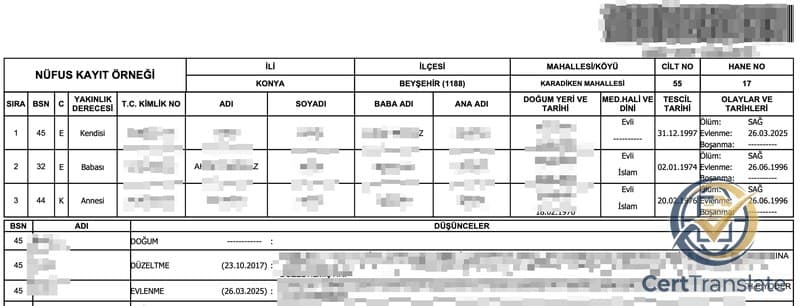
      Request the nüfus kayıt örneği if you need full family data

      Turkey's population-registry extract carries more detail than a bare certificate.

    2. 2

      Order a certified English translation of the full document

      Cover the registry data, the notary and sworn-translator stamps, and any apostille, with a signed Certificate of Accuracy.

    3. 3

      Submit the original plus the certified translation

      File them with USCIS, the university, or the credential evaluator.

    Ready to translate your Turkish documents?

    Certified for USCIS, universities, and credential evaluators — from $24.95/page.

    Start my translation

    Which direction are your documents going?

    Translating Turkish documents for the U.S.?

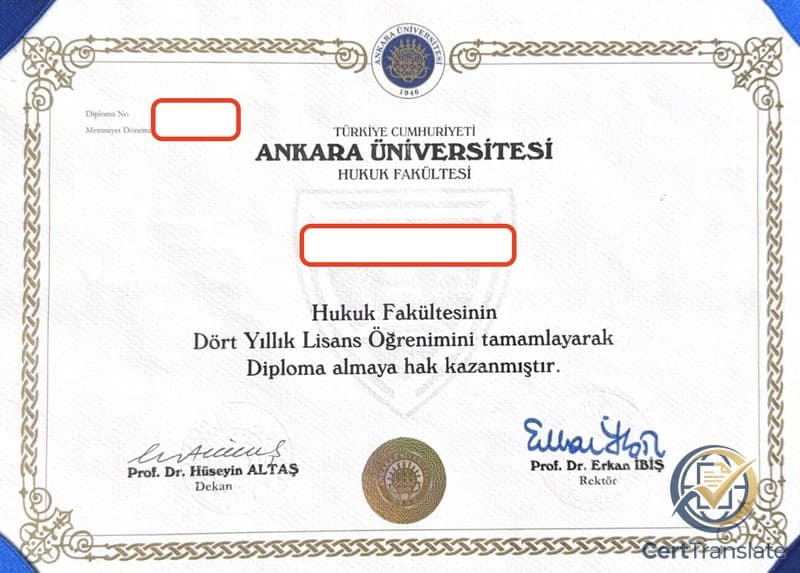
    Turkish birth certificates, diplomas, and transcripts submitted to USCIS, universities, or credential evaluators need a certified English translation — that is exactly what we do — backed by our revise-free-or-refund acceptance guarantee.

    Sending U.S. documents to Turkey?

    U.S.-issued documents usually need an apostille before they can be used in Turkey — and the apostille should be obtained before the translation, so the certificate itself gets translated too. We offer e-apostille processing as an add-on to any order.

    Why Turkey document translations get rejected

    The mistakes we see most often on Turkish documents — and what a correct certified translation does instead.

    Turkish letters ı, ğ, ş, ç, ö, ü mishandled

    These letters change a name's spelling; a dotless ı read as i, or ş read as s, breaks the match with the passport.

    Nüfus kayıt örneği confused with a birth certificate

    The population-registry extract and a birth certificate carry different fields; translating one as the other misstates the record.

    Only part of the document translated

    The whole document, including the notary and translator stamps, must be rendered.

    Real casework

    Real Turkish translation cases we've handled

    Anonymized Turkish-to-English orders. Each case shows the exact translation problem and how we solved it for the receiving authority.

    Cost & turnaround

    $24.95/ page

    A one-page belge is priced as a single page; multi-page records are priced by their page count. Standard delivery is 24–48 hours, with notarization and e-apostille available as add-ons. See full pricing.

    Turkey translation requirements — FAQ

    Do I need a notarized translation for a Turkish document used in the U.S.?

    No. U.S. authorities do not require Turkey's yeminli tercüman and noter system. A certified English translation with a signed Certificate of Accuracy is what USCIS, WES, and ECE accept.

    certified Turkish translation
    Is Turkey in the Hague Apostille Convention?

    Yes, since 1985. A Turkish public document used abroad is apostilled by the Governorship (Valilik) for administrative documents, or the Justice Commission for judicial documents.

    how apostilles work
    What is a nüfus kayıt örneği?

    It is the Turkish population-registry extract, which carries fuller family data than a bare certificate. For a U.S. submission it is often the more complete source document.

    birth certificate translation
    How are Turkish university grades translated for WES?

    Turkish transcripts use a 4.0 scale and percentages. A certified translation preserves both so WES or ECE can map them, rather than converting to a U.S. GPA.

    WES translation
    Which languages do you translate?

    We translate Turkish and 60+ other languages into English, each with a signed Certificate of Accuracy, for USCIS, universities, and evaluators.

    Turkish translation services
    How much does a Turkish document translation cost?

    Pricing is per page. A one-page belge is a single page; multi-page records are priced by page count.

    see live pricing
    Can I translate my own Turkish documents?

    No. USCIS and universities reject self-translation; an independent translator must complete and certify it.

    what a certified translation is

    Requirements in related countries

    Neighbors and countries with a similar translation standard.

    Sources

    Information verified against official sources. Last verified June 2026.

    Need a certified Turkish translation?

    Signed Certificate of Accuracy with every order, a revise-free-or-refund acceptance guarantee, optional notarization and e-apostille — delivered in 24–48 hours.