
“They translated my Egyptian marriage contract with all the witness names and mahr details intact. USCIS approved the I-130 petition without any questions about the translation.”
F
Fatima H.
Dearborn, MI
عقد الزواجوثيقة زواج
Certified English translation for USCIS, spouse petitions, courts, legal name changes, and consular use.
Ready within 24 hours
Complete translation
Word-for-word, same structure
Every field, stamp, seal, signature, and annotation
Certified package
Signed and Stamped Certificate of Accuracy
Company letterhead · translator signature · company stamp

We check your files and confirm the total before you pay




Arabic marriage certificate translation produces a certified English version of عقد الزواج, وثيقة زواج, and other Arabic-language marriage records from Egypt, Iraq, Syria, Saudi Arabia, Jordan, and other Arabic-speaking countries, formatted for USCIS spouse petitions, courts, and civil-status filings.
Most clients order this service for Form I-130 (spouse petition) and Form I-485 (adjustment of status) filings, where the marriage certificate proves the legal relationship that anchors the entire case. Form N-400 naturalization packets also frequently include a marriage certificate when the applicant’s eligibility depends on the marital relationship.
The same translation is needed when a state court, benefits agency, or insurance provider requires certified English proof of an Arabic-language marriage. In every case, the witness fields, name chains, and date systems have to be preserved exactly as they appear on the original record.
We preserve every witness attestation, mahr reference, and name chain exactly as the issuing authority recorded them. Dates are rendered in the original calendar system so the English version matches the Arabic source field by field.
PDF, photo, or scan — any format works. Takes about 30 seconds.

A native-speaking Arabic translator handles every word, stamp, and signature. Signed Certificate of Accuracy included — USCIS-ready format.
Review the completed translation before it is certified — unlimited free revisions until every detail is right. Final searchable PDF delivered typically within 24 hours.
4.9/5•From 2,400+ reviews
“They translated my Egyptian marriage contract with all the witness names and mahr details intact. USCIS approved the I-130 petition without any questions about the translation.”
Fatima H.
Dearborn, MI
“My Iraqi marriage record had a long family-name chain and court endorsements. CertTranslate kept every field and the immigration officer could compare it against the original without confusion.”
Ahmad R.
Houston, TX
“My Saudi marriage contract had Hijri dates and mahr terms that a previous translator converted incorrectly. CertTranslate preserved everything as printed and the attorney confirmed it was what USCIS needed.”
Layla M.
Falls Church, VA
We don't have a published case on Arabic marriage certificate translation specifically — here are recent Arabic translation cases on related documents.
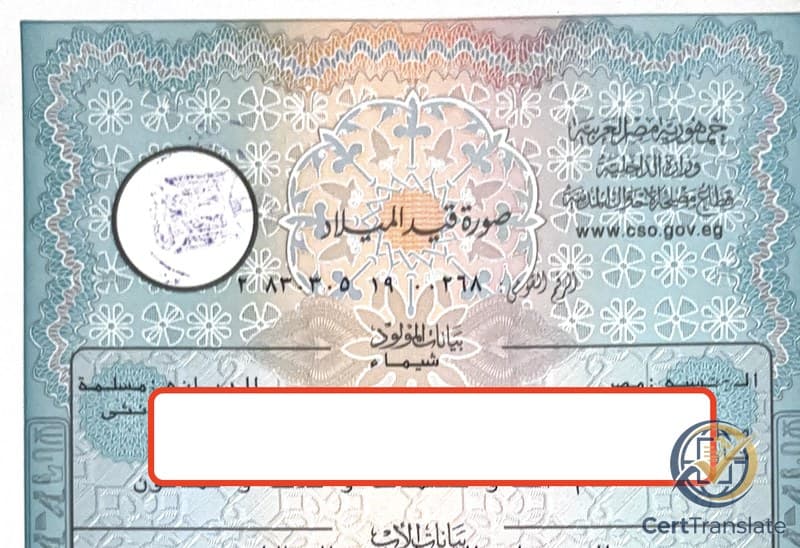
An Egyptian Copy of Birth Record (صورة قيد الميلاد) carried a prominent 14-digit number under the title that is easily misread as a reference code. It is the bearer's Egyptian National ID (الرقم القومي), and its digits structurally encode her date of birth, governorate of registration, and gender. We labeled the field correctly and added a Translator's Note explaining the encoding for the client's USCIS filing.
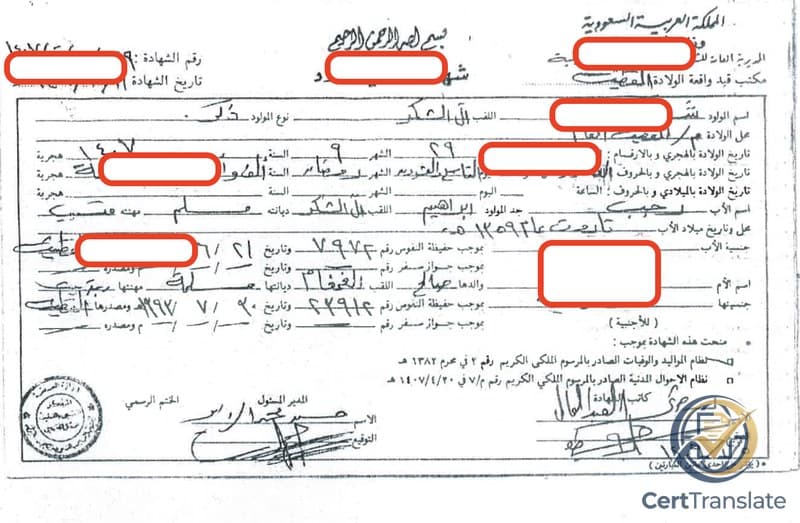
A handwritten Saudi Arabian birth certificate (شهادة ميلاد) from the Ministry of Health was submitted as a low-contrast multi-generation photocopy in which the mother's name, both parents' civil-register and passport numbers, the place of birth, the parents' occupations, the registration date written in Arabic words, and the issuing office could not be reliably read. After a clarification request did not produce either a higher-quality original or written confirmation of the unreadable values, we declined the order, refunded the client in full, and directed them to request a freshly issued certified extract from the Saudi civil-status office before resubmitting for USCIS.
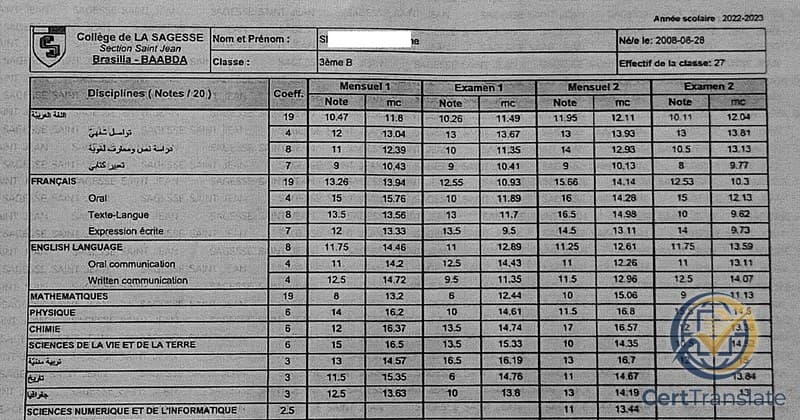
A Lebanese school report card from Collège de La Sagesse (Baabda) listed disciplines in two scripts on the same grade table: Arabic-script entries for Arabic Language, Civic Education, History, and Geography (taught under the Lebanese national curriculum), alongside French-script entries for French, English, Mathematics, the sciences, and Physical Education (taught under the French curriculum). Each subject had its own coefficient and grade. We translated every discipline into English, kept the Arabic original in brackets after each Arabic-script subject name, and preserved the French grade-level designations as credentials of the French educational system.
Arabic marriage certificate translation requires handling right-to-left civil-registry formatting, Hijri date systems, witness attestation fields, mahr and dowry references, and name-change conventions that do not exist in most Western marriage records — challenges that sit at the intersection of Arabic language expertise and marriage-certificate document knowledge.
An Egyptian marriage contract, an Iraqi marriage record, a Syrian civil-registry entry, and a Saudi عقد نكاح may all prove the same legal event but differ in witness fields, mahr references, name-change conventions, and civil-registry structure enough that the translation has to reflect the exact issuing system.
Your marriage certificate is translated by a native Arabic speaker who handles civil-registry records daily, so patronymic chains, witness attestations, Hijri-versus-Gregorian dates, and right-to-left layout are reviewed with filing-level accuracy rather than guessed.
If USCIS or any receiving authority rejects the translation for a translation-related reason, we correct it at no additional charge and keep naming consistent across the rest of your filing packet.
Arabic marriage certificates typically include witness names, attestation signatures, and sometimes religious-authority endorsements that form part of the legal record. These fields are not decorative — they establish the validity of the marriage under the issuing country’s legal system.
A translator who skips witness names, condenses attestation blocks, or treats witness fields as optional wording risks creating a translation that looks incomplete to a USCIS officer comparing it against the original. We translate every witness field, attestation block, and endorsement line as they appear on the source document.
Many Arabic marriage contracts include mahr (مهر) references, dowry terms, or financial conditions that are part of the legal marriage record. These terms have specific legal meaning in the issuing country’s family-law system and should not be paraphrased or dropped from the English version.
The translator renders these terms faithfully and uses the Arabic legal terminology as it appears on the document, with English explanations when clarity requires them. Over-translating mahr as simply “downry” or “gift” loses the legal specificity that a reviewing officer or attorney may need.
Arabic marriage records may or may not reflect a name change for either spouse. In some countries and traditions, the wife’s family name stays unchanged; in others, naming conventions shift after marriage. The birth certificate, passport, and marriage certificate in the same packet may therefore show different name configurations for the same person.
The translation has to preserve the names exactly as they appear on the marriage record and flag any visible differences from other documents in the filing set, so the applicant can address discrepancies before the officer raises them.
Arabic marriage records may use Hijri dates, Gregorian dates, or both systems on the same document. A translation that silently converts all dates to Gregorian creates a document that does not match the original — and a USCIS officer comparing the two will notice the discrepancy.
We preserve the original date system exactly as printed and make the calendar reference explicit in the English version. When a Gregorian equivalent is provided on the source, we reproduce it; when it is not, we do not invent one.
These marriage records share Arabic as the document language, but the civil-registry structure, witness requirements, and name-change conventions change by country.
Egyptian marriage contracts (عقد الزواج) are issued by a ma’zoun (مأذون) and typically include the spouses’ full names with patronymic chains, witness names, mahr details, and a registration number. Modern contracts are pre-printed with handwritten entries; older ones may be fully handwritten.
These records commonly appear in Form I-130 (spouse petition) and Form I-485 packets. Egypt is not a Hague Apostille Convention member, so legalization for non-U.S. destinations follows a consular path. We preserve every field, including the ma’zoun’s attestation and registry number, so the English version matches the original line by line.
Iraqi marriage records may carry extended family-name chains, court references, and administrative endorsements that reflect the country’s civil-status system. Records from different eras or regions within Iraq may vary in format and institutional language.
These documents often appear alongside birth certificates and nationality certificates in immigration packets. Iraq is not in the apostille system. We preserve the full name chain, court or registry references, and any endorsement stamps exactly as they appear, so the translation stays consistent with other Arabic-language records in the same filing.
Syrian marriage records may be issued as civil-registry extracts or court documents, sometimes carrying handwritten entries, layered stamps, and administrative notes from multiple processing stages. Quality of scans varies widely due to document age and storage conditions.
We translate the full record, including marginal notes, court endorsements, and stamp language. Syria is not in the Hague Apostille system. When the scan quality is borderline, we review the image before beginning and request a better scan if critical fields are unreadable.
Saudi marriage contracts (عقد نكاح) may use formal administrative Arabic with Hijri dates, mahr specifications, and witness attestations that follow Saudi family-law conventions. The contract structure and terminology reflect the Saudi legal system rather than the civil-registry patterns used in other Arabic-speaking countries.
Saudi Arabia is a Hague Apostille Convention member, so apostille is available for non-U.S. destinations. For USCIS filings, the certified translation is what matters. We preserve the Hijri dates, mahr terms, and witness fields exactly as printed so the English version is a faithful reproduction of the Saudi record.
Jordanian marriage certificates typically include both spouses’ names with family designations, witness names, and a civil-registry reference number. The format is structured but may include handwritten additions or court-endorsed amendments.
These records appear in family-petition and adjustment-of-status packets. Jordan is not in the apostille system. We keep the name sequences, witness fields, and registry identifiers aligned with the rest of the filing packet, especially when the marriage certificate sits alongside a birth certificate and passport from the same applicant.
$24.95
per page · no word cap
Typical length
Most Arabic marriage certificates are 1 to 2 pages
Typical total
$24.95
No hidden fees. Free Quote.
Arabic marriage certificate translation costs $24.95 per page. Most clients pay between $24.95 and $49.90 because the typical Arabic marriage certificate is one or two pages. You receive the confirmed page count before payment, and there is no language surcharge for arabic.
Most marriage certificate orders are delivered within 24 hours once we receive clear scans. When the file includes handwriting, multiple witness blocks, or mixed date systems, we confirm timing before production so there are no surprises.
Yes. This service is built for USCIS spouse petitions, court submissions, and other receiving authorities that need a complete certified English translation of an Arabic marriage record, including witness fields, mahr terms, and the full name chain. Our package includes the full English translation plus a signed Certificate of Accuracy, which is the format most receiving authorities expect for foreign-language records.
Yes. We handle marriage certificates from Egypt, Iraq, Syria, Saudi Arabia, Jordan, and other Arabic-speaking countries, with the translation matched to the exact issuing-country format and legal conventions. If your record uses a rare regional format, upload every page so the translator can match the exact issuing-country structure before production starts.
We review scans with handwriting, layered stamps, and faded ink regularly. When the image is usable, we translate it carefully. If a critical field is too faint or damaged, we ask for a better scan before we certify the file. When a field is genuinely unreadable, we mark it transparently instead of guessing, which is safer than inventing a name, date, or registry number.
Yes — you receive the completed translation for review before we certify it, and we make unlimited free revisions until every name, date, and detail is right. If USCIS later requests a change, we correct the certified file at no charge.
No — we bill the physical page you upload, never a word count. Many services cap a "page" at 250 words and re-bill a dense marriage certificate as two or three pages; here one page of your document is one $24.95 page, however dense the text.
We translate mahr (مهر) and related financial terms exactly as they appear on the source document, using the Arabic legal terminology with English explanation when necessary. We do not reduce these terms to a single generic English word because the legal specificity matters for officers and attorneys reviewing the record.
We translate the names exactly as printed on the marriage record and note any visible differences from the passport or other identity documents in the filing packet. Name discrepancies between Arabic civil records are common due to patronymic chain variations and romanization differences, so early awareness helps you address them before the officer raises questions.
An Arabic عقد الزواج (marriage contract) carries fields that have no Western equivalent — mahr terms, a ma’dhun’s attestation, patronymic name chains, and often Hijri dates. We translate every one so the English version matches the original line by line.
| Field | What it is | How we handle it |
|---|---|---|
| عقد الزواج / وثيقة زواج | The marriage contract or certificate (the document type) | Document type identified; contract vs civil-registry extract labeled. |
| المأذون / المحكمة / السجل المدني + رقم | Issuing authority (ma’dhun, court, or civil registry) and registration number | Authority and registry number preserved exactly as printed. |
| الزوجان (with name chains) | Both spouses, usually with full patronymic name chains | Full name chain preserved and reconciled with passport/birth records. |
| المهر (mahr) | Dower amount and terms specified in the contract | Rendered with the Arabic legal term plus an English explanation — never flattened to “gift”. |
| الشهود / التصديق | Witnesses and the attestation/endorsement block | Every witness and attestation line translated, not condensed. |
| التاريخ (هجري/ميلادي) | Marriage date, in Hijri and/or Gregorian | Calendar system preserved exactly; no Gregorian equivalent invented. |
Arabic divorce is recorded separately (talaq / court record), not as a margin note on the marriage contract — so a current marriage contract reflects the marriage as recorded. Where a scan is borderline (older handwritten or layered-stamp records), we request a clearer image rather than guess critical fields.
Most translation-related RFEs trace back to a few issues. These are what we check on every Arabic-language marriage record.
01Hijri date silently converted to Gregorian
We preserve the calendar system exactly as printed and never invent a Gregorian equivalent the source does not provide.
02Witness, attestation, or ma’dhun fields skipped
We translate every witness and attestation line, since they establish the marriage’s validity and a missing one looks incomplete to an officer.
03Mahr flattened to “gift” or “dowry”
We render mahr with the Arabic legal term plus an English explanation, preserving its specific legal meaning.
04Patronymic name chain not reconciled with passport/birth certificate
We preserve each full name chain as recorded and flag visible differences from other documents in the packet.
Patterns drawn from real Arabic-language marriage-record casework (Egypt, Iraq, Syria, Saudi Arabia, Jordan). Unreadable fields are marked transparently, never guessed.
Every order is checked against this list before certification — and covered by the revise-free-or-refund guarantee.
Start my translationCommon terms you will see on an Arabic-language marriage record, with what they mean on the certified English version.
Our guidance on Arabic marriage certificate translation reflects the published requirements of the authorities below.
Upload every page of the marriage record, including witness attestation pages, court endorsements, and any family-booklet extract. A complete source file helps ensure no legally significant field is missed in the translation.
If your filing also includes birth certificates, passport pages, or other Arabic-language civil records, ordering the full set together helps keep patronymic chains, Hijri dates, and romanization consistent across all translated documents.