
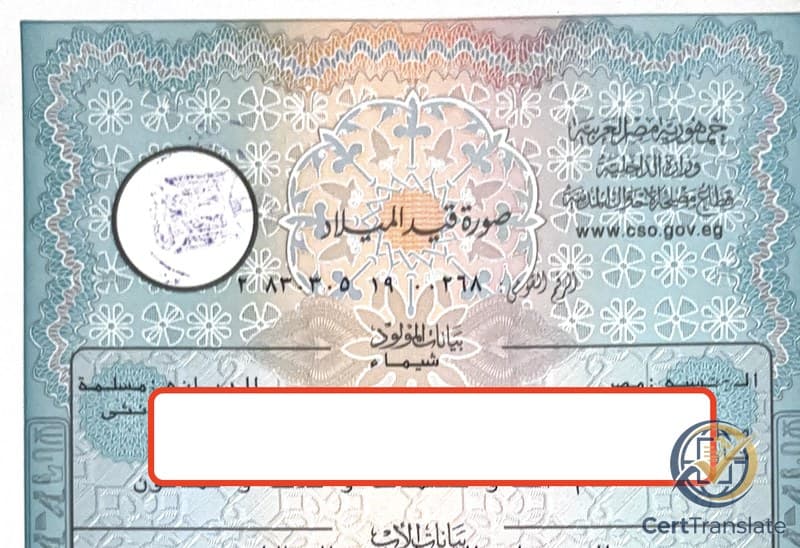
Encoded ID
The national ID number encoded the birth data
Every digit of the 14-digit number was verified against the birth fields it encodes before certification.
Read the caseشهادة ميلاد
Certified English translation for USCIS, passport applications, schools, courts, and other official uses.
Ready within 24 hours
Complete translation
Word-for-word, same structure
Every field, stamp, seal, signature, and annotation
Certified package
Signed and Stamped Certificate of Accuracy
Company letterhead · translator signature · company stamp

We check your files and confirm the total before you pay




Your finished package
Your delivery includes the source-document scan, a complete English translation, and a signed and stamped Certificate of Translation Accuracy.
Files checked and total confirmed before payment
Real Arabic casework
These are anonymized Arabic-to-English orders. Each case shows the source-document issue and the exact translation decision.
Encoded ID
Every digit of the 14-digit number was verified against the birth fields it encodes before certification.
Read the case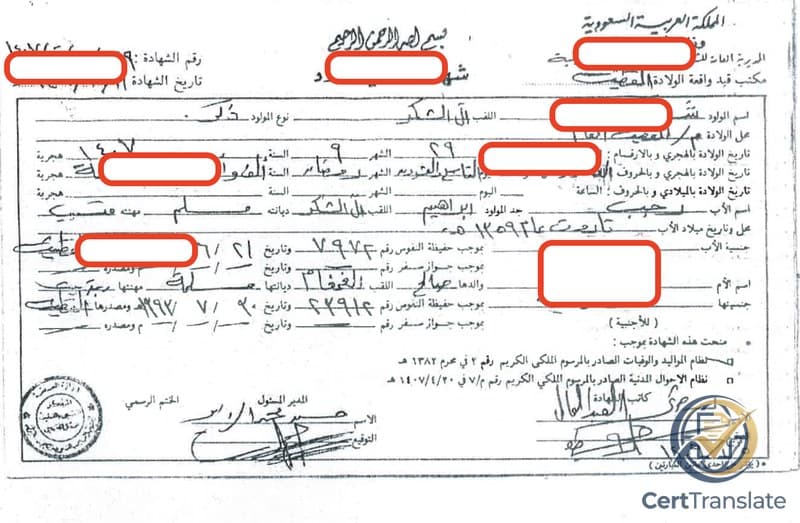
Honest limits
We named the unreadable fields and asked for a better copy instead of guessing at a legal record.
Read the case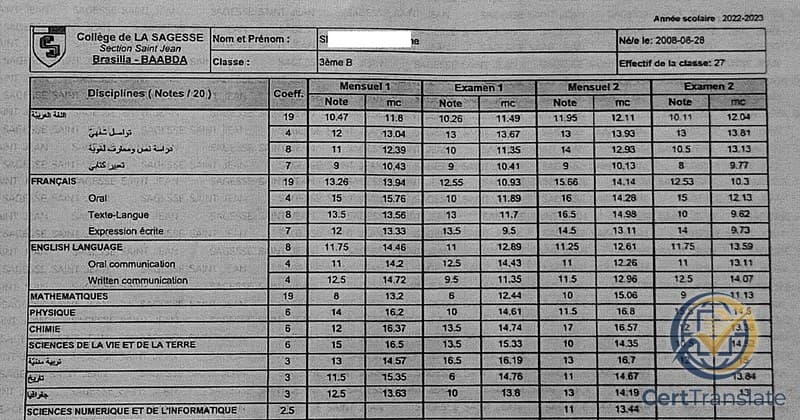
Bilingual layout
Every parallel line was translated by meaning, with the Arabic and French sides reconciled.
Read the caseBefore you order
Arabic-language birth records come from a dozen registries with different structures. Send every page, and we will identify the issuing system — and the calendar it uses — before work starts.
Modern Egyptian certificates (مميكنة) carry tightly structured civil-register labels and a 14-digit national number that encodes birth data. We verify the digits against the fields they encode — one wrong character breaks the cross-check.
Send the whole page, edge to edge — Egyptian registry labels run into the margins and every field matters.
Saudi records from الأحوال المدنية use formal administrative language and Hijri dates. We keep the original calendar as printed and label the Gregorian equivalent separately, so the officer sees the document’s real date.
Iraqi, Syrian, Jordanian, and Yemeni records often carry long family-name chains, handwriting, and layered stamps; Maghreb records may be bilingual Arabic-French. We translate every material element on both sides — the Arabic side often carries the fuller legal wording.
How it works
Upload once. We check the files and confirm the total before payment. Then our team translates, reviews, and certifies the complete package.
Send a PDF, scan, or phone photo. Include every stamp and annotation, any family-register extract, and a passport name page when available.
The full name chain, Hijri and Gregorian dates, registry numbers, encoded IDs, and every stamp and seal are checked against the source — in the original right-to-left layout.
Request corrections free. Once approved, receive the source scan, full English translation, and signed and stamped Certificate of Translation Accuracy.

One physical page means one billed page.
No 250-word cap and no dense-page rebilling.
Certified price
$24.95/ page
No payment until file review
Client reviews
Mariam A.
Dearborn, MI
“They translated my Egyptian birth certificate and kept the Arabic names and dates clear without dropping any of the registry details.”
Egypt · Birth certificate
Registry details preserved
Omar H.
Dallas, TX
“My Iraqi record had a long family-name chain and stamp lines that another service ignored. CertTranslate handled the full record correctly and kept the names consistent with my passport.”
Iraq · Name chain record
Full chain kept consistent
Rana S.
Boston, MA
“The right-to-left layout on my Syrian document was difficult, but the final English version was easy for our attorney to compare against the original.”
Syria · Older paper record
Easy side-by-side review
Questions before ordering
If your document does not match one of these situations, send it anyway. Support replies in 15–30 minutes during support hours.
The certified translation is priced per physical page. A typical one-page certificate costs one page, even when the page contains more than 250 words.
Most one- to three-page orders are delivered within 24 hours after we receive clear scans. If the record includes layered stamps, older handwriting, or a bilingual layout, we confirm the delivery window before work begins.
The delivery includes your source-document scan, a complete English translation, and a signed and stamped Certificate of Translation Accuracy. If a receiving authority rejects the translation for a translation-related reason, we revise it free. If it is still rejected, we refund the translation cost.
Yes. Egypt, Saudi Arabia, Iraq, Syria, Jordan, Yemen, and the Maghreb — each translated by its actual registry structure, including bilingual Arabic-French formats.
We can usually work from scans with stamps, embossing, handwriting, or slightly faded print. If a name, date, seal, or registry number is too weak to read safely, we ask for a better image rather than guessing.
Yes. You can review the completed translation and request unlimited free corrections before certification. If USCIS later requests a translation-related change, we correct the certified file at no charge.
No. We bill the physical page you upload, never a 250-word unit. A dense one-page certificate remains one billed page.
Both, transparently. The Hijri date stays as printed and the Gregorian equivalent is labeled separately — a silently converted date would contradict the source document the officer is holding.
We preserve the full chain exactly as recorded and keep it consistent with your passport. Trimming a four-part name to fit a U.S. form breaks identity matching across the packet.
We review the whole page and translate every material element on both sides. The Arabic side often carries fuller legal wording than the French, so translating only one side reads as incomplete.
USCIS generally requires certification, not notarization. Notarization remains available when a court, embassy, or another receiving authority asks for it.
Most frequent problems we correct
These are the recurring issues we see in Arabic civil-record packets and in translations clients ask us to review.
Our check: We preserve the full bin/bint chain exactly as recorded and keep it consistent with the passport, since trimming names breaks identity matching across the packet.
Our check: We keep the original date system as printed and label the Gregorian equivalent separately, so the officer sees the document’s real date.
Our check: We match the romanized spelling to the governing ID instead of inventing one, preventing inconsistency RFEs.
Our check: We review the whole page and translate every material element on both sides, since the Arabic side often carries the fuller legal wording.
The standard behind these checks
AcceptReady™ is CertTranslate's published standard for certified translations: complete word-for-word translation, mirrored page layout, signed and stamped Certificate of Accuracy on letterhead, and matched to the receiver's published requirements.
How to check each one yourselfChecked before certification. If an authority later requests a translation-related correction, revisions remain free.
Start my translationCommon filing contexts
Arabic birth certificates most often appear in family-based USCIS packets, but the same certified package may also be requested by a court, school, or benefits agency.
The key is consistency: the name chain and dates should line up with the passport and the rest of the supporting documents.
The birth record documents parentage; the name chain connects the beneficiary to the petitioner.
The certified English translation supports identity and parentage; romanization is matched to the passport.
Older records with Hijri dating are reconciled with modern documents into one identity chain.
A complete certified translation makes the Arabic record reviewable when the receiving authority works in English.
Document glossary
Common terms you may see on an Arabic-language birth record and how they appear in the certified English translation.
Reference library
Guidance and source links last rechecked .
Ready when you are
Upload every page you have — stamps, annotations, and any register extract included. We will confirm the document type, page count, price, and delivery time before you pay.
No payment until file review
