
Wyrok rozwodowy
The court judgment
Issued by a Sąd Okręgowy, with the sentencja and often many pages of uzasadnienie behind it.
Wyrok rozwodowyStwierdzenie prawomocnościOdpis aktu małżeństwa
Certified English translation for USCIS, spouse and fiancé(e) petitions, naturalization filings, courts, and other marital-history review.
Ready within 24 hours
Complete submitted record
Finality and court structure preserved
Case caption · ruling · finality · seals · registration notes
Certified package
Signed and Stamped Certificate of Accuracy
Company letterhead · translator signature · company stamp

We check your files and confirm the total before you pay




Your filing package
You get three files: a scan of your Polish record, the full English translation, and a signed and stamped Certificate of Translation Accuracy.
Files checked and total confirmed before payment
Documents we translate
Send the court copy or the registry record. We name the document, confirm the page count and the price, and tell you if the endorsement is missing.
Wyrok rozwodowy
Issued by a Sąd Okręgowy, with the sentencja and often many pages of uzasadnienie behind it.
Prawomocność
The court stamp confirming no appeal was filed. Without it, the copy does not prove the marriage ended.
Akt małżeństwa
The USC copy carrying a wzmianka about the divorce, which some offices accept in place of the judgment.
Real Polish-language casework
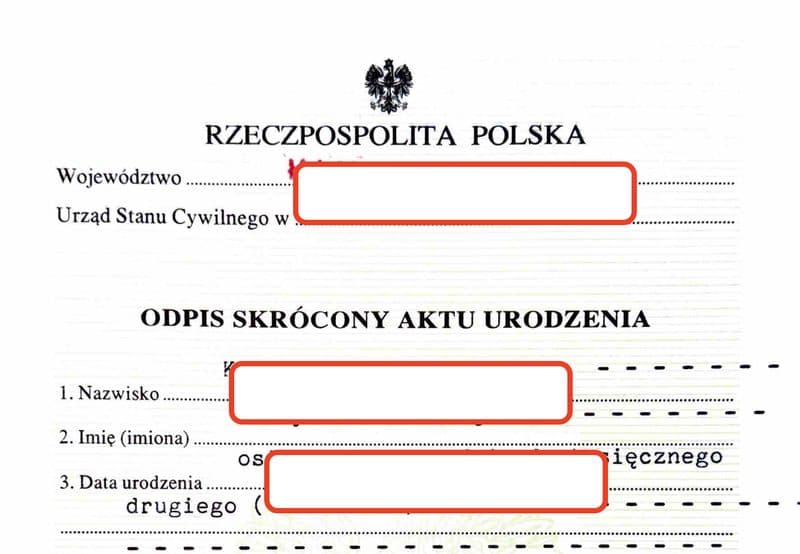
Neither case is a divorce file. Both are Polish civil records, and both turn on details that decide divorce packets too: how a place name behaves inside an authority’s title, and how a date is written out.
Poland · authority names
We rendered the region as the authority actually names it, instead of reducing the inflected form to the bare city name.
Read the case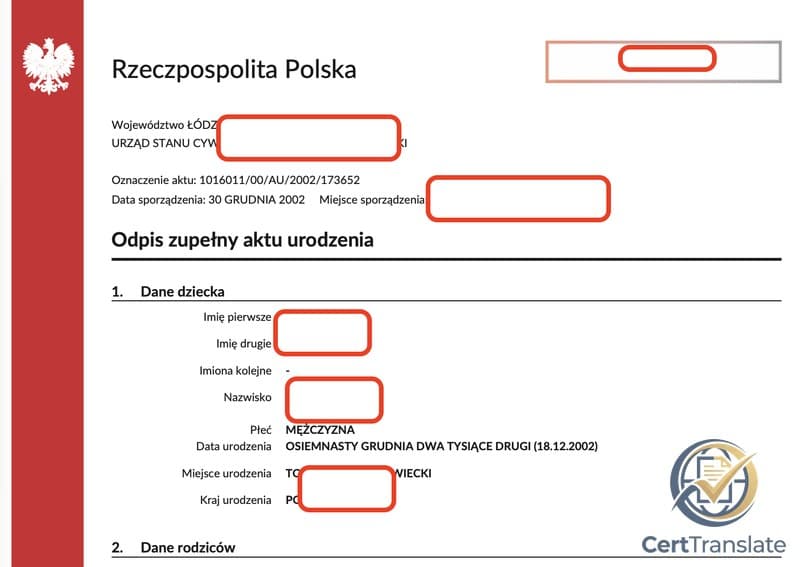
Poland · dates in words
We translated the spelled-out date and set the digits beside it, so a reviewer comparing documents did not have to parse Polish numerals.
Read the caseCountry-specific evidence
There is not. Poland proves a divorce two ways instead, and which one you hold decides what we translate and what the receiving office will accept.
A Polish divorce is decided by a Sąd Okręgowy, never by the local district court, and the ruling comes as a wyrok rather than a certificate.
The court title carries a place name in a grammatical form that does not match the city on a map, so we render the authority as it names itself.
A plain copy of the wyrok proves nothing on its own. What the receiving office needs is the copy carrying the court’s finality endorsement.
The judgment becomes final about a week after it is announced when neither side asks for written reasoning, and later if reasoning was requested and no appeal followed.
Only then will the court issue the copy with stwierdzenie prawomocności. That endorsement, with its date, is the part a U.S. reviewer reads as proof.
Once the ruling is final, the registry office adds a wzmianka about the divorce to the marriage record, and will issue a copy showing it.
Some offices accept that extract instead of the judgment. It is shorter and cheaper to obtain, so ask which one your recipient wants before ordering a long translation.
The sentencja is the operative ruling: the dissolution itself, fault, custody, and support. The uzasadnienie is the reasoning, and it can run ten pages or more.
Most filings need the sentencja with the endorsement. We tell you when the uzasadnienie is worth translating rather than billing you for pages nobody asked for.
How it works
Upload what the court or registry gave you. We identify the document, confirm the page count and the price, then translate, cross-check, and certify.
Send the wyrok with the page carrying the finality stamp, or the marriage record with its annotation. Add any appeal decision that changed the original ruling.
A Polish specialist translates the court structure and the operative provisions. A second reviewer checks the parties, the case number, the court title, and every date.
Ask for fixes before we certify. You then get the source copy, the full English translation, and the signed and stamped Certificate of Translation Accuracy.

How much does a Polish divorce decree translation cost?
No 250-word cap on dense court pages.
Certified price
$24.95/ page
No payment until file review
Client reviews
Dariusz K.
New York, NY
“I needed just the sentencja and klauzula prawomocności for my green card application. CertTranslate correctly identified which pages mattered.”
Poland · Sentencja with endorsement
Right pages identified
Beata S.
Houston, TX
“My divorce decree from a Sąd Okręgowy in Kraków included 10 pages of uzasadnienie plus the sentencja, and all of it came back accurate.”
Poland · Kraków court, long reasoning
Full record translated
Anna W.
Chicago, IL
“My wyrok rozwodowy included a fault determination and custody rulings for our two children. The legal wording survived the translation intact.”
Poland · Fault and custody rulings
Legal wording preserved
Questions before ordering
The translation rule is constant: file the Polish evidence with a complete certified English translation. Which Polish document proves the divorce is the part worth getting right first.
The price is $24.95 per physical page, with no word cap. A sentencja with its endorsement runs two or three pages, while a full judgment with reasoning runs much longer. We confirm the count before you pay.
A short judgment usually arrives within 24 hours. A wyrok with ten pages of reasoning takes longer, and we name the delivery window before production starts.
Your package holds the source copy, a full English translation, and a signed and stamped Certificate of Translation Accuracy. If USCIS raises a translation issue, we revise it free. That does not replace holding the right record in the first place.
No. Poland issues no separate certificate. Proof is either the court copy with the finality endorsement, or the marriage record carrying a divorce annotation from the registry office.
It is the court endorsement confirming the judgment is final and carries the date it became so. A copy without it shows a decision that could still, in principle, have been appealed.
Usually not for an immigration filing, where the operative ruling and the endorsement carry the evidence. Courts and attorneys sometimes want the reasoning, so check before ordering ten extra pages.
Yes, exactly as written. Polish courts can rule with or without a finding of fault, and that wording affects support, so softening it would change what the judgment says.
Often yes, and it is shorter to translate. Ask your receiving office which document it wants, because some accept the annotated extract while others insist on the court judgment.
USCIS generally asks for a certified English translation, not a notarized one and not an apostille. A court, consulate, or foreign registry may set its own rules, so follow that recipient’s checklist.
No. A translation makes the judgment readable; recognition belongs to the U.S. state where you file. The finality endorsement and its date are normally where that review begins.
What we check before certification
These issues repeat in Polish marital-history packets. The translation should show which court ruled, what it ordered, and when the ruling became final.
Our check: We check for the stwierdzenie prawomocności and tell you before production when the pages you sent do not carry it.
Our check: We keep the sentencja clearly separated from the uzasadnienie, so a reviewer finds the dissolution without reading ten pages first.
Our check: We preserve the Sąd Okręgowy and its place name in the form the court uses, since Polish authority titles inflect and the map spelling differs.
Our check: A finding that one spouse bears responsibility is a legal ruling with financial effects, so it is rendered exactly rather than smoothed away.
The standard behind these checks
AcceptReady™ is CertTranslate's published standard for certified translations: complete word-for-word translation, mirrored page layout, signed and stamped Certificate of Accuracy on letterhead, and matched to the receiver's published requirements.
How to check each one yourselfChecked before we certify. If an authority later asks for a translation-related correction, the revision is free.
Start my translationCommon USCIS contexts
USCIS reads divorce evidence to see whether an earlier marriage ended lawfully and when, which is exactly what the finality endorsement establishes.
Send the Polish record together with its certified English translation. The translation must not replace the source, shorten it, or quietly tidy it.
Proof that an earlier marriage ended supports the current marriage in a family-based case.
Both parties must show that prior marriages ended and that they are legally free to marry.
USCIS asks for decrees or other records showing that an earlier marriage ended lawfully.
A U.S. court reading a Polish judgment needs the finality date and the court identifiers in English.
Document glossary
These terms sit on the same judgment, but they name different things: the ruling, its finality, and where the divorce is recorded afterwards.
Reference library
Guidance and source links last rechecked .
Ready when you are
Send the wyrok with its endorsed page, or the marriage record carrying the divorce annotation. We confirm the record type, the page count, the price, and when it will be ready.
No payment until file review
