




What do you do when a Polish birth certificate writes the date of birth out in words and in digits on the same line?
TL;DRA Polish 'Odpis zupełny aktu urodzenia' issued electronically recorded the child's date of birth twice on the same line: first spelled out in full Polish words, then in DD.MM.YYYY digits. We rendered both forms in English — the words spelled out in English, the digits as Month DD, YYYY in parentheses — and added a Translator's Note explaining the Polish anti-tampering convention and the qualified-electronic-signature block. The certified translation was delivered for the client's USCIS filing.
Case Specifications
- Document
- Birth certificate
- Foreign Name
- Odpis zupełny aktu urodzenia
- Country
- Poland
- Languages
- Polish → English
- Submitted To
- USCIS
What We Received
A client submitted a modern Polish <em>Odpis zupełny aktu urodzenia</em> (Complete Copy of Birth Certificate) issued in 2026 by the Civil Registry Office (Urząd Stanu Cywilnego) of Tomaszów Mazowiecki in the Łódź Voivodeship. The document is the current Polish state form (reference USC/OZ/1e): a two-page record with a left-edge red band, a Republic-of-Poland eagle in the upper-left corner, an 'RP' graphic marker, ten numbered sections covering the child's data, parents' data, the reporter of the birth, expert and interpreter participation, the head of the registry office, additional annotations, copy metadata, and a qualified-electronic-signature block in place of a wet stamp.
What stood out was section 1, the child's data. The date-of-birth field carried the date written twice on the same line: first fully spelled out in Polish words ("OSIEMNASTY GRUDNIA DWA TYSIĄCE DRUGI" — 'eighteenth of December two thousand and second'), then the numeric DD.MM.YYYY form ("18.12.2002") in parentheses. The parents' dates of birth on the same page used only the short DD MONTH YYYY form, and the date the copy was issued used only digits. The <a href="/documents/birth-certificate">certified birth certificate translation</a> was needed for a <a href="/immigration/uscis">USCIS filing</a>.
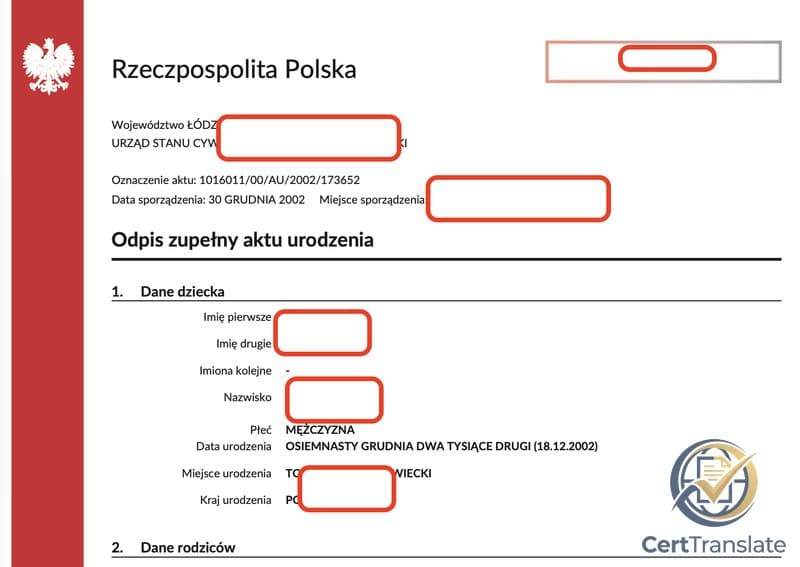
Why Translating Only the Digits Would Lose Information
The dual rendering of the date of birth is a Polish civil-registry convention, not a redundancy. The spelled-out form is the legally authoritative one — it descends from the pre-electronic era of paper act registers, where writing the date out in words made it impossible to alter a single digit without the change being obvious. The numeric form in parentheses is a reading aid. A translation that keeps only the digits loses the legally authoritative form; a translation that keeps only the words loses the easy-to-scan numeric anchor.
USCIS expects a <a href="/guides/what-is-certified-translation">complete and accurate certified translation</a> of every element on the source document. The adjudicator does not need to understand the historical reason for the dual rendering, but the translation must show that two forms exist in the original — otherwise a reviewer comparing the English to the Polish side-by-side will see a missing line and ask whether the translator dropped content.
How We Handled It
We rendered the date of birth in section 1 with both forms preserved on the same line: "EIGHTEENTH OF DECEMBER, TWO THOUSAND AND TWO (December 18, 2002)." The words were translated as English words — not transliterated, not summarized — and the numeric form was converted from the Polish DD.MM.YYYY convention to the unambiguous Month DD, YYYY US format inside the parentheses. Other dates on the document (the parents' dates of birth, the date the act was drawn up, the date the copy was issued, the electronic-signature timestamp) were rendered in single-form Month DD, YYYY without artificial duplication, because they appear only once in the original.
A short Translator's Note on the certification page documented the convention so the adjudicator could see what the dual rendering was: <em>"The original Polish form records the registered date of birth in section 1 twice on the same line — once spelled out in Polish words and once in the numeric DD.MM.YYYY form in parentheses. Both forms are reproduced in the translation, with the numeric form converted to Month DD, YYYY for unambiguous reading."</em> A second note covered the bottom of page 2: the document carries no wet ink stamp because it was issued electronically; the signature block is a qualified electronic signature of the issuing official, with the signing timestamp shown to the second. We also retained the Polish 'RP' graphic, the form reference 'USC/OZ/1e', and the page indicator 'strona 1/2 / 2/2' as graphic elements of the original template — these are part of the form's identity for anyone matching the translation back to the source.
"The original Polish form records the registered date of birth in section 1 twice on the same line — once spelled out in Polish words and once in the numeric DD.MM.YYYY form in parentheses. Both forms are reproduced in the translation, with the numeric form converted to Month DD, YYYY for unambiguous reading."

The Outcome
The certified translation was delivered to the client and forwarded with their USCIS packet. The dual date rendering and the electronic-signature block were no longer ambiguous elements on the English side — each was explained in one short Translator's Note that the adjudicator could read in a few seconds.
The modern Polish <em>Odpis zupełny</em> uses this convention on every issuance. We use the same approach in our <a href="/languages/polish">Polish translation work</a> for any document where a Polish state form spells out a date in words alongside the digits: render both forms in English, convert the numeric form to Month DD, YYYY, and document the convention.
What This Means for You
A Polish birth certificate that writes the date of birth in words and in digits on the same line is following a standard Polish civil-registry convention — both forms must appear in the certified translation. Translating only the digits drops the legally authoritative spelled-out form; translating only the words drops the numeric anchor. The certified translation should reproduce both, convert the numeric portion to the unambiguous Month DD, YYYY US format, and document the convention in a short Translator's Note so the receiving authority can read the English side without going back to the original.
Have a similar situation?
We handle modern Polish civil-registry documents — Odpisy zupełne and skrócone of birth, marriage, and death — including electronically issued copies with qualified electronic signatures, regularly.
Related Cases & Resources
Sources & References
- Meet Translation Requirements·USCIS·Verified 2026-06-29
Explore the Hub
Certified Translation
Documents
Languages
Immigration
Accepted By
All identifying information has been removed from document images. Case details are shared with client permission. No personal data is stored or displayed on this page.