
“They translated my Mexican marriage certificate and kept the witness names and prior-marriage note exactly right. That mattered for our spouse petition.”
P
Patricia G.
Chicago, IL
Acta de MatrimonioRegistro Civil de MatrimonioCertificación de Matrimonio
Certified English translation for USCIS, spouse petitions, courts, legal name changes, and consular use.
Ready within 24 hours
Complete translation
Word-for-word, same structure
Every field, stamp, seal, signature, and annotation
Certified package
Signed and Stamped Certificate of Accuracy
Company letterhead · translator signature · company stamp

We check your files and confirm the total before you pay




Spanish marriage certificate translation produces a certified English version of actas de matrimonio from Mexico, Colombia, the Dominican Republic, Peru, Cuba, and other Spanish-speaking countries, formatted for USCIS spouse petitions, courts, and civil-status filings.
Most clients need this combination for spouse petitions, adjustment of status, conditional residence removal, or civil-record updates after marriage. Form I-130 and Form I-485 are the most common filing contexts because the marriage certificate proves the relationship and often becomes the anchor for name-consistency review.
You may also need the translation for a court filing, a benefits office, or a state-level name-change workflow. In every case, the safest approach is to translate the complete record, including witnesses, annotations, and registry information, instead of trying to translate only the lines that look important at first glance.
We preserve spouse-name structure, witness information, and any references to prior unions so the record stays usable inside family-petition and civil-status filings.
PDF, photo, or scan — any format works. Takes about 30 seconds.

A native-speaking Spanish translator handles every word, stamp, and signature. Signed Certificate of Accuracy included — USCIS-ready format.
Review the completed translation before it is certified — unlimited free revisions until every detail is right. Final searchable PDF delivered typically within 24 hours.
4.9/5•From 2,400+ reviews
“They translated my Mexican marriage certificate and kept the witness names and prior-marriage note exactly right. That mattered for our spouse petition.”
Patricia G.
Chicago, IL
“My Colombian certificate had registry details another service wanted to skip. CertTranslate handled the full record correctly and preserved every office reference and witness line.”
Daniel V.
Orlando, FL
“Our Dominican record was longer than expected and included annotations. They translated every page and the packet was easy for our lawyer to review.”
Yesenia P.
Phoenix, AZ
Anonymized Spanish marriage certificate translations we've delivered. Click any case to see the exact problem and how we solved it.
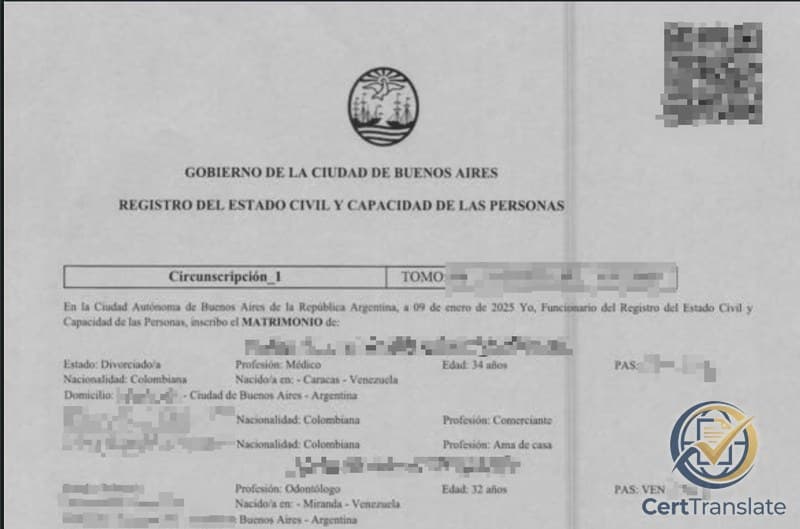
An Argentine marriage certificate (acta de matrimonio) from Buenos Aires pre-printed both gender endings on every status and relationship field — Soltero/a, Divorciado/a, Hijo/a de. The acta records a marriage between two men. We resolved each field to the correct gender, rendering every "Hijo/a de" as "Son of," and added a Translator's Note about the convention. The certified translation was delivered for the couple's USCIS filing.
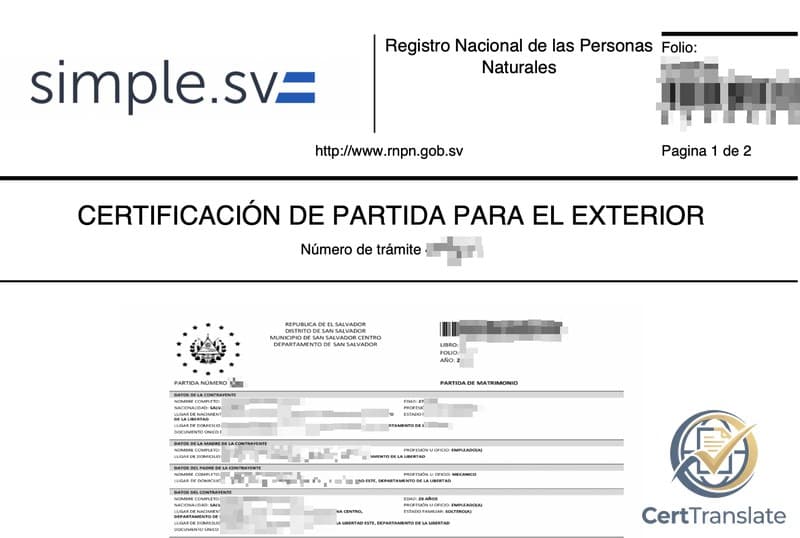
An El Salvador marriage certificate (certificación de partida de matrimonio para el exterior) arrived as a digital national-registry certification that embedded an image of the municipal marriage record. The single file carried two official seals and two signatures — one national, one municipal. We translated both layers in full, described each seal and signature, and attributed every element to its correct office. The certified translation was delivered for the client's USCIS filing.

A Colombian Registro Civil de Matrimonio from Notaría 4 Cúcuta carried a hand-placed X between two checkboxes. Both the Notaría and Consulado boxes were empty. Cross-checking the place-of-celebration field, the supporting-document field, and the officer's title confirmed Notaría. The certified translation rendered the row as Notary [X]. A Translator's Note documented the cross-field reasoning so the USCIS adjudicator did not have to redo it.
Spanish marriage certificate translation requires handling post-marriage surname changes, civil-versus-religious record distinctions, libreta de familia booklet formats, and prior-union references that vary across Mexican, Colombian, Dominican, Peruvian, and Cuban civil registries.
A Mexican acta de matrimonio, a Colombian registro civil de matrimonio, and a Dominican marriage record can all prove the same event while using different name orders, witness fields, and references to prior marriages or civil registries.
Your record is handled by a native Spanish specialist who works with marriage certificates every day, so surname changes, witness names, registrar lines, and side notes are reviewed in the context of the filing packet rather than translated in isolation.
If a receiving authority asks for a translation-only correction, we revise the file without charging extra so the marriage evidence remains consistent with the rest of your case.
Spanish-speaking countries do not document post-marriage naming the same way. Some records show both spouses with their original surnames, while related IDs or later annotations may reflect a different usage pattern that appears nowhere on a U.S. record.
The translator therefore has to preserve the original name format exactly while keeping the English version readable for USCIS officers who may be comparing it against passports, birth certificates, and petition forms in the same packet.
Some countries issue a marriage booklet or family record instead of a single flat certificate. Clients sometimes upload only the page they think matters, but booklet-style records often spread the legal data across multiple pages or later annotation sections.
This is a classic intersection issue: the translator has to know which booklet pages are substantive, how to label them, and how to keep the English output tied to the original page structure.
In some Spanish-speaking countries, the document a client calls a marriage certificate may actually be a church-issued record, a civil extract, or a record that references both religious and civil acts. Those are not interchangeable in every filing context.
The translation has to show exactly what the source document is, who issued it, and whether it is describing a civil act, a religious ceremony, or both. That distinction is too document-specific for a broad Spanish page and too language-specific for a generic marriage page.
Marriage certificates sometimes mention that a spouse is divorced, widowed, or entering a second union. When that appears on the record, the translated English version needs to preserve it because a family-petition reviewer may then expect a divorce decree or death certificate elsewhere in the packet.
This record is therefore part of a broader evidence chain. We translate the exact marital-status language and do not omit prior-union references just because the client thinks the current marriage is the only event that matters.
Many Spanish marriage records list witnesses, officiants, registry staff, or local authorities in ways that do not map neatly onto U.S. document labels. Those lines still have to be translated because they show how the marriage was documented and by whom.
A complete translation therefore keeps the witnesses and officiant data visible instead of trimming the record down to the spouses and date alone. That extra detail often helps the receiving authority understand the legal status of the certificate.
The document name may look familiar from one country to another, but marriage-record structure changes a great deal across Latin America and the Caribbean.
Acta de Matrimonio
es-MXAlso issued as copia certificada / formato de libro
Mexican marriage certificates often include civil registry references, witness details, and annotations that later connect to divorce or correction records. Some clients submit a simple certificate while others submit booklet-style or annotated copies, and the translation needs to track whichever format was actually issued.
These records are common in I-130 spouse petitions and I-485 adjustment filings. Mexico is in the Hague Apostille system for many non-U.S. destinations, but for USCIS the focus remains the full certified translation. We preserve the registry data, spouse names, and witness sections exactly as they appear on the source document.
Registro Civil de Matrimonio
es-COColombian marriage records often include notaria or registry-office references that help identify the formal civil act. The challenge is to keep those institutional labels readable in English without stripping them out of the record.
In spouse-based immigration filings, especially I-130 and I-485 packets, those details may matter when the officer compares the marriage certificate against birth records, prior-divorce documents, and petition forms. Colombia uses apostille for non-U.S. legalization, so we keep the office references, witness lines, and side notes fully translated rather than reducing the record to a summary.
Acta de Matrimonio
es-DOAlso issued as acta en extracto (summary form)
Dominican marriage records can include long-form civil details and annotations that later affect name consistency across passports, birth certificates, and dependent records. If the spouses use names differently before and after marriage, the translation needs to make the original structure visible rather than hiding the difference.
That matters in I-130 and I-485 family packets, where the receiving authority wants a clean English version of the actual record, not a rewritten version that silently standardizes names or witness information. The Dominican Republic uses apostille for non-U.S. legalization, but USCIS still centers the certified English translation.
Acta de Matrimonio
es-PEPeruvian records may use registry extracts or forms whose wording differs noticeably from Mexican or Colombian formats, even when the legal purpose is the same. Our job is to preserve those local labels while still producing clear English that a U.S. reviewer can follow.
These records commonly appear in I-130 family petitions, I-485 filings, and state-agency updates. Peru uses apostille for non-U.S. legalization, and translation remains a separate step. The translation itself covers all visible text, including marginal notes, witness lines, and official references to the civil registry office.
Certificación de Matrimonio
es-CUCuban marriage records can carry historical institutional naming, handwritten endorsements, and later annotations that change how the record should be read in context. Those features are easy to overlook unless the translator is used to older civil-status documents from the region.
For U.S. filings, especially I-130 and I-485 packets, the key is completeness and consistency with the rest of the evidence set. Cuba is outside the Hague Apostille system, so a non-U.S. destination may require consular legalization rather than an apostille; USCIS still wants a complete certified English translation either way. We preserve the institutional labels, annotations, and spouse-name sequence exactly as shown.
Married somewhere else in the Spanish-speaking world? We translate marriage records from every country in the region — Argentina, Chile, Ecuador, Honduras, Venezuela and Spain included. These five are simply the registry formats we see most often.
Start your translation$24.95
per page · no word cap
Typical length
Most certificates are 1 to 2 pages; booklet records can be longer
Typical total
$24.95
No hidden fees. Free Quote.
Our service starts at $24.95 per page. Most simple certificates are one or two pages, while booklet or annotation-heavy files can reach three pages. You receive the confirmed page count before payment, and there is no language surcharge for spanish.
Most marriage certificate orders are delivered within 24 hours once we receive clear scans. Booklet records or files with dense annotations may take longer than a simple one-page certificate, but we confirm timing before production starts.
Yes. The translation package is built for USCIS, courts, and other authorities that need a complete certified English version of a Spanish marriage record. Our package includes the full English translation plus a signed Certificate of Accuracy, which is the format most receiving authorities expect for foreign-language records.
Yes. We handle marriage certificates from Mexico, Colombia, the Dominican Republic, Peru, Cuba, and other Spanish-speaking jurisdictions, with attention to each country record format. If your record uses a rare regional format, upload every page so the translator can match the exact issuing-country structure before production starts.
Handwritten annotations, registrar seals, and older booklet pages can usually still be translated if the scan is usable. When a page is too weak to read safely, we ask for a better image before we certify the final translation. When a field is genuinely unreadable, we mark it transparently instead of guessing, which is safer than inventing a name, date, or registry number.
Yes — you receive the completed translation for review before we certify it, and we make unlimited free revisions until every name, date, and detail is right. If USCIS later requests a change, we correct the certified file at no charge.
No — we bill the physical page you upload, never a word count. Many services cap a "page" at 250 words and re-bill a dense marriage certificate as two or three pages; here one page of your document is one $24.95 page, however dense the text.
Often, yes. If the marriage certificate states that one spouse was divorced or widowed, the receiving authority may expect the supporting record too. We translate the marriage certificate exactly as issued and can also prepare the related divorce or death record so the packet remains consistent.
Yes. The translation can be prepared for either document, but the receiving authority may not treat them the same way. We translate the source exactly as issued and keep the issuing authority, ceremony type, and legal wording visible so USCIS or another reviewer can tell whether the record documents a civil act, a religious act, or both.
A Spanish acta de matrimonio is a civil-registry record, and its marginal notes (notas marginales) can change what the certificate proves today. We translate the full record — registry data, witnesses, and every annotation — so a USCIS officer sees the complete, current status.
| Field | What it is | How we handle it |
|---|---|---|
| Acta / registro civil de matrimonio | The certificate type — civil-registry act, extract, or libreta de familia | Document type identified and labeled, not assumed to be a flat certificate. |
| Registro Civil / oficialía + libro/acta/foja nº | Issuing registry office and the book/act/page reference | Institution and registry numbers preserved exactly as printed. |
| Contrayentes | The two spouses, usually with both paternal and maternal surnames | Full surname structure preserved and reconciled with the passport/packet. |
| Fecha y lugar del matrimonio | Date and place of the marriage | Translated precisely; place names kept as recorded. |
| Testigos / oficiante | Witnesses and the officiating authority | Kept visible in English, not trimmed to spouses-and-date. |
| Notas marginales / estado civil previo | Marginal annotations (later divorce, annulment, corrections) and prior marital status | Every annotation translated — the field that shows whether the marriage still stands. |
A civil-registry record and a church-issued record are not interchangeable for every filing. We translate whichever you have exactly as issued, and never drop notas marginales — a later divorce or annulment is recorded there, not on a separate page.
Most translation-related RFEs trace back to a few issues. These are what we check on every Spanish-language marriage record.
01Marginal annotations (notas marginales) omitted
We translate every annotation, since a later divorce or annulment is recorded there and changes what the certificate proves.
02Only one page of a booklet submitted
We identify libreta-de-familia and booklet formats and translate the substantive pages, not just the one that looks important.
03Surnames not preserved or not reconciled with the passport
We keep both paternal and maternal surnames as recorded and align them with the rest of the packet to avoid identity flags.
04A religious record submitted where a civil one is expected
We label the issuing authority and ceremony type so the officer can tell whether the record is a civil act, a religious act, or both.
Patterns drawn from real Spanish-language marriage-record casework (Mexico, Colombia, Dominican Republic, Peru, Cuba). Unreadable fields are marked transparently, never guessed.
Every order is checked against this list before certification — and covered by the revise-free-or-refund guarantee.
Start my translationCommon terms you will see on a Spanish-language marriage record, with what they mean on the certified English version.
Our guidance on Spanish marriage certificate translation reflects the published requirements of the authorities below.
Often in the same packet
For your filing
Upload every page, especially if the record comes as a booklet or carries annotations. Multi-page marriage evidence often looks repetitive until an officer needs the one line that explains a name change or prior union.
If your filing packet also includes birth certificates or divorce records in Spanish, order them together so names, dates, and registry labels stay consistent across the translated set.