




What should you do if your Spanish marriage certificate has no signature or seal — only a QR code and a verification URL?
TL;DRA Spanish marriage certificate (Certificación Literal de Inscripción de Matrimonio) was downloaded from sede.mjusticia.gob.es — a fully electronic PDF with no wet signature, no rubber stamp, and no physical seal. We preserved the electronic-signature reference and verification block character-for-character and added a Translator's Note explaining that, under Ley 20/2011 del Registro Civil, the certificate is authenticated entirely digitally and verifiable at the Spanish government URL printed on the page. The certified translation was delivered for the client's USCIS filing.
Case Specifications
- Document
- Marriage certificate
- Foreign Name
- Certificación Literal de Inscripción de Matrimonio
- Country
- Spain
- Languages
- Spanish → English
- Submitted To
- USCIS
What We Received
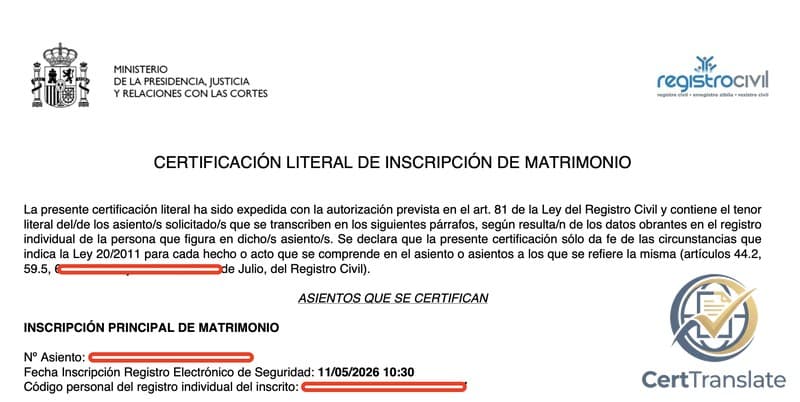
A client submitted a Spanish marriage certificate (Certificación Literal de Inscripción de Matrimonio) for a civil marriage celebrated at the Excelentísimo Ayuntamiento de Tarifa (Cádiz), with a certified copy generated on the same day by the Registro Civil de España through the Ministry of Justice e-portal at sede.mjusticia.gob.es. The certified marriage certificate translation was needed for a USCIS filing.
The document was a single page of plain text under the Ministry of the Presidency, Justice and Relations with the Cortes letterhead. At the foot of the page, in place of the usual signature-and-seal block, sat three small framed fields: 'FECHA Y HORA DEL DOCUMENTO', 'DIRECCIÓN DE VALIDACIÓN' (a https://sede.mjusticia.gob.es/es/comprobacion-autenticidad URL), and 'FIRMADO ELECTRÓNICAMENTE POR' (Secretaría de Estado de Justicia). Below that, a barcode and a verification code in the format RG:A&Db-zeV6-j7$Z-hEm$.
No wet ink signature on the page. No round rubber stamp, no embossed seal, no apostille glued to the back. The document is authenticated entirely digitally by design.
Why This Required Special Handling
A USCIS adjudicator opening a foreign-government civil-registry document expects, in most cases, to see three familiar trust artifacts on the page: a named registrar's signature, an official stamp or seal, and — if filing from outside the U.S. — an apostille or consular legalization. The Spanish Civil Registry's electronic certificate has none of these in their familiar wet-ink form.
Under Spain's Ley 20/2011 del Registro Civil, articles 44.2, 59.5, 62.1 and 81, the certificación literal issued through the Civil Registry's electronic portal is the legally authoritative form of the certificate. The named Encargado del Registro Civil (Registrar) appears in a 'DATOS DE FIRMANTE' block at the bottom of the body text; the cryptographic signature on the PDF itself is issued by the Secretaría de Estado de Justicia (the State Secretariat of Justice), the institutional signer for documents released through sede.mjusticia. Two distinct signers — one named, one institutional — and both visible only as text. There is no signature glyph anywhere on the page.
A translator who silently 'fills in' a signature description (writing '[Signature: Carmen Fernandez Mayo]' where there is no signature) introduces a USCIS-grade factual error into the certified translation. A translator who omits the verification block, the URL, and the verification code leaves the USCIS reviewer with no way to confirm the document. The translation has to render exactly what is on the page — and explain why what is on the page is enough — without exceeding the translator's role under USCIS translation requirements.
How We Handled It
We rendered the body of the certificate in standard US English, preserving the two-surname Spanish naming convention (LOPEZ RODRIGUEZ; AVECILLA ORTEGA) and converting the DD/MM/YYYY dates to Month DD, YYYY for clarity. The 'DATOS DE FIRMANTE' block kept the Registrar's name as it appears in the source and rendered the title 'ENCARGADO/A' as 'Registrar' — not the literal calque 'Officer in Charge' — because 'Registrar' is the accepted English translation of the office under Ley 20/2011.
The verification block at the foot of the page was reproduced as a three-column English table mirroring the original: 'Date and Time of the Document', 'Validation Address' (with the sede.mjusticia.gob.es verification URL transcribed character-for-character), and 'Electronically Signed By' (Secretariat of State for Justice). The barcode at the bottom was described as '[Barcode]' at its location, and the verification code RG:A&Db-zeV6-j7$Z-hEm$ was transcribed character-for-character — those characters are the only key a USCIS adjudicator needs to confirm the certificate at source.
Nowhere on the certified translation does the phrase '[Signature: Name]' appear, because no signature appears on the original. A translator's signature qualifier would be a factual statement that the translator could not make about a document that contains no signature.
"The original document carries an electronic signature only — no handwritten signature, no rubber stamp, and no embossed seal are present on the page. Authenticity is established entirely in digital form, under Spain's Ley 20/2011 del Registro Civil (arts. 44.2, 59.5, 62.1, and 81), through the electronic signature issued by the Secretaría de Estado de Justicia, the verification URL https://sede.mjusticia.gob.es/es/comprobacion-autenticidad, and the verification code RG:A&Db-zeV6-j7$Z-hEm$ printed at the foot of the page. The certificate is the legally authoritative form of issuance for marriage records held by the Registro Civil de España since the Civil Registry portal entered general service."

Two further Translator's Notes accompanied the certification block: one explaining that the property-regime label 'Régimen económico matrimonial: LEGAL' refers to the default statutory regime under Spanish law (sociedad de gananciales / community of acquisitions), rendered here as 'STATUTORY' so a US family-law reviewer does not read the literal Spanish word 'LEGAL' as a category label; and one explaining that 'EXCMO. AYUNTAMIENTO' is the honorific reference to the City Hall ('Excelentísimo Ayuntamiento' = 'Most Excellent City Council / Honorable City Hall'), glossed on first mention. Dates in DD/MM/YYYY format were converted to Month DD, YYYY throughout.
The Outcome
The certified translation was delivered to the client, with the verification URL and verification code transcribed exactly as they appear in the source so a USCIS adjudicator can verify the certificate against the Spanish Civil Registry directly. The Translator's Note explains the electronic-only authentication so the absence of a wet signature on the translation matches the absence of one on the original.
This pattern is routine for modern Spanish civil-registry documents. Spain's sede.mjusticia portal issues birth, marriage, and death certificates with the same electronic-only authentication structure. The same Translator's Note has now accompanied Spanish certified translations of more than two dozen sede.mjusticia documents on file with no RFE on the authentication structure.
What This Means for You
A Spanish Civil Registry certificate that arrives as a sede.mjusticia.gob.es PDF — with an electronic-signature reference, a verification URL, and a verification code instead of a wet signature and seal — is the legally authoritative form of the document under Ley 20/2011. A certified translation that preserves the verification block character-for-character and includes a Translator's Note explaining the electronic-only authentication gives a USCIS adjudicator everything they need to confirm the certificate without an apostille or a paper original.
Have a similar situation?
We translate Spanish marriage, birth, and death certificates from the sede.mjusticia.gob.es electronic Civil Registry portal regularly, with Translator's Notes that explain the electronic-only authentication to USCIS.
Related Cases & Resources
Sources & References
- Meet Translation Requirements·USCIS·Verified 2026-06-27
- Ley 20/2011, de 21 de julio, del Registro Civil — texto consolidado·Boletín Oficial del Estado — Gobierno de España·Verified 2026-06-27
- Sede Electrónica del Ministerio de la Presidencia, Justicia y Relaciones con las Cortes — Comprobación de autenticidad·Ministerio de la Presidencia, Justicia y Relaciones con las Cortes — Gobierno de España·Verified 2026-06-27
Explore the Hub
Certified Translation
Documents
Languages
Immigration
Accepted By
All identifying information has been removed from document images. Case details are shared with client permission. No personal data is stored or displayed on this page.