




How should a Ukrainian marriage certificate be translated for an N-400 name change so USCIS recognizes the new surname?
TL;DRA Ukrainian marriage certificate from Odesa was translated in 2026 to evidence a wife's surname change on her N-400 filing. Both spouses had taken the husband's surname, and the wife had been using it on her US documents for years. The translator deferred to the bearers' Ukrainian passport spellings for every Latin-script name, rendered patronymics under BGN/PCGN Ukrainian, and documented the convention in a Translator's Notes block. The translation was delivered without an RFE on the name change.
Case Specifications
- Document
- Marriage certificate
- Foreign Name
- Свідоцтво про шлюб
- Country
- Ukraine
- Languages
- Ukrainian → English
- Submitted To
- USCIS N-400 naturalization filing
What We Received
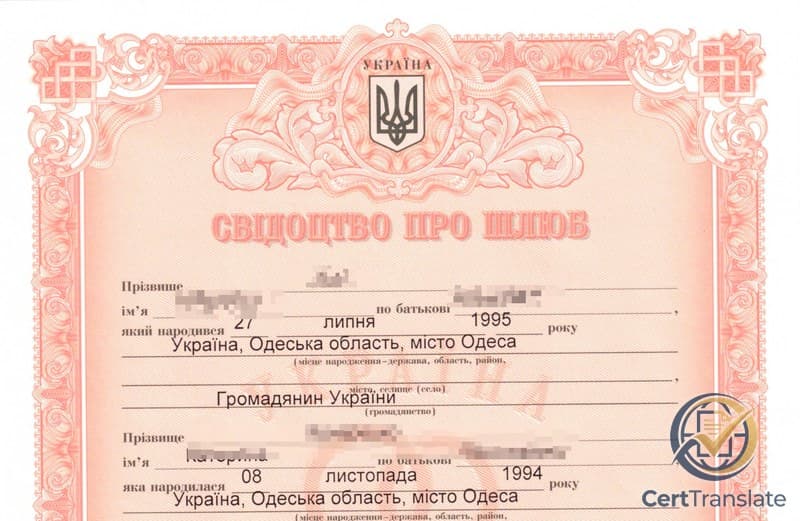
A client submitted a Ukrainian Свідоцтво про шлюб (marriage certificate) registered in 2018 in the city of Odesa. The translation was needed for an N-400 naturalization filing, to evidence the wife's surname change after marriage. By 2026, the wife had been using the husband's surname on her US passport, green card, and SSN card for years. She wanted a certified Ukrainian marriage certificate translation whose name spellings matched those US documents exactly.
The certificate followed the standard post-1993 Ukrainian civil-registry layout. Each spouse's surname, given name, and patronymic appeared in full. So did both citizenships, the registration date in figures and in words, the act-record number, and a block confirming the post-marriage surnames of both spouses. The seal was the round blue official seal of the Ministry of Justice of Ukraine, applied by the Prymorskyi District Department of State Registration of Civil Status Acts.
Why This Required Special Handling
The N-400 asks the applicant to list every current and former legal name. Each name change must be evidenced with a certified copy of the underlying record. The marriage certificate is the legal hinge between the wife's pre-marriage and post-marriage identities. Any Latin-script spelling on the translation that does not match her existing US documents reads to USCIS as a chain-of-evidence gap, not a stylistic variant.
BGN/PCGN Ukrainian is the correct system for a Ukrainian-language document, but a system-correct transliteration that ignores the bearer's existing passport is still wrong for an N-400. Ukraine has used the Ukrainian National Standard 2010 in its passports for over a decade, and the wife's US records inherit that spelling. The translator's job is to follow the evidence chain — passport first, the name-mismatch guide rule of thumb applies — not to re-romanise from first principles.
Patronymics add a second layer. Ukrainian patronymics — the middle element built from the father's name with the suffix -ovych for sons and -ivna for daughters — are legal parts of the name. They appear in full on Ukrainian passports and on every civil-registry record. Dropping them, or romanising them inconsistently with the passport, breaks the same evidence chain. The patronymic on the marriage certificate has to match the patronymic on every other Ukrainian-language record the applicant has filed with USCIS.
How We Handled It
We deferred to the bearers' existing Ukrainian passport spellings for both surnames and both given names. The husband's surname was rendered exactly as it appears in his passport. That is the surname the wife adopted at marriage and now uses on her US documents. The wife's pre-marriage surname followed the same passport-first rule. Where the passport-supplied spelling agrees with BGN/PCGN Ukrainian, we noted the convention. Where it commits to a non-standard Latin spelling, we follow the passport without comment.
Both patronymics were rendered under BGN/PCGN Ukrainian — -ovych for the husband, -ivna for the wife. Each patronymic stays in the third position of the full name as the Ukrainian record requires. The post-marriage surname block records both spouses' surnames after the marriage. We rendered it with the same single shared surname for both. The Ukrainian convention is a single shared surname, not a hyphenated combination like some other civil-law systems use.
We transliterated the Cyrillic series identifier as 'I-ZhD' (Roman numeral + Ukrainian Cyrillic 'ЖД' → 'ZhD' under BGN/PCGN Ukrainian). The printed certificate number was preserved digit-for-digit. We rendered «М.П.» (Місце печатки) as 'L.S.' (locus sigilli). The seal description named the round blue Ministry of Justice of Ukraine seal and preserved the EDRPOU registry code printed in it. The head registrar's handwritten signature was marked as illegible, with the printed initials and surname retained.
"Translator's Note 1 — Names: The spouses' full names appear in the original in Ukrainian Cyrillic in the order surname, given name, patronymic. They have been transliterated per the spellings shown in the bearers' Ukrainian passports; patronymics have been rendered under BGN/PCGN Ukrainian. Translator's Note 2 — Series identifier: The Cyrillic series designation «I-ЖД» on the certificate is rendered as «I-ZhD» in Latin transliteration; the certificate number is preserved verbatim. Translator's Note 3 — Seal abbreviation: «М.П.» (Місце печатки) is rendered as «L.S.» (locus sigilli — place of seal). Translator's Note 4 — Seal text: The round blue official seal text is in Ukrainian. Legible elements have been translated; the state-registry identification (EDRPOU) code printed in the seal has been preserved. Translator's Note 5 — Date format: Dates in the original appear in DD.MM.YYYY format and have been rendered as Month DD, YYYY in this translation."

The translation was delivered in the standard CertTranslate layout — one body page mirroring the original certificate, followed by the Certification of Translation Accuracy with the five Translator's Notes. The order met USCIS certified-translation requirements and was packaged with the original-language source for the applicant's filing.
The Outcome
The certified translation was delivered to the client for the N-400 packet, with every name spelling matched to the wife's existing US documents and to the husband's Ukrainian passport. The Translator's Notes block gave the adjudicator the context to read the transliteration choices as deliberate and standards-based.
We apply the same passport-first rule on every Ukrainian-language civil-registry record we translate for USCIS — marriage certificates, birth certificates, name-change certificates, internal-passport stamps. Adjudicators read consistency across the applicant's documents as a single chain of evidence, and the translator's job on each record is to keep that chain unbroken.
What This Means for You
If you are filing an N-400 with a Ukrainian marriage certificate as name-change evidence, the translation must follow the spellings already on your Ukrainian passport and your US documents. A system-correct transliteration that does not match those documents is a chain-of-evidence gap, not an alternative reading. Give the translator your passport spellings up front. Ask for a Translator's Note documenting the convention used.
Have a similar situation?
We translate Ukrainian marriage, birth, name-change, and internal-passport records — applying BGN/PCGN Ukrainian conventions and matching every name to the bearers' Ukrainian passports — for N-400 and other USCIS filings regularly.
Related Cases & Resources
Sources & References
- Form N-400, Application for Naturalization·USCIS·Verified 2026-07-17
- Meet Translation Requirements·USCIS·Verified 2026-07-17
- Resolution No. 55 of January 27, 2010 — Ukrainian National Transliteration Standard·Cabinet of Ministers of Ukraine·Verified 2026-07-17
Explore the Hub
Certified Translation
Documents
Languages
Immigration
Accepted By
USCIS Forms
All identifying information has been removed from this case. Case details are shared with client permission. No personal data is stored or displayed on this page.