CertTranslateCertTranslate
O
By Olena Shevchenko
Reviewed by Andriy KovalMarch 2026

Ukrainian Patronymic Translation: По Батькові, Name Order & USCIS

По батькові is the Ukrainian patronymic — a legal name derived from the father's first name. It appears on all Ukrainian documents but has no field on U.S. forms. Translators include it in the certified translation and add a note explaining it to the adjudicator.

Every Ukrainian person has three name components: прізвище (surname), ім'я (given name), and по батькові (patronymic). The patronymic is not a middle name you can omit or abbreviate — it is a legal name component that appears on every official Ukrainian document. When these documents are translated for U.S. immigration, courts, or universities, the patronymic creates a specific set of challenges that this guide addresses.

This guide explains how the patronymic system works, how the suffixes are formed, why U.S. forms struggle to accommodate it, and how experienced translators handle the mismatch. If your Ukrainian documents show a three-part name and your U.S. forms show a two-part name, this is the explanation — and the solution. For a broader look at name mismatches across all languages, see our name mismatch guide.

  • Written by a native Ukrainian translator who navigates patronymic challenges in every translation
  • Covers suffix formation rules, name order conventions, and USCIS form mapping
  • Includes transliteration differences between Ukrainian and Russian patronymics

We are not immigration attorneys. This guide covers how translators handle Ukrainian patronymics in certified translations, not legal advice on name changes.

How the Three-Part Ukrainian Name System Works

In Ukraine, every person's full legal name consists of three components, always in this order on official documents: Прізвище (прізвище / Surname) comes first. Ім'я (ім'я / Given name) comes second. По батькові (по батькові / Patronymic) comes third.

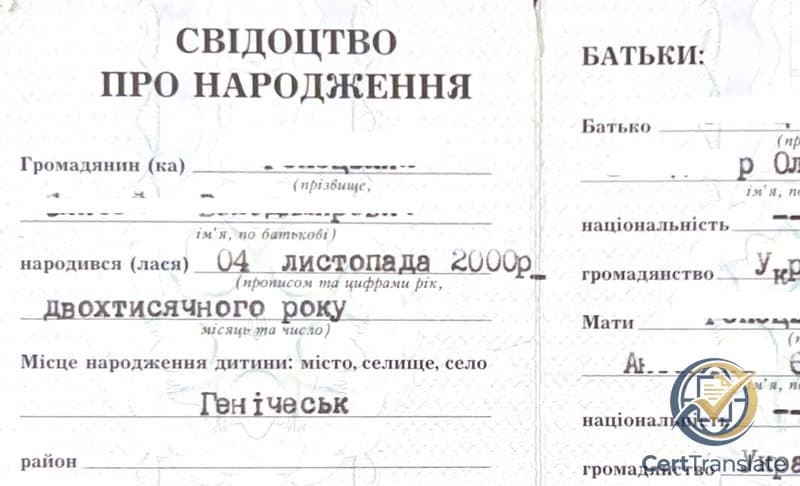
For example, a full Ukrainian name on a birth certificate might read: Коваленко Марія Олександрівна. Here, Коваленко is the surname, Марія is the given name, and Олександрівна is the patronymic (meaning "daughter of Олександр/Oleksandr").

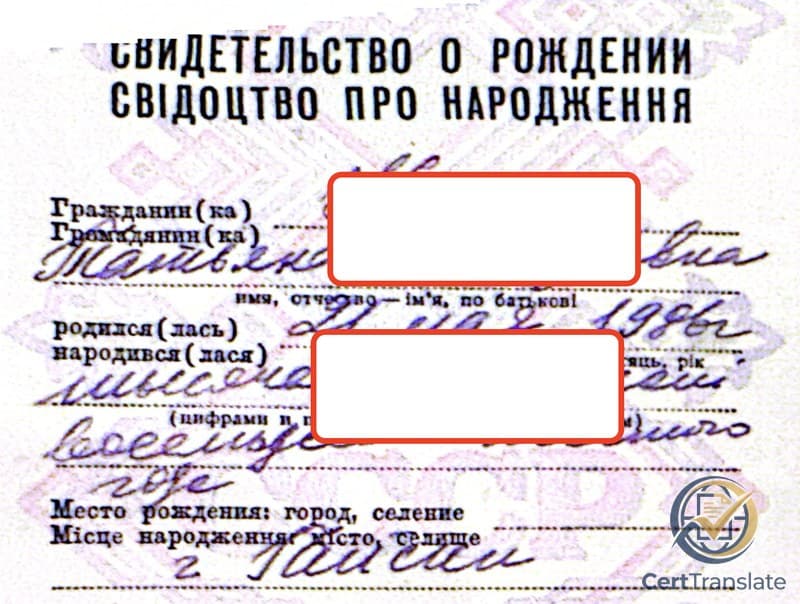
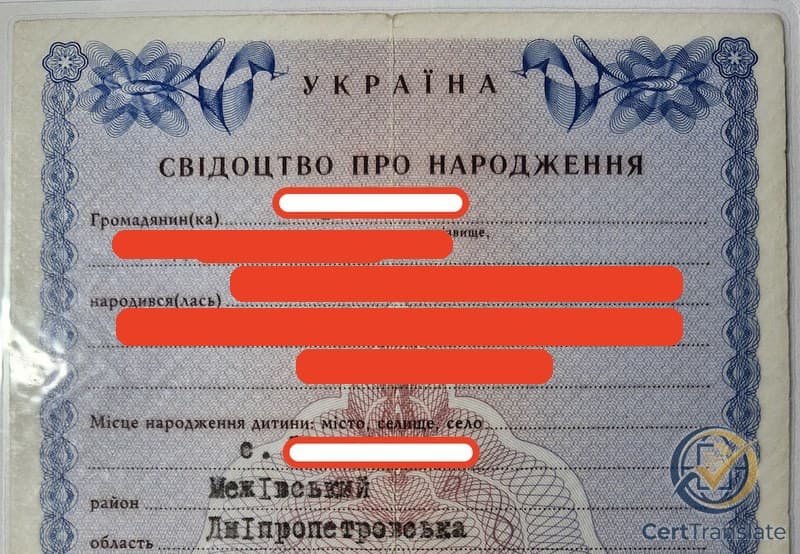
This three-part structure is not decorative or optional. It is the legal standard across all Ukrainian documents: birth certificates (свідоцтво про народження), passports, marriage certificates, diplomas, court documents, and employment records. Omitting the patronymic from any of these documents would make the name legally incomplete.

Important note on name order: Ukrainian documents list names in прізвище-ім'я-по батькові order (surname first). U.S. documents use given-name-first order. This means the same person's name appears in reverse order on Ukrainian vs. U.S. documents, which can confuse adjudicators who are not familiar with the convention. The translator's note should flag this difference.

How Patronymic Suffixes Are Formed

The patronymic is derived from the father's given name by adding a gender-specific suffix. Understanding the formation rules helps translators verify that the patronymic matches the father's name across documents — and catch errors when it does not.

Male patronymics: Most male patronymics end in -ович or -евич (sometimes -ійович). Examples: Олександр → Олександрович, Іван → Іванович, Сергій → Сергійович, Михайло → Михайлович, Андрій → Андрійович, Василь → Васильович.

Female patronymics: Most female patronymics end in -івна or -ївна (sometimes -евна for Russian-influenced forms). Examples: Олександр → Олександрівна, Іван → Іванівна, Сергій → Сергіївна, Михайло → Михайлівна, Андрій → Андріївна, Василь → Василівна.

Ukrainian vs Russian patronymics: This is a critical distinction. Ukrainian and Russian patronymics from the SAME father's name look different. For a father named Сергій (Ukrainian) / Сергей (Russian): Ukrainian male patronymic = Сергійович, Russian male patronymic = Сергеевич. These are different spellings of the same patronymic in two different languages. If a person's birth certificate shows the Ukrainian form and their older passport shows the Russian form, the translator must recognize this as a language difference, not a name discrepancy.

Verification across documents: When translating a packet of documents, the translator verifies that the patronymic is consistent. If the birth certificate shows Олександрівна and the father's name on the same certificate is Олександр, the patronymic is confirmed. If the patronymic does not match the father's name, it may indicate a clerical error, a different father, or a documentation issue that the applicant should resolve before filing.

Patronymic Suffix Reference

The following reference covers the most common Ukrainian father's names and their patronymic forms for both genders. This is what translators use to verify patronymic–father name consistency across a document packet. The reference also shows the equivalent Russian forms, since Soviet-era documents often used Russian patronymics for Ukrainian families.

Олександр (Александр): Male — Олександрович (Александрович). Female — Олександрівна (Александровна). This is the single most common patronymic in Ukrainian documents.

Іван (same in both languages): Male — Іванович (same). Female — Іванівна (Ивановна). Note the Ukrainian feminine form Іванівна vs Russian Ивановна — these produce different transliterations.

Сергій (Сергей): Male — Сергійович (Сергеевич). Female — Сергіївна (Сергеевна). The different suffixes (-ійович vs -еевич) produce clearly different English transliterations.

Михайло (Михаил): Male — Михайлович (same). Female — Михайлівна (Михайловна).

Андрій (Андрей): Male — Андрійович (Андреевич). Female — Андріївна (Андреевна).

Василь (Василий): Male — Васильович (Васильевич). Female — Василівна (Васильевна).

Петро (Пётр): Male — Петрович (same). Female — Петрівна (Петровна).

Микола (Николай): Male — Миколайович (Николаевич). Female — Миколаївна (Николаевна). The Ukrainian name Микола and Russian Николай are the same name in two languages.

Володимир (Владимир): Male — Володимирович (Владимирович). Female — Володимирівна (Владимировна). The different first name forms (Володимир vs Владимир) produce noticeably different transliterations.

Юрій (Юрий): Male — Юрійович (Юрьевич). Female — Юріївна (Юрьевна).

This list is not exhaustive but covers the names that appear most frequently in Ukrainian document translation. Translators who work with Ukrainian documents daily recognize these patterns instantly.

Patronymic vs Middle Name

The Ukrainian patronymic is frequently confused with a Western middle name, but they are fundamentally different concepts. Understanding the difference is important for both the translator and the USCIS adjudicator.

A Western middle name is chosen freely by the parents. It can be anything: a family name, a favorite name, a saint's name, or no middle name at all. Two siblings can have completely unrelated middle names. A middle name can be omitted or abbreviated to an initial on many documents without legal consequence.

A Ukrainian patronymic is structurally derived from the father's first name using predictable suffix rules. It cannot be freely chosen. All children of the same father share the same patronymic root (though the gender suffix differs). The patronymic cannot be legally omitted from official Ukrainian documents — a document without a patronymic would be considered incomplete.

For practical purposes on U.S. forms, the patronymic is typically entered in the "Middle Name" field because there is no dedicated patronymic field. USCIS adjudicators who handle Ukrainian cases regularly understand this convention. However, for adjudicators who are less familiar with Ukrainian naming, the translator's note explaining the patronymic system is essential context.

One common point of confusion: some Ukrainian applicants have BOTH a patronymic AND what they consider a "middle name" (a second given name chosen by their parents). This is less common in Ukrainian naming than in Western naming, but it does occur. In these cases, the translator includes all name components as they appear on the source document and notes the distinction.

Why USCIS Forms Create Problems

U.S. immigration forms are built for a two-part or three-part Western name structure: First Name, Middle Name (optional), Last Name. Ukrainian names have three mandatory parts that do not map cleanly to this structure. Here is what typically happens:

The I-485 (Adjustment of Status) scenario: The applicant's Ukrainian birth certificate shows Коваленко Марія Олександрівна. On the I-485, the applicant enters: Family Name: Kovalenko, Given Name: Mariia, Middle Name: Oleksandrivna. The Ukrainian passport shows: KOVALENKO MARIIA (Коваленко Марія Олександрівна). Some passports include the patronymic on the data page, others do not. This creates an immediate mismatch: the I-485 shows "Oleksandrivna" as a middle name, the passport may not show it at all, and the birth certificate shows it as a patronymic in a different position.

The I-130 (Family Petition) scenario: The petitioner is questioned about names on the beneficiary's documents. If the birth certificate shows three name components and the I-130 shows two, the adjudicator may ask for clarification. The translator's note in the certified translation preempts this question.

The N-400 (Naturalization) scenario: The applicant is asked for their legal name. If previous filings used the patronymic as a middle name and the naturalization application omits it (or vice versa), it creates an inconsistency in the record. The translator cannot control how the applicant fills out forms, but the certified translation with an explanatory note provides the context needed to resolve the inconsistency.

General principle: The translator translates what is on the document — including the patronymic in its correct position. The translator then adds a note explaining the three-part Ukrainian name system and recommending that the applicant use the patronymic consistently in the "Middle Name" field across all U.S. filings. This is not legal advice; it is translation context that helps the adjudicator understand the source documents.

Feminine Surnames in Ukrainian

Beyond patronymics, Ukrainian surnames also have gender-specific forms. This is another naming convention that does not exist in English and creates translation challenges.

Surnames ending in -ський / -цький: The masculine form ends in -ський (Полтавський), the feminine form ends in -ська (Полтавська). Similarly: Вишневецький (m) / Вишневецька (f). On English-language documents, both forms typically transliterate to the same spelling (Полтавський = Poltavskyi, Полтавська = Poltavska) — a husband and wife may have visually different surnames in Ukrainian that standardize in English.

Surnames ending in -ий: Some Ukrainian surnames ending in -ий take a feminine form ending in -а or -я. Example: Білий (m) / Біла (f). Not all -ий surnames have gendered forms — it depends on whether the surname is adjectival in origin.

Surnames ending in -енко, -чук, -юк: These very common Ukrainian surname endings (Коваленко, Бондарчук, Костюк) do NOT change between masculine and feminine forms. Both the husband and wife are Коваленко. This is the majority case for Ukrainian surnames.

Why this matters for translation: When a birth certificate shows the mother as Полтавська and the father as Полтавський, a translator unfamiliar with Ukrainian naming might think these are two different surnames. They are not — they are the masculine and feminine forms of the same family name. The translator renders both accurately and may add a note explaining the convention if the receiving authority is unlikely to understand the pattern.

Cross-document consistency: The translator ensures that the surname form is correctly rendered from each source document. A woman's birth certificate will show her maiden surname in feminine form, her marriage certificate will show her new surname in feminine form, and her husband's documents will show the same surname in masculine form. The translator notes this pattern across the packet.

Common Name Mismatches Involving Patronymics

Based on handling thousands of Ukrainian document packets, these are the most frequent patronymic-related mismatches that occur across documents:

Patronymic on birth certificate, missing from passport: Some Ukrainian passports (especially the older-format internal passports) included the patronymic on the data page, while the new biometric passport's machine-readable zone may not include it. The birth certificate always has it. The translator notes this discrepancy and explains that the patronymic remains a legal name component even when the passport MRZ does not display it.

Ukrainian patronymic form vs Russian patronymic form: A person's birth certificate might show Сергійович (Ukrainian) while an older document shows Сергеевич (Russian). These are the same patronymic in two different languages. The translator notes this and explains that the forms are linguistically equivalent.

Name order reversed between Ukrainian and U.S. documents: The birth certificate shows Коваленко Марія Олександрівна (surname first), while the I-485 shows Mariia Oleksandrivna Kovalenko (given name first). The translator notes that Ukrainian document convention places the surname first.

Transliteration differences across eras: Older documents may transliterate Олександрівна as "Aleksandrovna" (Russian-style), while the current passport shows "Oleksandrivna" (Ukrainian-style). These are the same name rendered under different transliteration systems. The translator explains the system change and confirms identity continuity.

Married name change affecting surname but not patronymic: When a Ukrainian woman changes her surname at marriage, she changes her прізвище but keeps her по батькові. So Петренко Марія Олександрівна after marriage to Коваленко becomes Коваленко Марія Олександрівна. The patronymic stays the same. If an adjudicator sees different surnames on the birth certificate and the I-485 but the same patronymic, the marriage certificate translation connects the dots.

How Translators Handle Patronymics

The translator's role with patronymics is the same as with any other name component: translate faithfully, align with passport evidence, and explain the system to the English-speaking reader. Here is the specific approach:

Include the patronymic in every translation: The patronymic is never omitted, abbreviated, or moved to a different position. If the source document shows Коваленко Марія Олександрівна, the translation shows "Kovalenko Mariia Oleksandrivna" with the order matching the source, and a note indicating the name order convention.

Add a standard translator's note: The note explains the three-part system once per document or once per packet: "In Ukrainian naming convention, a person's full legal name consists of three components: прізвище (surname/family name), ім'я (given name/first name), and по батькові (patronymic, derived from the father's given name). The patronymic is a mandatory legal name component, not an optional middle name."

Align transliteration with passport: The patronymic's English spelling must be consistent with the applicant's passport wherever possible. If the passport shows "Oleksandrivna" (Ukrainian transliteration), the birth certificate translation should use the same spelling, even if a Russian transliteration system would produce "Aleksandrovna."

Cross-reference the patronymic against the father's name: In a birth certificate translation, the translator verifies that the child's patronymic matches the father's first name (ім'я батька). If they don't match, the translator flags it. This simple check catches clerical errors and data entry mistakes that could cause problems later.

Handle Ukrainian vs Russian patronymic forms: If different documents in the same packet show the Ukrainian and Russian forms of the same patronymic, the translator notes this equivalence: "Сергійович (Ukrainian) and Сергеевич (Russian) are the same patronymic in the two official languages used in Ukrainian civil records at different periods."

Common Questions About Ukrainian Patronymics

What is по батькові on Ukrainian documents?
По батькові is the patronymic — a name derived from the father's first name using gender-specific suffixes (-ович/-івна for most names). It is a mandatory legal name component in Ukraine and appears on birth certificates, passports, diplomas, marriage certificates, and all other official documents. It identifies the person by their father's name and is not the same as a Western middle name.
Why do Ukrainian names have three parts?
Ukrainian legal names consist of three mandatory components: прізвище (surname), ім'я (given name), and по батькові (patronymic). The patronymic system has ancient roots and is enshrined in Ukrainian civil law. All three components are required on every official document. This differs from the U.S. system where a middle name is optional.
How do you translate a Ukrainian patronymic for USCIS?
The translator includes the patronymic exactly as it appears on the source document. Since USCIS forms have only First Name and Last Name fields (plus an optional Middle Name), the patronymic is typically entered in the Middle Name field. The translator adds a note explaining that the по батькові is a patronymic derived from the father's name, not a freely chosen middle name. This context helps the adjudicator understand the source documents.
Is a patronymic the same as a middle name?
No. A Western middle name is freely chosen by parents and can be anything. A Ukrainian patronymic is systematically derived from the father's first name using specific suffix rules. It cannot be changed or omitted and appears on every official document in Ukraine. However, on U.S. forms, the patronymic is typically entered in the Middle Name field as a practical accommodation, since there is no dedicated patronymic field.
What if my name looks different on my Ukrainian passport and my birth certificate?
This is very common and usually results from transliteration differences. Older passports may use Russian-based transliteration, while newer passports use Ukrainian-based transliteration. For example, Олександрівна might appear as "Aleksandrovna" on one document and "Oleksandrivna" on another. The translator translates each document faithfully and adds a note explaining that these are the same name under different transliteration systems.
Do Ukrainian women have different surnames from their husbands?
Some Ukrainian surnames have gender-specific forms. Surnames ending in -ський/-цький (masculine) become -ська/-цька (feminine). For example, Полтавський (husband) and Полтавська (wife) are the same family name. However, the most common Ukrainian surname endings (-енко, -чук, -юк) do NOT change between genders. The translator renders each form as written and adds a note when gendered surname forms appear on documents.
Expert
Guided by Olena Shevchenko

Need Ukrainian documents translated with proper patronymic handling?

We translate entire Ukrainian document packets together, ensuring consistent patronymic rendering, proper transliteration alignment, and explanatory translator's notes that USCIS adjudicators need to understand the three-part name system.