




Why does a Ukrainian birth certificate translation say 'Volodymyr' on the passport but 'Vladimir' in some translations, and which is correct for USCIS?
TL;DRA Ukrainian birth certificate from Dnipropetrovsk Oblast was translated for USCIS under BGN/PCGN Ukrainian — not the Russian rules a Russian-trained translator would default to. The two systems map shared Cyrillic letters differently (и → y, not i; г → h, not g), producing 'Volodymyr' over 'Vladimir' and 'Vasyl' over 'Vasili.' Ukrainian conventions kept every name aligned with the holder's passport (Ukrainian National Standard 2010) and prevented a USCIS name-mismatch RFE.
Case Specifications
- Document
- Birth certificate
- Foreign Name
- Свідоцтво про народження
- Country
- Ukraine
- Languages
- Ukrainian → English
- Submitted To
- USCIS
What We Received
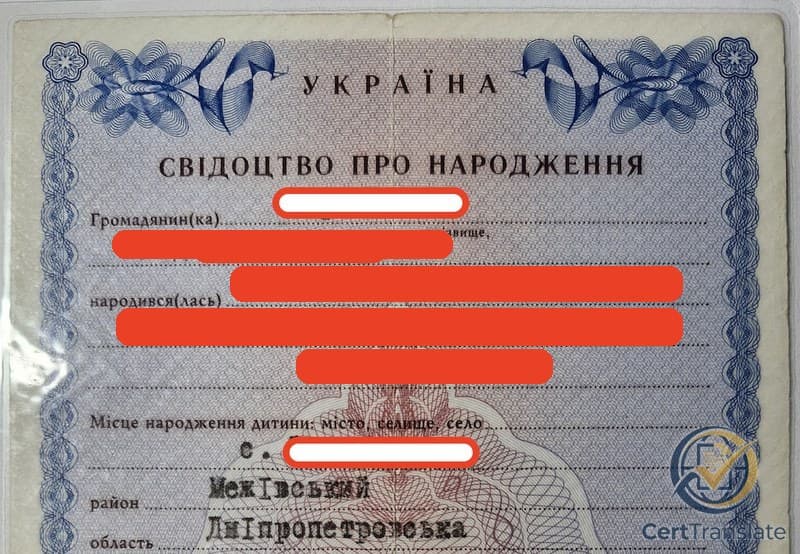
A client submitted a Ukrainian Свідоцтво про народження — a single inside page from a civil-registry booklet — issued in 1996 by a village council executive committee in the Mezhivskyi District of Dnipropetrovsk Oblast. The cursive entries were Ukrainian-language: child's surname, given name, and patronymic; both parents' surnames, given names, and patronymics; both parents' nationality (українець / українка); the place of birth; and the place of registration. The translation was needed for a USCIS filing alongside the holder's Ukrainian passport, and the client wanted a certified Ukrainian birth certificate translation whose name spellings matched the passport.
The series identifier on the booklet was Cyrillic — a Roman numeral followed by two Ukrainian Cyrillic letters and a number — and the bottom-right corner carried the pre-printed form-printer indicator 'МТГ. 1993.' Every element of the document, from the holder's name to the Oblast name to the form-printer indicator, had to be carried into the English translation; the only question was which transliteration system to use.
Why This Required Special Handling
Ukrainian Cyrillic and Russian Cyrillic share most of their alphabets, but the two languages romanise the shared letters differently. Under BGN/PCGN Ukrainian, 'и' transliterates to 'y' and 'г' transliterates to 'h'; under BGN/PCGN Russian, the same letters become 'i' and 'g' respectively. The downstream effect is large and visible: 'Володимир' becomes 'Volodymyr' under Ukrainian rules but 'Vladimir' under Russian rules; 'Василь' becomes 'Vasyl' or 'Vasili'; 'Григорій' becomes 'Hryhorii' or 'Grigory.' Same Cyrillic, different Latin output.
Ukrainian-issued passports have used the Ukrainian National Standard 2010 (Cabinet of Ministers Resolution No. 55 of January 27, 2010), which agrees with BGN/PCGN Ukrainian on the disputed letters, for over a decade. So a Ukrainian holder's passport already commits to spellings like 'Volodymyr' rather than 'Vladimir.' If a translator unfamiliar with the Ukrainian system applies Russian conventions to the birth certificate, the resulting translation says 'Vladimir' while the passport says 'Volodymyr' — a name mismatch across the holder's documents.
Per USCIS translation requirements, a certified translation must be complete and accurate. A Russian-style transliteration of a Ukrainian-language document is technically an error of system selection, not a typo — but the practical consequence is the same: the adjudicator sees two spellings of the same name and may issue a Request for Evidence asking which one is correct. The translator does not get to choose how the holder's name is spelled in Latin script — the holder's Ukrainian government already chose, and the translation has to follow.
How We Handled It
We transliterated every personal name and place name under BGN/PCGN Ukrainian, deferring to the holder's passport spelling for the holder's own name where the family supplied it. The surname kept its Ukrainian 'y' where Russian rules would have produced 'i', and both parents' patronymics ended in -ovych and -ivna rather than the Russian -ovich and -evna. Place names followed the same rule: 'Mezhivskyi District' (not 'Mezhevskoy Rayon') and 'Dnipropetrovsk Oblast' (not 'Dnepropetrovsk Oblast').
The Cyrillic series identifier 'I-КИ' was carried into the translation as 'I-KY,' applying the same Ukrainian convention to the booklet's pre-printed series letters. The document number was preserved digit-for-digit, and the pre-printed form-printer indicator 'МТГ. 1993' in the bottom-right corner was carried over as 'MTH. 1993,' again under Ukrainian rules. The Translator's Notes block then carried short clarifying notes — one for the transliteration system, one for the Cyrillic series identifier, one for the form-printer indicator — written so a USCIS adjudicator reading them once would not return to the question.
"Translator's Note 1 — Transliteration system: Cyrillic personal names, surnames, patronymics, and place names have been transliterated using the BGN/PCGN Ukrainian convention (which agrees with the Ukrainian National Standard 2010 used in Ukrainian-issued passports on the relevant letters). Where a holder's identity-document spelling was supplied, that spelling has been preserved in the translation. Translator's Note 2 — Cyrillic series identifier: The series 'I-КИ' on the booklet (a Roman numeral followed by two Ukrainian Cyrillic letters) is rendered as 'I-KY' in transliteration. The document number is preserved unchanged. Translator's Note 3 — Form-printer indicator: The marking 'МТГ. 1993' in the lower-right corner of the original is a pre-printed form-printer indicator (not a data field) and has been rendered in transliteration as 'MTH. 1993.'"

An additional note documented the conversion of dates from the source's DD.MM.YYYY format to the unambiguous 'Month DD, YYYY' US convention (e.g., '05.11.1998' → 'November 5, 1998') and confirmed that the round purple official stamp on the page bears the State Emblem of Ukraine (the trident), not a Soviet emblem — a distinction worth noting on a 1996 document, three years into Ukraine's post-1993 civil-registry forms. The translation was delivered in our standard CertTranslate layout with the Translator's Certification block on the final page.
The Outcome
The certified translation was delivered to the client for the USCIS filing, with every name spelling matched to the holder's Ukrainian passport. The Translator's Notes block gave the adjudicator the context to read the transliteration choices as deliberate and standards-based rather than as inconsistent.
We have applied the same approach on every Ukrainian-language civil-registry document we have translated for USCIS — birth certificates, marriage certificates, name-change certificates, internal-passport stamps — since we began handling these documents, without an RFE on transliteration of names.
What This Means for You
A certified Ukrainian birth certificate translation for USCIS must use BGN/PCGN Ukrainian — not BGN/PCGN Russian — for every Cyrillic name and place name, and must defer to the holder's existing passport spelling where applicable. If your translator returns spellings like 'Vladimir' or 'Vasili' for names your Ukrainian passport spells 'Volodymyr' or 'Vasyl,' the document has been transliterated under the wrong system and should be corrected before submission.
Have a similar situation?
We translate Ukrainian birth, marriage, name-change, and internal-passport records — applying BGN/PCGN Ukrainian throughout and matching every name to the holder's Ukrainian passport — for USCIS filings regularly.
Related Cases & Resources
Sources & References
- Meet Translation Requirements·USCIS·Verified 2026-06-11
- Romanization System for Ukrainian — BGN/PCGN 2019·U.S. Board on Geographic Names / Permanent Committee on Geographical Names (UK)·Verified 2026-06-11
- Resolution No. 55 of January 27, 2010 — Ukrainian National Transliteration Standard·Cabinet of Ministers of Ukraine·Verified 2026-06-11
Explore the Hub
Certified Translation
Documents
Languages
Immigration
Accepted By
All identifying information has been removed from document images. Case details are shared with client permission. No personal data is stored or displayed on this page.