




Why do my German civil and church marriage certificates show different wedding dates, and will USCIS treat that as a discrepancy?
TL;DRA client filed with USCIS two German marriage certificates from the same 1986 wedding in Giessen — a civil Familienbuch-Abschrift showing May 30, 1986, and a Catholic Kirchliche Trauung showing May 31, 1986. The "discrepancy" is standard German practice: the civil ceremony at the Standesamt is the legally binding marriage and must take place first; the church wedding is optional and typically follows a day later. The church certificate also recorded baptism dates ("getauft am"), not birth dates — a detail that can be misread. We delivered one certified German-to-English translation package for both documents, with Translator's Notes explaining the Standesamt-vs-church timing and the baptism-versus-birth distinction.
Case Specifications
- Document
- Marriage certificate (civil + church)
- Foreign Name
- Beglaubigte Abschrift aus dem Familienbuch + Kirchliche Trauung
- Country
- Germany
- Languages
- German → English
- Submitted To
- USCIS
What We Received
A client submitted two German marriage documents from a 1986 wedding in Giessen (Hesse):
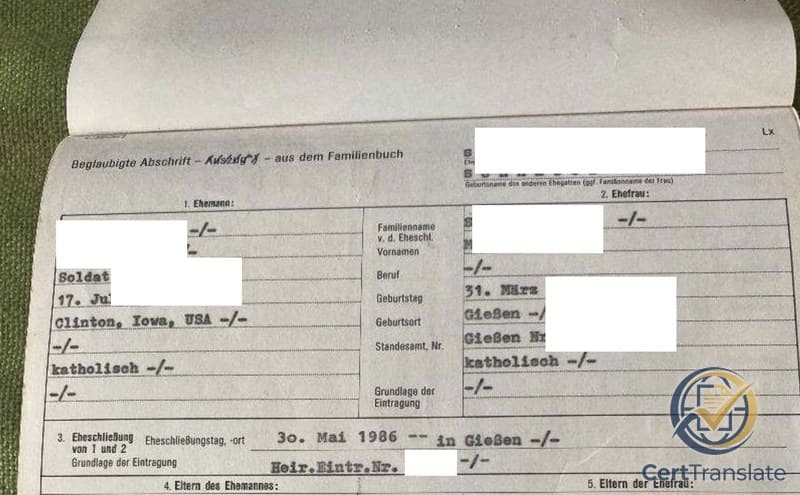
First, a civil Beglaubigte Abschrift aus dem Familienbuch — a certified copy from the Family Book kept by the Standesamt (civil registry). The marriage date field read "30. Mai 1986 — in Gießen," Marriage Entry No. 150.
Second, a Kirchliche Trauung — a Catholic church marriage certificate issued by the Katholisches Pfarramt St. Bonifatius in Gießen, Marriage Register No. 2/86. The "sind am" (were married on) field read "31. Mai 1986" — one day after the civil date.
The client needed a certified German translation of both documents for a USCIS filing. Before the order was placed, the client's attorney had flagged the two different wedding dates as a possible problem.
Why a German Wedding Produces Two Documents With Different Dates
Under German law, only a civil marriage performed by a Standesamt officer is legally recognized. A church ceremony has no civil effect — it is a separate religious sacrament. Couples who want both typically hold the civil wedding first (often late Friday afternoon) and the church ceremony the next day. Until 2009, German law actually required the civil marriage to precede any religious ceremony.
What this produces is a single marriage with two legitimate dated documents. The Familienbuch / Standesamt record carries the legal wedding date — the date a U.S. agency should treat as the "married since" date on any I-130, I-485, N-400, or consular filing. The Kirchliche Trauung carries the religious ceremony date — a day later in this case, but it could be the same day or weeks later.
On top of that, a Catholic parish certificate records each spouse's baptism date under the label "getauft am," not the birth date. In this document the husband's "getauft am 09. 08. 1964" (baptized August 9, 1964) sat directly above his birthplace parish — not a conflict with the civil record's birth date of July 17, 1964, but easy to misread by a reviewer who assumes any date next to a person's name is their date of birth. The wife's baptism date of April 28, 1968 sat likewise above her civil birth date of March 31, 1968.
A literal line-by-line translation leaves all of this for the USCIS adjudicator to reconcile. A good certified marriage-certificate translation does the reconciliation work inside the document itself, so the adjudicator does not have to.
How We Handled It
We delivered both documents as a single certified-translation package with the original German layout faithfully reproduced on each page — the civil Familienbuch as a grid form (husband column / center labels / wife column, sections numbered 1–7 as in the original), and the church certificate as flowing German form text with underlined fill-ins.
Every date was rendered in unambiguous U.S. form (Month DD, YYYY) with the source format noted — "17. Juli 1964" → July 17, 1964; "30. Mai 1986" → May 30, 1986; "31. Mai 1986" → May 31, 1986. The place name "Gießen" (with the German letter ß) was rendered uniformly as "Giessen" per the standard German-orthography rule that ß is replaced by ss where the letter is unavailable — an ASCII-safe form for USCIS name-matching systems.
The two key reconciliations were stated in the certification block's Translator's Notes rather than injected into the translation body:
"Translator's Note (church certificate): The dates labeled "getauft am" on this certificate are dates of baptism, not dates of birth. Under German civil law, the legally binding wedding date is the date entered at the Standesamt (civil registry); a church ceremony has no civil effect and typically takes place the day after the civil wedding. This certificate records the Catholic church ceremony of May 31, 1986, performed the day after the civil marriage of May 30, 1986 documented in the accompanying Family Book copy."

A separate Translator's Note on the civil record documented the preserved hand-struck "Auszug" in the heading (indicating the document is a Certified Copy, not an Extract) and the "—/—" convention (a standard German civil-registry marker indicating that no further entry follows on the line and no addendum has been recorded).
A few smaller items were also noted for completeness: a probable typographical error in the husband's mother's maiden name ("Leonrad," likely intended as "Leonard" — preserved as written in the original); the expansion of the abbreviations "Geb.Urk." (Geburtsurkunde / Birth Certificate) and "Abst.Urk." (Abstammungsurkunde / Certificate of Descent) that appear in the civil record; and the two coexisting spellings "Gießen" / "Giessen" used within the church document itself.
The Outcome
The certified translation package — both documents plus Translator's Notes — was delivered to the client for filing. Because the "date discrepancy" and the "baptism versus birth" issue are explained inside the translation itself, the adjudicator reads a self-contained record rather than two foreign-language documents that look like they contradict each other.
This is a common pattern: roughly one in three German marriage-certificate orders we handle includes a parallel church certificate, and in nearly every case the two dates are a day apart. We have not had one of these translations returned on a USCIS RFE asking which wedding date is "the real one."
What This Means for You
A German wedding legitimately produces two documents with different dates — the civil Standesamt record and, if the couple had a church ceremony, a church certificate dated one day later or more. Both are genuine, and the legally binding date is the Standesamt date.
A certified translation with Translator's Notes explaining the Standesamt-versus-church timing — and clarifying that Catholic parish certificates record baptism dates, not birth dates — lets a U.S. adjudicator see a single, internally consistent record instead of two documents that appear to conflict.
Have a similar situation?
We handle German civil + church marriage packets regularly.
Related Cases & Resources
Sources & References
- How to Respond to a Request for Evidence (RFE)·USCIS·Verified 2026-05-27
Explore the Hub
Guides
Documents
Languages
Immigration
Accepted By
All identifying information has been removed from document images. The parties' names, birth data, and any document-identifying entries have been masked. Case details are shared with client permission. No personal data is stored or displayed on this page.