



Do you need to translate the back of a Mexican birth certificate for USCIS?
TL;DRA client submitted a Mexican acta de nacimiento (birth certificate) for a USCIS filing and asked us to skip the second page as 'just the back.' The reverse side was not blank. It carried the issuing authorities — SEGOB, RENAPO, and CONAFREC — plus the state seal and two government validation QR codes. We translated both sides in full and delivered a complete certified copy for the client's USCIS filing.
Case Specifications
- Document
- Birth certificate (digital acta de nacimiento, two-sided)
- Foreign Name
- Acta de Nacimiento (formato digital con Firma Electrónica)
- Country
- Mexico
- Languages
- Spanish → English
- Submitted To
- USCIS filing (immigration benefit application)
What We Received
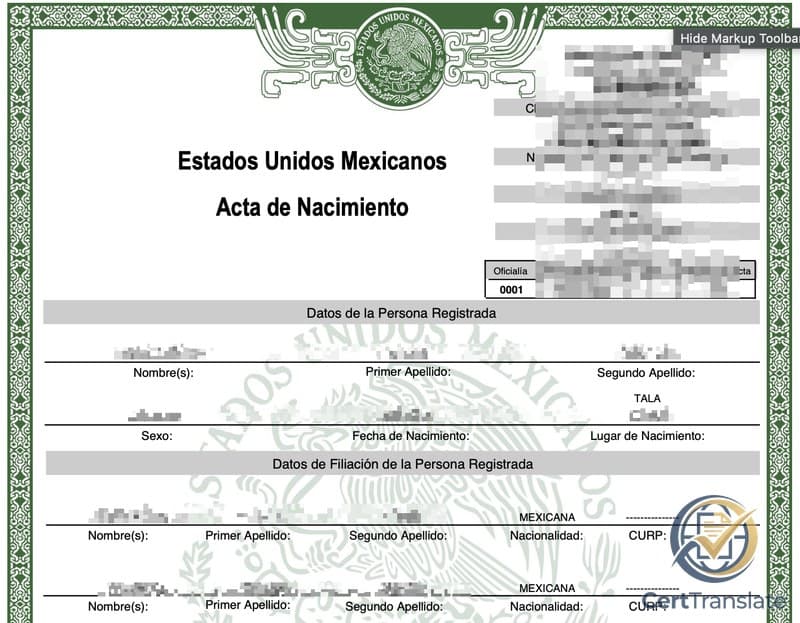
A client submitted a Mexican acta de nacimiento (birth certificate) issued in the state of Jalisco. It was a digital acta — the modern electronic version with an Electronic Identifier and an Advanced Electronic Signature. The client asked us to translate only the first page and to skip the second as 'just the back.'
The order was a two-sided Spanish acta de nacimiento translation for a USCIS filing. A standard certified birth certificate translation has to reproduce the whole document. So the 'back' needed a closer look before anything was dropped.
Why the Reverse Side Mattered
USCIS asks for a complete English translation of the entire foreign document. The rule covers everything on the page — seals, stamps, and the reverse side. A page that looks decorative can still carry information an adjudicator expects to see translated.
On a Mexican digital acta, the second page is not a blank back. It is the validation page. It identifies the federal authorities behind the record and carries the QR codes used to verify the document online. Treating it as throwaway risks an incomplete certified copy. For the underlying rules, see our acta de nacimiento translation guide and the USCIS document translation requirements.
How We Handled It
We translated both pages in full. On the reverse side, we rendered the names of the issuing authorities and kept each Spanish acronym on first mention. These are the Secretaría de Gobernación (SEGOB), the National Population and Identity Registry (RENAPO), and the National Council of Civil Registry Officials (CONAFREC).
We described the non-text elements in brackets. The national emblem and the Jalisco state coat of arms were marked as seals. The two government validation QR codes were marked as [QR Code], with a short note on what each one points to. We did not reproduce the personal identifier encoded in the QR.
We added a Translator’s Note so an adjudicator understands the document is two-sided and nothing was left out:
"This birth certificate is a two-sided Mexican digital acta de nacimiento. The reverse side carries the issuing authorities' identification — the Secretaría de Gobernación (SEGOB), the National Population and Identity Registry (RENAPO), and the National Council of Civil Registry Officials (CONAFREC) — together with the state coat of arms and two government validation QR codes. All visible text on both sides has been translated. The emblems, seals, and QR codes are described in brackets. No content was omitted."

The Outcome
We delivered a complete certified translation covering both pages of the acta, ready for the client's USCIS filing. The certification statement confirms the translation is complete and accurate.
We translate both sides of every Mexican digital acta as standard. When the reverse carries authority identification or validation codes, it belongs in the certified copy.
What This Means for You
The back of a Mexican birth certificate is rarely blank. On a digital acta de nacimiento, the reverse side is the official validation page, and a complete certified translation includes it. If you are filing with USCIS, send both sides of the document to your translator. See our Spanish translation services for related civil-record work.
Have a similar situation?
We translate Mexican civil records — actas de nacimiento, matrimonio, and defunción — into English for USCIS. Digital actas are handled in full, both sides: the front record and the reverse validation page, with issuing-authority names rendered, emblems and seals described, and QR codes marked. $24.95/page, delivered in 24 hours.
Related Cases & Resources
Sources & References
- 8 CFR 103.2(b)(3) — Submitting documents in a foreign language·U.S. Government Publishing Office (eCFR)·Verified 2026-07-28
Explore the Hub
Certified Translation
Documents
Languages
Immigration
All identifying information has been removed from this case study. The holder's full name, CURP, Electronic Identifier, verification code, and signatures are not displayed, and no document image is shown. Case details are shared with client permission.