




How do you translate 'Licenciado' on a Mexican notarial document — 'Licentiate' or 'Attorney'?
TL;DRA Mexican notarial cotejo from Notaría Pública No. 44 of Quintana Roo certified a photocopy of a U.S. passport. The notary's title 'Licenciado' marks a Licenciatura en Derecho — an attorney, not a 'Licentiate'. We translated it as 'Attorney' / 'Atty.' on the signature line and inside the notary seal, kept the cotejo's scope clear (the copy is certified, not the passport content), and added a Translator's Note. The translation was delivered for the client's USCIS filing.
Case Specifications
- Document
- Notarial passport certification (cotejo)
- Foreign Name
- Certificación de Pasaporte
- Country
- Mexico
- Languages
- Spanish → English
- Submitted To
- USCIS
What We Received
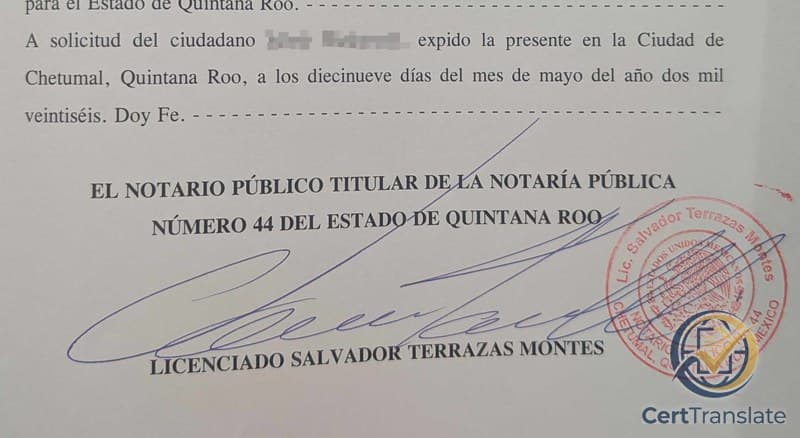
A client submitted a single-page Mexican notarial 'Certificación de Pasaporte' from Notaría Pública No. 44 of Quintana Roo. The document is a cotejo — a notarial act certifying that the photocopy is a faithful reproduction of the original. The notary's name appears twice on the page: above his signature, and inside the round red notary seal. Both times it is prefixed with 'Licenciado' (abbreviated 'Lic.'). The cotejo accompanied the client's <a href="/translate/spanish-passport">Mexican notarial passport-copy translation</a> packet for a USCIS filing.
Why This Required Special Handling
In Mexican usage, 'Licenciado' before a notary's name marks a Licenciatura en Derecho — a Bachelor of Laws. A Mexican notario público is a lawyer with a state appointment under the Notary Law. The English cognate 'Licentiate' is archaic and rarely used. A USCIS officer who reads 'Licentiate Salvador Terrazas Montes' has no signal that the notary is legally trained.
The cotejo's scope also has to stay clear. A Mexican notarial cotejo certifies that the photocopy faithfully reproduces an original. It does not authenticate the passport's underlying content. A translation that blurs this scope risks the USCIS reader treating the cotejo as if it vouched for the passport itself. See our <a href="/guides/certified-vs-notarized">certified vs. notarized translation guide</a> for the same distinction in U.S. practice.
Finally, the document uses several Mexican notarial register markers — 'Hago constar', 'Doy fe', 'fiel reproducción', 'foja útil', and dashed line-fillers. Each has a standard English rendering and a common amateur mis-rendering. A USCIS officer benefits from a translation that uses the standard form.
How We Handled It
We translated 'Licenciado Salvador Terrazas Montes' as 'Attorney Salvador Terrazas Montes' under the signature. We then mirrored the same rendering inside the round red notary seal. 'Lic. Salvador Terrazas Montes — Estados Unidos Mexicanos — Notario Público No. 44 — Chetumal, Quintana Roo, México' became 'Atty. Salvador Terrazas Montes — United Mexican States — Notary Public No. 44 — Chetumal, Quintana Roo, Mexico'. Both occurrences were treated consistently — a USCIS reader does not see one title on the signature and a different one inside the seal.
We kept the cotejo's scope explicit. The body certifies that the photocopy is 'a faithful reproduction of its original'; we translated this verbatim. A Translator's Note describes what a Mexican notarial cotejo actually authenticates. The note is short, factual, and tied to the article of the Quintana Roo Notary Law cited in the original (Article 82, Section I). The client's separately translated U.S. passport copy travels with the cotejo as part of the same <a href="/documents/passport">certified passport translation</a> packet.
We translated the Mexican notarial register in standard form. 'Hago constar' became 'I hereby certify'. 'Doy fe' became 'I so attest'. 'Foja útil' became 'one (1) sheet', not the calque 'one useful page'. The dashed line-fillers were preserved — they exist to prevent later additions. A Translator's Note explains the convention. The signature was marked '[Illegible signature]' rather than guessed at from context.
"The Spanish title 'Licenciado' (abbreviated 'Lic.') before the notary's name marks a Licenciatura en Derecho — the Mexican law degree required to hold a state notarial appointment — and is the standard form of address for an attorney in Mexico. It has been rendered as 'Attorney' / 'Atty.' to match U.S. usage, on both the signature line and inside the round notary seal. The document is a notarial cotejo (Article 82, Section I of the Quintana Roo Notary Law cited in the original): it certifies that the photocopy is a faithful reproduction of an original the notary had in view, and does not authenticate the passport's underlying content. The dashed line-fillers running to the end of short lines in the original are a Mexican notarial convention used to prevent later additions to the act; they have been preserved. Spelled-out numbers ('cinco mil trescientos sesenta y nueve' = 5,369; 'diecinueve de mayo del año dos mil veintiséis' = May 19, 2026) have been kept spelled-out as in the original, with their numeric equivalents noted in this Translator's Note for the reader's convenience. The handwritten signature above the printed name was not legible and has been marked '[Illegible signature]'."

The Outcome
The certified translation was delivered to the client as a DOCX and a PDF. The Translator's Certification page covers competence, completeness, and the title-rendering note. The title reads as 'Attorney' under the signature and 'Atty.' inside the seal — a USCIS officer reading either part of the page gets the same signal.
We have used the same approach on every Mexican notarial cotejo since 2024 — passports, birth, marriage, school records — without an RFE on the title-rendering question.
What This Means for You
If your Mexican notarial document carries the title 'Licenciado' or 'Lic.' before the notary's name, the correct U.S. rendering is 'Attorney' / 'Atty.', not 'Licentiate'. The same applies inside the round notary seal — both occurrences should be translated consistently. A short Translator's Note on the title and the cotejo's scope lets a USCIS reader place the document without guessing. See our <a href="/guides/uscis-translation-requirements">USCIS translation requirements guide</a> for the broader completeness rules.
Have a similar situation?
We translate Mexican notarial documents — cotejos, notarial copies of passports and IDs, escrituras, poderes — with the Mexican notarial register and title conventions handled the way USCIS and U.S. state agencies expect.
Related Cases & Resources
Sources & References
- Meet Translation Requirements·USCIS·Verified 2026-07-13
- Ley del Notariado para el Estado de Quintana Roo·Justia México·Verified 2026-07-13
Explore the Hub
Certified Translation
Documents
Languages
Immigration
Accepted By
All identifying information has been removed from document images. Case details are shared with client permission. No personal data is stored or displayed on this page.