




What do you do when a Japanese family register shows a name that was officially corrected?
TL;DRA Japanese koseki (family register, 個人事項証明 / Certificate of Individual Matters) recorded the registrant's mother under a prior name and a later corrected name, linked by an official correction entry (更正). Japan issues no separate birth certificate, so the koseki is the birth record. We translated each revision, correction, and prior-record entry with its date, converted the Japanese era dates to Gregorian, and added a Translator's Note. The certified translation was delivered for the client's USCIS filing.
Case Specifications
- Document
- Family register (Koseki)
- Foreign Name
- 個人事項証明 (Koseki — Certificate of Individual Matters)
- Country
- Japan
- Languages
- Japanese → English
- Submitted To
- USCIS
What We Received
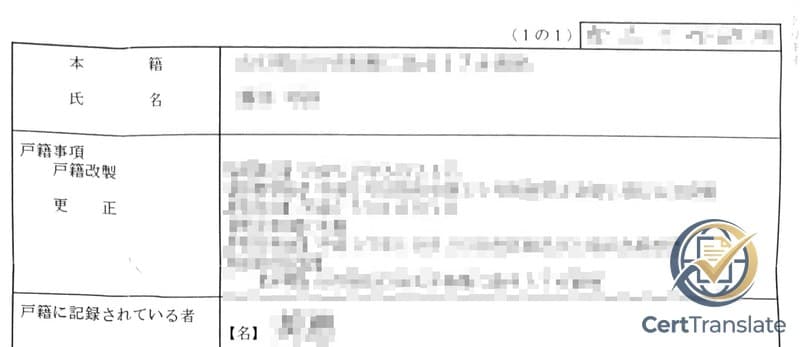
A client submitted a Japanese koseki (戸籍) — specifically a 個人事項証明 (Certificate of Individual Matters), a single-person extract from the family register. Japan does not issue a standalone birth certificate. The koseki is the official record of a person's birth, parents, and family events, so this extract served as the birth record for the client's <a href="/immigration/uscis">USCIS filing</a>.
The extract listed the registrant's birth entry, parents, parental-authority record, and the register events for that one person. It also recorded the mother under two forms of her name. An earlier entry showed a prior name. A later correction entry (更正) replaced it with the current one. We provide <a href="/documents/koseki-tohon">certified translation of a Japanese family register</a> for exactly these documents.
Why Two Names on One Register Is Not a Discrepancy
USCIS expects every name in a translated document to match the applicant's other records. A koseki that shows the mother under two names can look like a discrepancy. It is not — the register is recording its own correction history.
A naive translation creates two risks. Drop the correction and prior-record entries, and the basis for the change disappears; show both names without labeling the correction, and an adjudicator may issue a Request for Evidence. Our <a href="/guides/name-mismatch-guide">name mismatch guide</a> covers the cross-document version of this problem.
How We Handled It
We translated every entry on the register, not just the current values. The register revision (改製), the address correction, and the mother's name correction (更正) were each rendered with their item, reason, and date. Under each correction we translated the previous record (従前の記録) exactly as written, so the earlier and current forms both appear, clearly labeled.
The registrant's own birth entry — date, place of birth, the notifying parent, and the accepting municipal office — was translated field by field. We converted the Japanese era dates to the Western calendar and kept the era name in parentheses. This covered the Showa-era birth date and the Heisei-era correction dates. The square municipal seal appears in black on the monochrome copy. We rendered it as a bracketed [STAMP] note, and we handle records like this across our <a href="/languages/japanese">Japanese translation</a> work.
"The mother's name appears in two forms because the family register records an official correction (更正). The prior name is shown under the previous-record entry (従前の記録), and the current name is the corrected entry. Japan issues no separate birth certificate; this Certificate of Individual Matters is an extract of the family register (koseki)."

The Outcome
The certified translation was delivered for the client's USCIS filing. The two forms of the mother's name read as what they are — an official recorded correction, with the prior name and its replacement both visible and dated.
We handle Japanese koseki extracts regularly, including registers that carry revisions, corrections, and prior-record entries. The approach is the same each time: translate every entry with its date, label the correction structure, and meet <a href="/immigration/uscis">USCIS translation requirements</a>.
What This Means for You
A name that changes on a Japanese family register is usually an official correction, not a mistake. If your koseki shows a parent under two names, a certified translation that renders every correction and previous-record entry — with dates and a clear Translator's Note — shows USCIS the change is part of the official record.
Have a similar situation?
We translate Japanese koseki extracts — Certificates of Individual Matters and All Matters — including registers with revisions, corrections, and prior-record entries, regularly.
Related Cases & Resources
Sources & References
- Meet Translation Requirements·USCIS·Verified 2026-07-20
Explore the Hub
Guides
Documents
Languages
Immigration
Accepted By
All identifying information has been removed. Case details are shared with client permission. No personal data is stored or displayed on this page.