




How do you translate a Spanish form that prints both the masculine and feminine ending on every field?
TL;DRAn Argentine marriage certificate (acta de matrimonio) from Buenos Aires pre-printed both gender endings on every status and relationship field — Soltero/a, Divorciado/a, Hijo/a de. The acta records a marriage between two men. We resolved each field to the correct gender, rendering every "Hijo/a de" as "Son of," and added a Translator's Note about the convention. The certified translation was delivered for the couple's USCIS filing.
Case Specifications
- Document
- Marriage certificate
- Foreign Name
- Acta de Matrimonio
- Country
- Argentina
- Languages
- Spanish → English
- Submitted To
- USCIS
What We Received
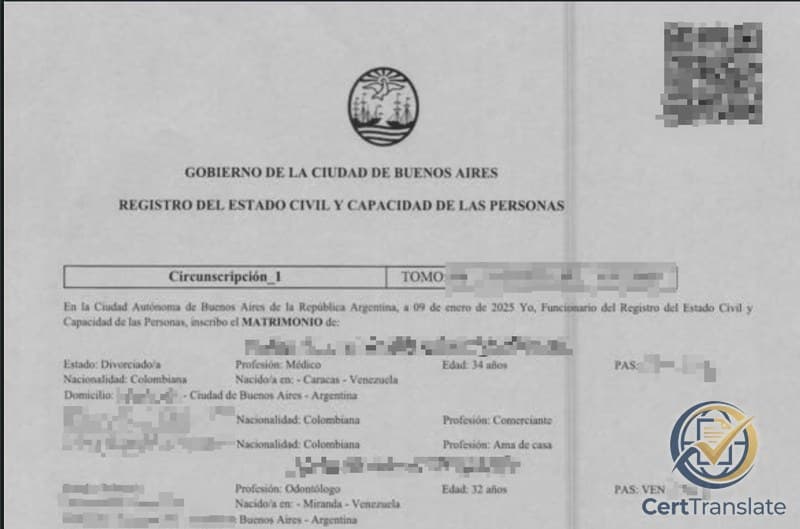
A client sent an Argentine marriage certificate (acta de matrimonio) from the Buenos Aires civil registry. The pre-printed form shows both gender endings on every field: Estado: Soltero/a, Divorciado/a; Hijo/a de; Nacido/a en. The acta records a marriage between two men.
The same combined endings repeat for the two witnesses near the bottom of the page. Each witness has an Estado: Soltero/a line of their own. So the convention runs through the whole form, not only the spouses' blocks.
The blank form does not pick a gender. It prints both endings, and the registrar's entry decides which one applies. The <a href="/documents/marriage-certificate">certified Argentine marriage certificate translation</a> was needed for the couple's <a href="/immigration/uscis">USCIS filing</a>.
Why Both Gender Endings Are a Translation Problem
A blank Spanish civil-registry form is gender-neutral by design. It prints both endings — Soltero/a means "single," Hijo/a de means "son/daughter of" — and the registry entry decides which one is true.
A literal English copy would read "Son/Daughter of" on every parent line. That looks unresolved, and USCIS expects a clean, complete English rendering (see our <a href="/guides/uscis-translation-requirements">USCIS translation requirements</a>).
The trap is the husband-and-wife assumption. This acta records two grooms. So every "Hijo/a de" resolves to "Son of," and the two prior-status fields resolve independently — one "Divorced," one "Single."
Names and roles also have to stay consistent across the filing. A field left as "Son/Daughter of" forces an adjudicator to guess. A certified translation should remove that guesswork, not add it.
How We Handled It
We read each field against the person it described and resolved the ending to one gender. For the spouses, "Estado: Soltero/a" became "Marital Status: Single" for one and "Divorciado/a" became "Divorced" for the other.
Every parent line — "Hijo/a de" — became "Son of," because both spouses are men. We did not copy the slash forms into English. We also did not invent a gender the record did not support.
We resolved the witness fields the same way, each against the witness named on that line. Where a field was not obvious from the entry alone, we checked it against the given name and the rest of the record. Nothing was left to assumption.
We added a short Translator's Note so the reader understands the source form, not just the result:
"The original is a pre-printed civil-registry form that displays combined masculine/feminine endings on its fields (e.g., Soltero/a, Hijo/a de). Each field has been rendered in the gender that applies to the named individual, as recorded in the document. No information has been added or omitted."

The Outcome
The certified translation was delivered for the couple's USCIS filing. Every field was rendered in a single, correct gender, and the combined-ending convention was documented in the note.
We see combined-ending fields on Spanish-language civil-registry documents regularly. We resolve them with the same method every time, whether the record is a marriage, birth, or death certificate.
We translate Spanish civil-registry documents from Argentina and across Latin America the same way — the same standard behind all our <a href="/translate/spanish-marriage-certificate">Spanish marriage certificate translation</a> work.
What This Means for You
Combined gender endings on a Spanish form are a feature of the blank document, not a mistake to correct. If your Argentine or Latin American certificate shows Soltero/a, Hijo/a de, or Nacido/a en, a certified translation can resolve each field to the right gender and note the convention. You do not need to alter the original — the translation handles it.
Have a similar situation?
We translate Argentine and Latin American civil-registry documents — marriage, birth, and death certificates — resolving combined gender-ending fields and keeping every seal, signature, and file number intact.
Related Cases & Resources
Sources & References
- Meet Translation Requirements·USCIS·Verified 2026-07-28
Explore the Hub
Certified Translation
Documents
Languages
Immigration
All identifying information has been removed from document images. Case details are shared with client permission. No personal data is stored or displayed on this page.