




What should you do if a Hague apostille was sent to you on its own, without the public document it certifies?
TL;DRA client sent us a Spain-issued Hague Apostille to translate for a U.S. visa filing, but the underlying public document the apostille authenticates was not included. We translated the apostille as a self-contained certified Spanish apostille translation and added a Translator's Note stating that no underlying document accompanied it. We delivered the file within 24 hours and notified the client that the underlying record also needs to be translated before the visa filing is complete.
Case Specifications
- Document
- Hague Apostille (standalone)
- Foreign Name
- Apostille — Convention de La Haye du 5 Octobre 1961
- Country
- Spain
- Languages
- Spanish → English
- Submitted To
- U.S. consular visa application
What We Received
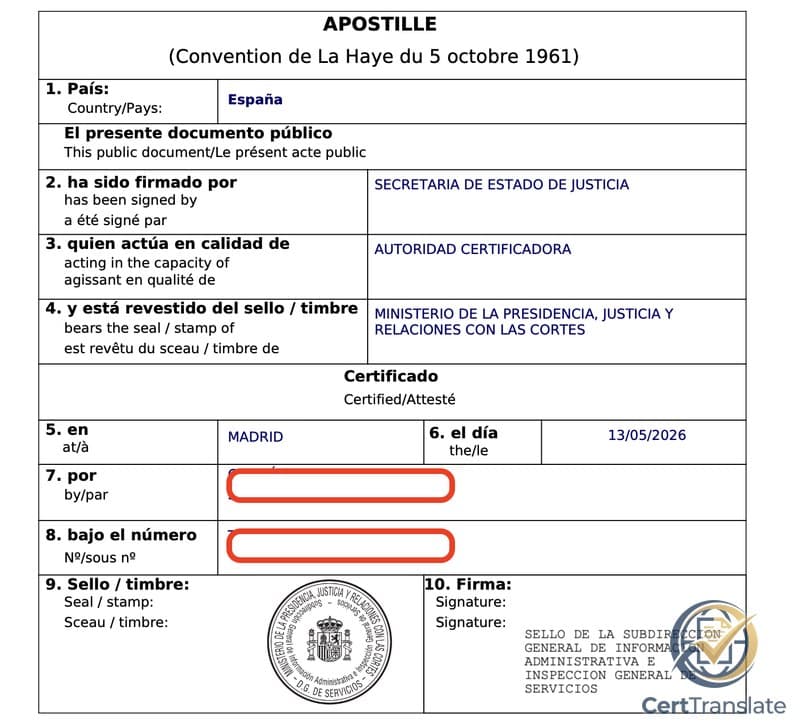
A client submitted one file for certified Spanish translation: a single-page Hague Apostille (Apostille — Convention de La Haye du 5 Octobre 1961) issued in Madrid on 13/05/2026 under reference TLMAC/2026/018462. The apostille was signed electronically by the Subdirectora General of the Subdirectorate General of Administrative Information and General Inspection of Services of the Ministerio de la Presidencia, Justicia y Relaciones con las Cortes.
The apostille bore the standard ten numbered Hague fields, an electronic seal of the Ministry, two printed verification codes (AD:zg24-yHhh-fqHT-bBX8 and RG:A&Db-zeV6-j7$Z-hEm$), and a QR code linking to the Ministry's eRegister portal. The client's brief stated the translation was needed to apply for a U.S. visa.
No other document accompanied the apostille in the submission. The file metadata implied the underlying record was a marriage certificate, but the marriage certificate itself was not in the packet.
Why This Required Special Handling
Under the Hague Apostille Convention of 5 October 1961, an apostille authenticates the signature, capacity, and seal of a specific underlying public document. The apostille is not a record in its own right — it is an authentication wrapper around another document. Without that underlying document, the apostille has no authentication target visible to the receiving authority.
In the Spanish electronic-apostille (TLMAC) system the issue is easy to miss. Each apostille looks formally complete on its own page: it has its own reference number, electronic seal, two verification codes, and a QR. A non-specialist client who sees that may reasonably assume the apostille is the document. It is not. The codes on the Ministry's eRegister portal resolve back to one specific underlying public document — so the apostille declares that a document exists, but does not show what it says.
For a U.S. consular visa filing, the consular officer will normally want to see both the underlying foreign-language record (here, a Spanish marriage certificate) and its English translation. Translating only the apostille addresses the wrapper, not the record. A certified translation that quietly papered over the gap — by, for example, describing the apostille as if it were the marriage certificate — would be wrong. So would a translation that simply ignored the question.
How We Handled It
We produced a certified translation of the apostille as a self-contained one-page document, mirroring the original Hague layout exactly: ten numbered fields with their Spanish / English / French sub-labels preserved, both verification codes reproduced character-for-character, electronic-signature notation in brackets, the electronic Ministry seal described in brackets with its full inscription, and the QR-code presence noted.
The Translator's Certification block carried three numbered Translator's Notes. The first stated explicitly that the apostille is a Hague authentication and that the underlying public document was not provided for translation along with it. The second recorded the DD/MM/YYYY → Month DD, YYYY date conversion (13/05/2026 → May 13, 2026). The third noted that the document is electronically signed and that the apostille's authenticity can be independently verified by the receiving authority using the printed codes on the Spanish Ministry's eRegister portal.
Separately, we sent the client a short note in writing — outside the certified translation file itself — explaining that the apostille on its own does not satisfy a U.S. consular filing, and that the underlying public document the apostille authenticates needs to be obtained from the issuing authority and translated before the visa application is submitted. The translation of the apostille remains valid and reusable; the certification scope makes clear what it does and does not cover.
"1. The original document is a single-page Hague Convention apostille (Apostille — Convention de La Haye du 5 Octobre 1961) issued by the Subdirectorate General of Administrative Information and General Inspection of Services of the Ministry of the Presidency, Justice and Relations with the Cortes (Madrid, Spain). The apostille certifies the signature, capacity, and seal of a separate public document; that underlying public document was not provided for translation together with this apostille. 2. The date 13/05/2026 in field 6 is in DD/MM/YYYY format and has been rendered as May 13, 2026 in this translation. 3. The original document is electronically signed; the signature field bears a notation describing the official electronic seal rather than a handwritten signature. The apostille's authenticity can be verified by the receiving authority on the Spanish Ministry's eRegister portal (https://sede.mjusticia.gob.es/eregister) using the printed verification codes (AD: and RG:)."

Standard handling rules applied throughout: every form value present in the original was translated, including the seal text and the field-6 date; the Hague-standard trilingual labels (Spanish / English / French) were preserved rather than overwritten, in line with the precedent we set in translating a trilingual Spanish apostille; and the QR code and the Spanish coat of arms were noted in brackets at their approximate positions, with no attempt to reproduce them graphically. The certified translation was bound to a CertTranslate certification page naming source language (Spanish), target language (English), and the source as a one-page original — accurate to what was actually filed, not to a packet that did not arrive.
The Outcome
The certified translation of the apostille was delivered within 24 hours. The Translator's Note makes the scope of the translation explicit, so a U.S. consular officer reading the file sees a translation of an apostille — not a translation of an unprovided underlying record. The verification-code reference lets the officer (or the client's immigration attorney) verify the apostille's authenticity independently on the Spanish Ministry's eRegister portal.
We applied the same approach on every Spain-issued apostille that has arrived standalone since 2024: translate the apostille as a self-contained one-page certified file, document the missing-document gap in the certification block, and notify the client in writing that the underlying record also needs to be obtained and translated. None of those translations has been the cause of a U.S. consular or USCIS follow-up.
What This Means for You
A Hague Apostille is an authentication of another document, not a standalone certificate. If you have only the apostille page and not the underlying public document — the marriage certificate, birth certificate, criminal record, court order, or notarial deed it certifies — a translation of the apostille alone will not be enough for a U.S. visa filing. Request the underlying record from the issuing authority and have both translated together. If you are unsure what document the apostille authenticates, the verification codes printed on the apostille usually let you look it up on the issuing country's apostille registry portal.
Have a similar situation?
We translate Spain-issued Hague apostilles, along with the marriage, birth, criminal-record, and notarial documents they authenticate, for U.S. consular visa filings and USCIS cases regularly.
Related Cases & Resources
Sources & References
- Convention of 5 October 1961 Abolishing the Requirement of Legalisation for Foreign Public Documents·Hague Conference on Private International Law (HCCH)·Verified 2026-06-29
- eRegister — Verification of Apostilles Issued by Spain·Ministerio de la Presidencia, Justicia y Relaciones con las Cortes (Spain)·Verified 2026-06-29
- Meet Translation Requirements·USCIS·Verified 2026-06-29
Explore the Hub
Certified Translation
Documents
Languages
Immigration
Accepted By
All identifying information has been removed from document images and from the case description. Case details are shared with client permission. No personal data is stored or displayed on this page.