




What does 'digo' mean on a handwritten Brazilian birth certificate, and how should it be translated?
TL;DRA 1964 handwritten Brazilian birth certificate from the 17.º Subdistrito - Bela Vista cartório in São Paulo opened with 'Talão 929 IMPAR, digo Talão 929 par' — a registrar's inline self-correction using the Portuguese formula 'digo' (literally 'I say') in place of a strikethrough. We rendered the corrected value 'Stub 929 EVEN' and marked the formula as 'digo (correction)', then added a Translator's Note explaining the cartório convention. The certified translation was delivered for the client's USCIS filing.
Case Specifications
- Document
- Birth certificate
- Foreign Name
- Certidão de Nascimento
- Country
- Brazil
- Languages
- Portuguese → English
- Submitted To
- USCIS
What We Received
A client submitted a Brazilian birth certificate (Certidão de Nascimento) issued in April 1964 by the 17.º Subdistrito - Bela Vista cartório (Município e Comarca da Capital do Estado de São Paulo). The document is a pre-printed form with the substantive content — registration entry, parents' names, grandparents' names, time and place of birth, declarant — handwritten in dense cursive by the registrar.
The first line of the entry block reads 'Talão 929 IMPAR, digo Talão 929 par'. The registrar wrote 'Stub 929 ODD', then immediately corrected the value to 'Stub 929 EVEN' inline, using the Portuguese formula 'digo' — literally 'I say' — in place of a strikethrough. The corrected wording is the operative one.
The lower portion of the form carries a stack of stamps and seals — a round Civil Registry seal in the upper right, a printed cartório block and a notary instruction stamp on the lower left, an authorized-clerk authentication stamp in the lower center, and a printed stamp-duty-exemption box on the lower right citing Decreto nº 4857 of November 9, 1939. A handwritten reference written vertically along the right margin is partially illegible. The certified birth certificate translation was needed for a USCIS filing.
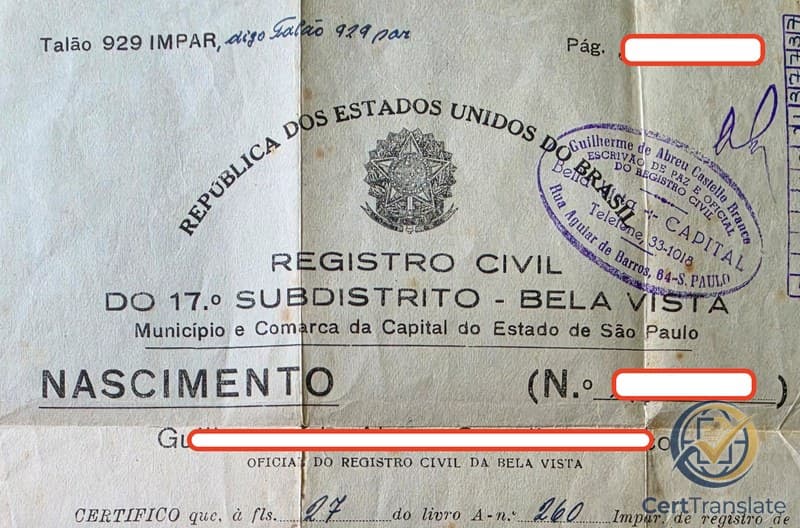
Why This Required Special Handling
The Portuguese formula 'digo' is a 19th- and 20th-century Brazilian cartório convention: when a clerk writing a registry entry by hand catches an error mid-sentence, the standard practice is to write the original word, follow it with 'digo' (literally 'I say'), and then write the corrected word — leaving the original visible rather than striking it through. The original wording, the formula, and the corrected wording all become part of the certified record. Modern Brazilian registries no longer use it; mid-century cartório books are full of it.
A literal English rendering as 'I say' reads as if the registrar interrupts the certified entry to speak — confusing to a USCIS adjudicator reviewing the translation and unrecognizable as the correction marker that it is. Dropping the formula and rendering only the corrected value silently strips a substantive element from the original — exactly the kind of editing that USCIS translation rules (see our USCIS translation requirements guide) prohibit.
The same document also presented the common challenges of a 62-year-old handwritten cursive form filled across pre-printed blank lines: ambiguous accents on personal names (Luís vs. Luis), multiple overlapping stamps in the lower portion that needed location markers so a reviewer could match each one to a specific area of the source, and a vertical right-margin annotation partially obscured by paper folds.
How We Handled It
We rendered the corrected value inline and marked the formula explicitly. The line 'Talão 929 IMPAR, digo Talão 929 par' was translated as 'Stub 929 ODD, digo (correction): Stub 929 EVEN' — the corrected value remains the operative wording, the original ODD is preserved exactly as in the source, and the parenthetical '(correction)' tells a US reviewer that 'digo' is functioning as a strikethrough marker, not as the registrar's dialogue.
We restored the acute accent on the first name ('Luís', not 'Luis') consistent with Brazilian-Portuguese orthography. The lower-portion stamps were rendered with explicit location markers — '[ROUND STAMP (upper right): ...]', '[PRINTED STAMPS (lower left): (1) ... (2) ...]', '[STAMP (lower center): ...]', '[FRAMED BOX (lower right): ...]' — so a USCIS adjudicator can map each transcription to the position it occupies on the source.
The decree date in the stamp-duty-exemption box, written as '9-11-1939' on the source, was rendered as 'November 9, 1939' in the body of the translation, with the date-format conversion documented in a Translator's Note. The vertical right-margin annotation was marked as '[Handwritten notation in right margin (vertical, partially illegible)]' rather than a guessed transcription.
"The page header of the original reads 'Talão 929 IMPAR, digo Talão 929 par' — 'Stub 929 ODD' followed by an inline correction to 'Stub 929 EVEN' by the registrar. The Portuguese word 'digo' (literally 'I say') is a standard handwritten-Brazilian-cartório formula used to introduce a correction in place of a strikethrough; it is reproduced in the translation followed by the parenthetical '(correction)' so the marker is unmistakable. The original Portuguese phrasing is preserved exactly, and the corrected value 'Stub 929 EVEN' is the operative wording on the source."

Five additional Translator's Notes accompanied the certification block: one documenting the DD-MM-YYYY → Month DD, YYYY date conversion (e.g. '2 de abril de 1964' → 'April 2, 1964', and the decree's '9-11-1939' → 'November 9, 1939'); one identifying 'D.' before a woman's name as the courtesy abbreviation 'Dona' (rendered as 'Mrs.') and 'branca' as the period-appropriate skin-color/race field (rendered as 'white'); one identifying 'Maternidade S. F. Matarazzo' as the São Francisco Matarazzo Maternity Hospital in São Paulo (abbreviated form retained as in the original); one marking the registrar's handwritten signature as '[Illegible signature]' (a stylized rubric without a legible name); and one noting that the final digit of the printed stub page number 'Pág. Nº 000050' is partially obscured by ink bleed, with the most plausible reading retained.
The Outcome
The certified translation was delivered to the client for inclusion in their USCIS filing. The 'digo (correction)' inline marker, the bracketed stamp-location notes, and six Translator's Notes give a USCIS adjudicator full visibility into every editorial decision — including which value on the top line is operative and why a 1964 Portuguese formula appears in an English certified text.
We have applied the same 'digo (correction)' rendering and Translator's Note treatment to other mid-century Brazilian cartório records since 2024 — birth, marriage, and death certificates issued before electronic record-keeping became standard. The convention is rare enough in modern translation work that documenting it on the certification page is the difference between a clean filing and an adjudicator's question.
What This Means for You
A handwritten Brazilian cartório record from the mid-20th century may contain the inline correction formula 'digo' — literally 'I say' — placed between an original and a corrected wording instead of a strikethrough. A certified translation that preserves the original wording, marks the formula as '(correction)', and documents the cartório convention in a Translator's Note gives a USCIS adjudicator the context to identify the operative value without treating the line as ambiguous. If you are translating any Brazilian civil-registry document issued before about 1980, expect the translator to flag this convention specifically rather than render the formula word-for-word.
Have a similar situation?
We translate mid-century Brazilian cartório records — birth, marriage, and death certificates with handwritten cursive entries and scribal conventions like "digo" — regularly.
Related Cases & Resources
Sources & References
- Meet Translation Requirements·USCIS·Verified 2026-07-02
- Decreto-Lei nº 4.857 de 9 de novembro de 1939 — Registros Públicos·Presidência da República — Casa Civil·Verified 2026-07-02
Explore the Hub
Certified Translation
Documents
Languages
Immigration
Accepted By
All identifying information has been removed from document images. Case details are shared with client permission. No personal data is stored or displayed on this page.