




What do you do when a bilingual Soviet birth certificate has Russian and Ukrainian printed on every field?
TL;DRA 1986 Soviet-era birth certificate booklet (свидетельство о рождении / свідоцтво про народження) issued in the Ukrainian SSR carried every printed form label in both Russian and Ukrainian on parallel lines, with the handwritten content filled in Russian only. We rendered each label once in English — since both languages map to the same English term — preserved the holder's, parents', and registry data exactly as written, and added a Translator's Note identifying the bilingual structure so the USCIS adjudicator could see the original was a single record, not two.
Case Specifications
- Document
- Birth certificate
- Foreign Name
- Свидетельство о рождении / Свідоцтво про народження
- Country
- Soviet Union (Ukrainian SSR)
- Languages
- Russian, Ukrainian → English
- Submitted To
- USCIS
What We Received
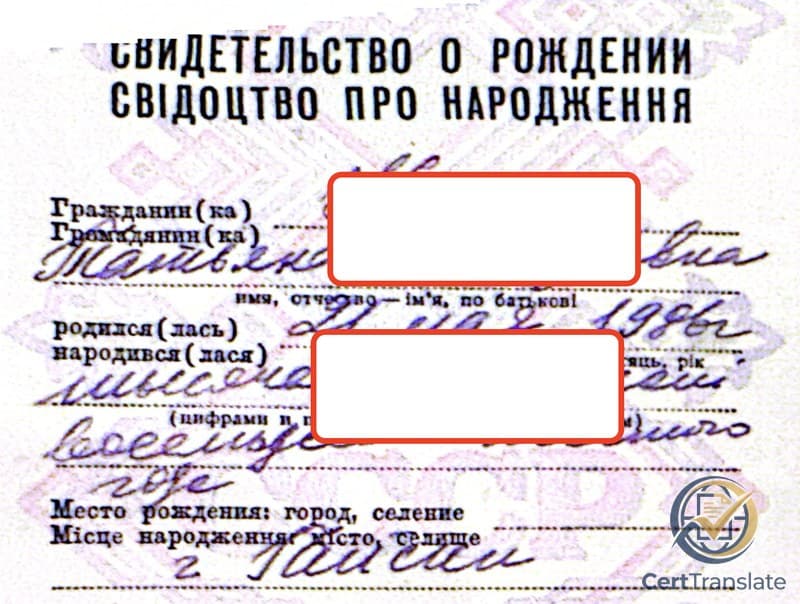
A client submitted a Soviet-era birth certificate (свидетельство о рождении / свідоцтво про народження) issued in 1986 in the Ukrainian SSR — Vinnytsia Oblast region. The document is the standard USSR civil-status booklet of the period: a horizontal two-page spread with an ornamented border, official paper-grade watermark, a round purple ink stamp from the local registry office, the registrar's signature, and a typewriter-printed certificate series and number.
What is unusual about the form is its layout. Every printed field label appears twice on parallel lines: the Russian-language version above, the Ukrainian-language version below — for example, <code>Гражданин(ка)</code> / <code>Громадянин(ка)</code> (Citizen), <code>родился(лась)</code> / <code>народився(лася)</code> (was born), <code>область, край</code> / <code>область, край</code> (region). The handwritten content — citizen's surname, given name and patronymic, date of birth in figures and again in words, place of birth, parents' names and ethnic nationalities, registration place and date — was entered in Russian only, in continuous cursive across the bilingual label rows. The <a href="/documents/birth-certificate">certified birth certificate translation</a> was needed for the client's <a href="/immigration/uscis">USCIS filing</a>.
Why a Word-for-Word Translation of the Form Doesn't Work
A bilingual Soviet form is not actually two documents. The Russian and Ukrainian label rows are saying the same thing in two languages — both <code>Гражданин(ка)</code> and <code>Громадянин(ка)</code> translate to "Citizen" in English. A word-for-word reproduction that shows "Citizen / Citizen", "Was born / Was born", "Region / Region" reads as either a translator's error or a sign that the original is somehow contradictory. Neither is the case, but a USCIS adjudicator who has not seen this form before has no way to know that.
The opposite mistake — translating only the Russian line and silently dropping the Ukrainian one (or vice versa) — fails the requirement that <a href="/guides/what-is-certified-translation">a certified translation be complete and accurate</a>. Every word printed on the document must be accounted for. There is also a tendency, especially with non-Slavic translators, to render the bilingual rows as a parallel English column ("Citizen | Citizen") to mirror the original, which doubles the page count and obscures the actual content. None of these approaches gives the receiving authority what it actually needs: a clean, single-language English rendering of a single bilingual record.
How We Handled It
We rendered each form-field label once in English on a single line — "Citizen — Surname:", "Date of birth (in figures):", "Region:" — followed by the value as written by the registrar. This works because Russian and Ukrainian, despite their distinct identity, share the same legal-bureaucratic terminology for civil-status fields, and both label rows on the original map to one English term. We then matched the handwritten content (in Russian) field-by-field: the citizen's name and patronymic, the date of birth in figures (May 21, 1986) and again in words ("one thousand nine hundred and eighty-six"), the place of birth, the district, the region (Vinnytsia Oblast), the republic (Ukrainian SSR), the registration entry number and date, the parents' surnames, given names, patronymics, and ethnic nationalities ("Ukrainian" for the father, "Russian" for the mother), the issuing registry office, the date of issuance, and the certificate's series and number.
Two parallel decisions kept the translation defensible. The handwritten place-of-birth entry — a town name in cursive — was not clearly legible in the available scan; we marked it <code>[Town name partially illegible]</code> at both occurrences in the body and recorded the issue in a separate Translator's Note rather than guessing at the spelling. A later handwritten annotation in different ink at the bottom of the certificate (apparently added in 1994 — the kind of post-issuance marriage or name-change reference that registry clerks routinely add to Soviet civil-status booklets, similar to the <a href="/cases/handwritten-margin-annotation-ukrainian-birth-certificate">handwritten passport annotations we see on later Ukrainian booklets</a>) was reproduced in the same position as on the original and labeled as a partially illegible later addition.
"The original is a Soviet-era bilingual birth certificate (Russian and Ukrainian); the printed form labels appear in both languages on parallel lines, and the translation renders the substantive content once in English."

The Outcome
The certified translation was delivered to the client and forwarded with their USCIS packet. The bilingual label structure was no longer visible as a complication on the English side — what the adjudicator saw was a single clean record with one Translator's Note explaining the format of the original.
Soviet-era bilingual civil-status booklets — Ukrainian SSR, Belarusian SSR, Kazakh SSR, Moldavian SSR, the Baltic SSRs — share the same dual-language form layout. We use the same approach in every case in our <a href="/languages/russian">Russian translation work</a> and <a href="/languages/ukrainian">Ukrainian translation work</a>: collapse the bilingual labels to single English terms, translate the handwritten content faithfully in whichever language(s) it was filled, and surface the bilingual structure of the original as a Translator's Note rather than as duplicated columns on the English side.
What This Means for You
A bilingual Soviet birth certificate is a single record, not two — and it should be translated as one. A certified translation that renders each form label once in English, preserves the handwritten content in whichever Soviet-republic language it was filled, and documents the bilingual format in a Translator's Note shows the receiving authority exactly what is on the page without making it look like two stacked documents.
Have a similar situation?
We handle Soviet-era and post-Soviet civil-status booklets — birth certificates, marriage certificates, work record books — with bilingual labels, cursive entries, and handwritten annotations regularly.
Related Cases & Resources
Sources & References
- Meet Translation Requirements·USCIS·Verified 2026-06-11
Explore the Hub
Certified Translation
Documents
Immigration
Accepted By
All identifying information has been removed from document images. Case details are shared with client permission. No personal data is stored or displayed on this page.