
“I needed my mother’s Soviet-era death certificate translated for my I-485 filing. CertTranslate preserved the ZAGS office reference and cause-of-death medical terminology exactly as printed. USCIS accepted it immediately.”
N
Natalya K.
Chicago, IL
Native Russian speakers | ZAGS registry expertise | Medical terminology | 24-hour delivery

Reviewed by Natalia Vega
Senior Certified Translation Reviewer
8,000+ documents translated · Updated Aug 2026
Review before payment · acceptance guarantee




Reviewed by Natalia Vega
Senior Certified Translation Reviewer
8,000+ documents translated · Updated Aug 2026
Russian death certificate translation produces a certified English version of свидетельство о смерти from Russia, Soviet-era issuers, Kazakhstan, Belarus, and other CIS countries, formatted for USCIS immigration filings, probate courts, insurance claims, and benefits agencies.
Most clients need this service when filing Form I-130 or Form I-485 with USCIS, where the death certificate proves the death of a prior spouse and establishes eligibility for a new spouse petition. Form N-400 naturalization packets may also require a translated death certificate when marital history is relevant to the application.
The same translation is needed for probate courts, estate settlements, insurance claims, and benefits agencies that require certified English proof of a Russian-language death record. In every case, the cause-of-death field, registry identifiers, and the decedent’s full name chain must be preserved exactly as they appear on the original.
For Russian death certificate translation, we preserve the ZAGS registry formatting, translate cause-of-death medical terminology with clinical accuracy, and keep the decedent’s Cyrillic-to-Latin name matching consistent across the entire filing packet.
PDF, photo, or scan — any format works. Takes about 30 seconds.

A native-speaking Russian translator handles every word, stamp, and signature. Signed Certificate of Accuracy included — USCIS-ready format.
Review the completed translation before it is certified — unlimited free revisions until every detail is right. Final searchable PDF delivered typically within 24 hours.
4.9/5•From 2,400+ reviews
“I needed my mother’s Soviet-era death certificate translated for my I-485 filing. CertTranslate preserved the ZAGS office reference and cause-of-death medical terminology exactly as printed. USCIS accepted it immediately.”
Natalya K.
Chicago, IL
“My father’s death certificate from Kazakhstan was in Russian with a ZAGS format I had not seen before. They translated everything accurately and matched the name spelling to my passport for the immigration filing.”
Sergei D.
Sacramento, CA
“The death certificate was part of a probate case and the cause-of-death field had medical terminology that another translator got wrong. CertTranslate used the correct clinical English and the court accepted the translation without questions.”
Marina V.
Brooklyn, NY
We don't have a published case on Russian death certificate translation specifically — here are recent Russian translation cases on related documents.
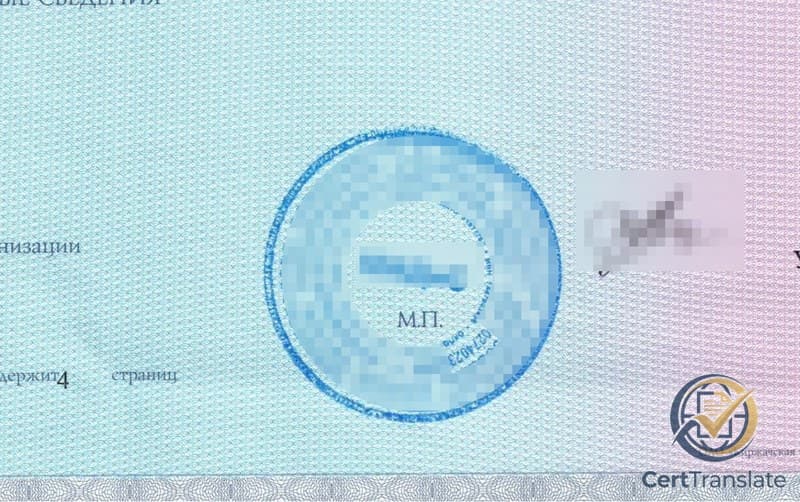
A Russian vocational diploma and its four-page supplement carried the issuing institute’s round seal. The seal’s 13-digit registration number, the OGRN, was printed in fine curved type, and two digits were blurry enough to misread. We produced two candidate readings and tested both against the OGRN check-digit algorithm. Only one reading passed, so that number went into the certified translation, with a Translator’s Note on record. The translation was delivered for the client’s USCIS filing.
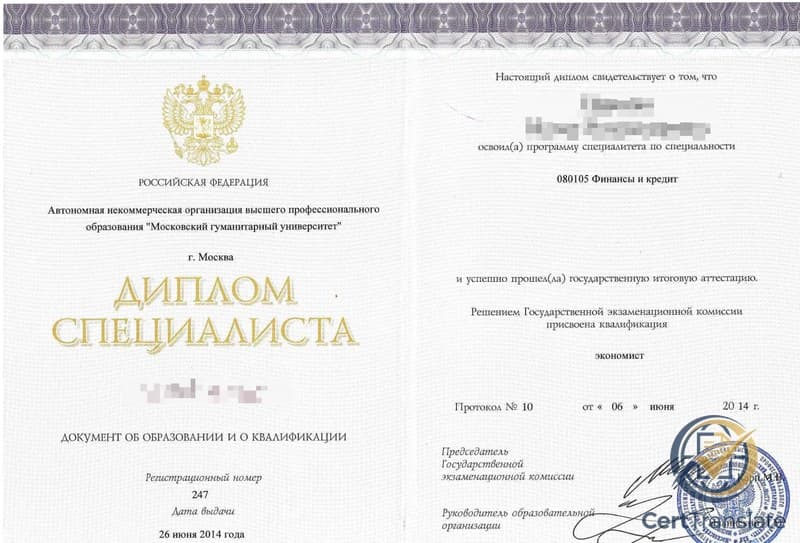
A 2014 Russian Specialist's Diploma in Finance and Credit needed an English translation for an Academic Evaluation Services (AES) filing. The diploma supplement disclosed two prior legal names of the issuing university, with the date of each rename. We rendered Section 5 of the supplement verbatim so the credential evaluator could verify institutional continuity. The packet was delivered for AES credential evaluation.
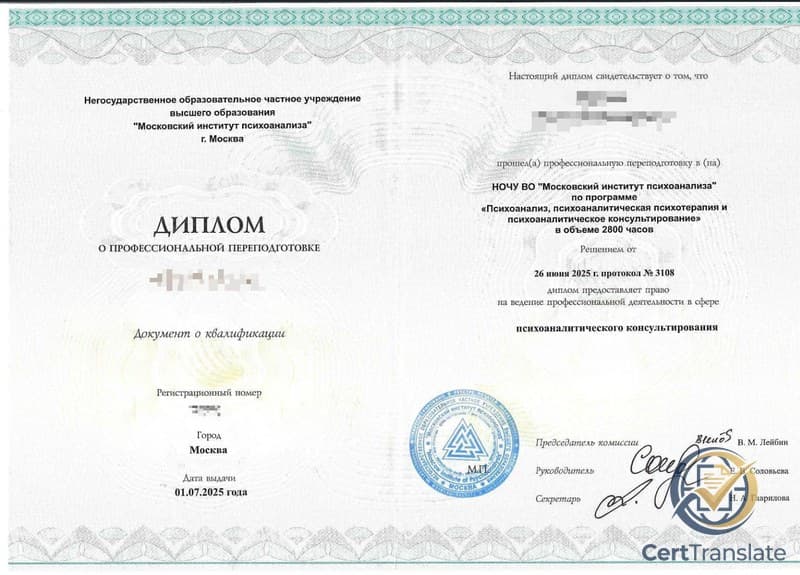
A client submitted two Russian credentials from the Moscow Institute of Psychoanalysis: a 2025 Diploma of Professional Retraining (2,800 hours, psychoanalytic counseling) and a 2022 Certificate of Advanced Training (48 hours). Both fall under Russian supplementary professional education — not academic degrees. We labeled each document type precisely, preserved the legal grant phrase, and kept the hour counts intact. The packet was delivered for Academic Evaluation Services (AES) filing.
Russian death certificate translation requires handling ZAGS civil-registry formatting, cause-of-death medical terminology that may use ICD codes or descriptive Russian phrasing, Cyrillic-to-Latin romanization matched to surviving family members’ passports, and Soviet-era institutional references — challenges that sit at the intersection of Russian language expertise and civil-record document knowledge.
A modern Russian ZAGS death certificate, a Soviet-era death record, and a Russian-language death certificate from Kazakhstan or Uzbekistan may share a language but differ in cause-of-death formatting, medical terminology conventions, and registry structure enough that the translation has to reflect the exact issuing system.
Your death certificate is translated by a native Russian speaker who handles civil-registry records daily, so ZAGS formatting, Cyrillic romanization matched to passport spelling, cause-of-death medical terminology, and registry identifiers are reviewed in one workflow rather than guessed.
If a receiving authority asks for a translation-only correction, we revise the file at no extra cost so the English version stays aligned with the original record and the rest of the filing packet.
Russian death certificates include a cause-of-death field (причина смерти) that often uses medical terminology, ICD codes, or descriptive clinical Russian. A translator without medical-record experience may produce English phrasing that sounds imprecise or clinically incorrect to a reviewing officer or insurance adjuster.
We translate cause-of-death fields with the medical context in mind, using accepted English clinical terminology that matches the Russian source. When the original uses an ICD code, we preserve it alongside the translated description so both the code and the language are traceable to the source record.
Russian death certificates issued by ZAGS (ЗАГС — запись актов гражданского состояния) offices include registry numbers, issuing-office identifiers, and civil-status references that have to appear in the English version. These labels are not generic — they are specific to the ZAGS system and carry identity-verification data.
We preserve ZAGS registry numbers, office names, and record identifiers exactly as printed so the reviewing officer or court can cross-reference the translation against other civil records in the packet without confusion.
When a death certificate is filed as part of an immigration case, the decedent’s name on the translation has to match how the same person appears on birth certificates, marriage certificates, and other records in the packet. Patronymics (отчество) and Cyrillic romanization choices must stay consistent across all translated documents.
We match the Cyrillic-to-Latin romanization to the passport or other identity records in the filing set and flag any visible discrepancies so the applicant can address them before the officer raises questions.
Soviet-era death certificates may reference ZAGS offices, administrative divisions, and republic designations that no longer exist. A translator who modernizes or abbreviates these references produces a document that does not match the original.
We preserve the original Soviet-era institutional wording, republic names, and administrative references exactly as they appear on the source record. When a translator note helps clarify the historical context, it complements the original text rather than replacing it.
These death records share Russian as the document language, but the registry system, medical terminology conventions, and institutional formatting change by country and era.
Modern Russian death certificates follow a standardized ZAGS format with fields for the decedent’s full name with patronymic, date and place of death, cause of death, date and place of birth, registry number, and issuing-office details. Post-2010 records often use a pre-printed form with handwritten or typed entries.
These records commonly appear in USCIS filings to prove the death of a prior spouse (I-130, I-485), in probate proceedings, and in insurance or benefits claims. We preserve every field, including the cause-of-death medical terminology, ZAGS registry number, and issuing-office name, so the English version matches the original record line by line.
Soviet-era death records may use different form layouts, reference republic-level ZAGS offices that no longer exist, and include administrative language from a different governmental system. The cause-of-death field may use older medical terminology or descriptive phrasing rather than modern ICD codes.
These records still appear in immigration and probate filings, especially when establishing family history or proving the death of a parent or prior spouse decades ago. The translation must preserve the original institutional references, administrative language, and medical terminology without modernizing or normalizing them.
Russian-language death certificates from Kazakhstan may use a similar ZAGS-style format but with institutional naming and regulatory references that reflect the Kazakh civil-registry system. Bilingual Russian-Kazakh death records may appear from post-independence issuers.
We keep the Russian-language civil-registry terminology intact while making the country and institutional context clear for the reviewing authority. When the record is part of a larger filing set, we ensure name spelling and registry references stay consistent across the death certificate and other civil documents.
Belarusian death certificates may appear primarily in Russian, following a format similar to Russian ZAGS records but with institutional naming that reflects the Belarusian civil-registry system.
We preserve the original institutional references and medical terminology as printed, keeping the translation consistent with other Belarusian or Russian-language civil records in the same filing packet.
$24.95
per page · no word cap
Typical length
Most Russian death certificates are 1 page
Typical total
$24.95
No hidden fees. Free Quote.
Russian death certificate translation costs $24.95 per page. Most clients pay $24.95 because the typical Russian death certificate is one page. Records with supplementary annotations may run to $49.90. You receive the confirmed page count before payment, and there is no language surcharge for russian.
Most death certificate orders are delivered within 24 hours once we receive clear scans. Soviet-era records with older formatting or handwritten entries may take additional review time, but we confirm the delivery window before production starts.
Yes. This service is built for USCIS, probate courts, insurance companies, and benefits agencies that need a complete certified English translation of a Russian death record, including the cause-of-death field and ZAGS registry identifiers. Our package includes the full English translation plus a signed Certificate of Accuracy, which is the format most receiving authorities expect for foreign-language records.
Yes. We handle death certificates from Russia, Soviet-era issuers, Kazakhstan, Belarus, and other Russian-language civil-registry systems, with the translation matched to the exact issuing context. If your record uses a rare regional format, upload every page so the translator can match the exact issuing-country structure before production starts.
We can usually translate scanned death certificates if the text, cause-of-death field, and registry seal remain readable. If any critical field is too faint or cut off, we ask for a better scan before we certify the file. When a field is genuinely unreadable, we mark it transparently instead of guessing, which is safer than inventing a name, date, or registry number.
Yes — you receive the completed translation for review before we certify it, and we make unlimited free revisions until every name, date, and detail is right. If USCIS later requests a change, we correct the certified file at no charge.
No — we bill the physical page you upload, never a word count. Many services cap a "page" at 250 words and re-bill a dense death certificate as two or three pages; here one page of your document is one $24.95 page, however dense the text.
We translate the cause-of-death field (причина смерти) using accepted English clinical terminology that corresponds to the Russian medical phrasing. If the source includes an ICD code, we preserve it alongside the translated description. We do not simplify or paraphrase medical terminology because the reviewing authority may need the exact clinical language.
USCIS commonly requires a translated death certificate when the applicant is filing a spouse petition (I-130) or adjustment of status (I-485) and a prior spouse has died. The death certificate establishes that the prior marriage was legally terminated, which affects eligibility for the current petition. Probate courts and insurance companies request the same document for estate and benefits purposes.
A Russian свидетельство о смерти carries a clinical cause-of-death field and the date/place of death — the field a widow/widower petition relies on. We translate the full record, render medical terms precisely, and keep the decedent’s name consistent with the rest of the packet.
| Field | What it is | How we handle it |
|---|---|---|
| Свидетельство о смерти / актовая запись | Death certificate vs the underlying civil-act record (the type) | Document type identified and labeled, not assumed. |
| ЗАГС + № актовой записи + дата выдачи | Issuing civil-registry office, act-record number, and issue date | Office and act number preserved exactly for cross-referencing. |
| Умерший (ФИО + отчество + дата рождения) | Decedent’s full name with patronymic and date of birth | Отчество preserved and reconciled with the decedent’s other records. |
| Дата и место смерти | Date and place of death | Surfaced clearly — the field a widow/widower petition (I-130/I-360) relies on. |
| Причина смерти (+ ICD / мед. свидетельство) | Cause of death, often with an ICD code or clinical phrasing | Rendered in accepted English clinical terminology; ICD code preserved alongside. |
| Серия-номер / печать | Certificate series-number and seal | Series-number and seal described and labeled in English. |
Cause of death may derive from a separate медицинское свидетельство о смерти (medical death certificate) — we note the source when both appear. Soviet-era records may reference republic-level ZAGS offices that no longer exist; we preserve that wording. Cyrillic names are romanized to match the surviving family’s passports.
Most translation-related RFEs trace back to a few issues. These are what we check on every Russian-language death record.
01Cause-of-death medical terms or ICD code mistranslated or dropped
We render причина смерти in accepted English clinical terminology and preserve any ICD code alongside it.
02Decedent name/patronymic not reconciled with other documents
We match the name and отчество to the decedent’s other records so a prior-spouse death is clearly the same person.
03Date or place of death not clearly surfaced
We surface the date and place of death, since a widow/widower petition (I-130/I-360) depends on it.
04Soviet-era institutional references modernized
We keep republic names and ZAGS-era wording as printed, adding a translator note for context rather than replacing them.
Patterns drawn from real Russian-language death-record casework (Russia, Soviet-era, Kazakhstan and other CIS issuers). Unreadable fields are marked transparently, never guessed.
Every order is checked against this list before certification — and covered by the revise-free-or-refund guarantee.
Start my translationCommon terms you will see on a Russian-language death record, with what they mean on the certified English version.
Our guidance on Russian death certificate translation reflects the published requirements of the authorities below.
Often in the same packet
For your filing
Upload every page of the death certificate, including any medical annotation pages, correction entries, or supplementary registry notes. A complete source file helps ensure the cause-of-death field, registry identifiers, and the decedent’s full name chain are translated accurately.
If your filing also includes birth certificates, marriage certificates, or other Russian-language civil records, ordering the full set together helps keep patronymics, romanization, and registry references aligned across all translated documents.