
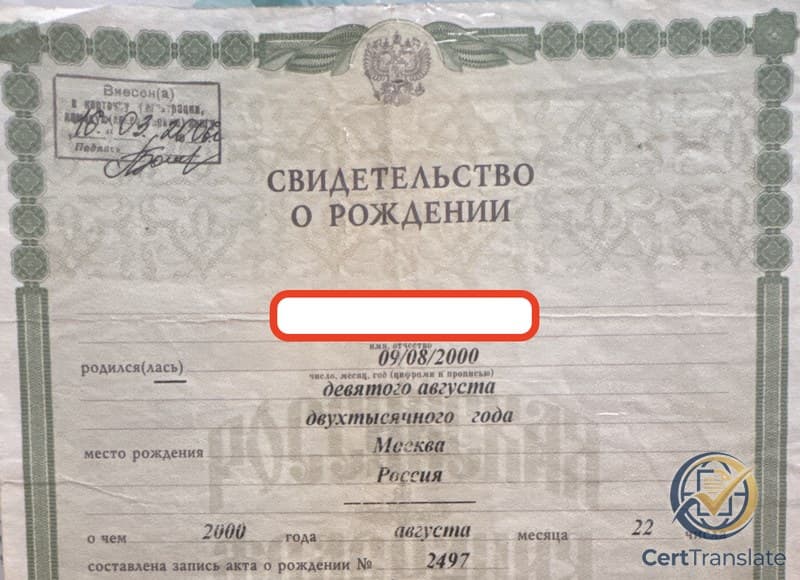
Field meaning
Two fields looked alike: citizenship and ethnicity
«Гражданство» and «национальность» were translated by meaning — citizenship and ethnicity — and kept separate.
Read the caseСвидетельство о рождении
Certified English translation for USCIS, passport applications, schools, courts, and other official uses.
Ready within 24 hours
Complete translation
Word-for-word, same structure
Every field, stamp, seal, signature, and annotation
Certified package
Signed and Stamped Certificate of Accuracy
Company letterhead · translator signature · company stamp

We check your files and confirm the total before you pay




Your finished package
Your delivery includes the source-document scan, a complete English translation, and a signed and stamped Certificate of Translation Accuracy.
Files checked and total confirmed before payment
Real Russian casework
These are anonymized Russian-to-English orders. Each case shows the source-document issue and the exact translation decision.
Field meaning
«Гражданство» and «национальность» were translated by meaning — citizenship and ethnicity — and kept separate.
Read the case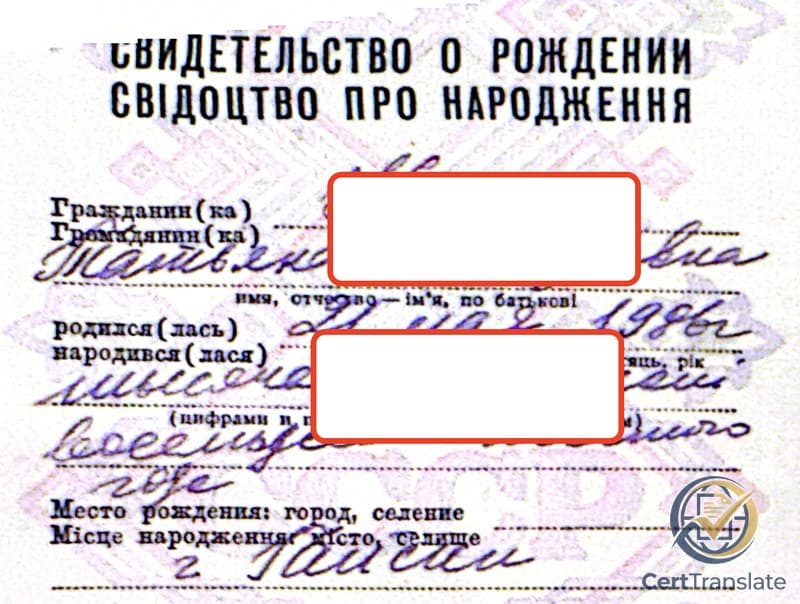
Soviet bilingual
We translated the paired labels once, by meaning, and flagged which language carried the handwritten entries.
Read the case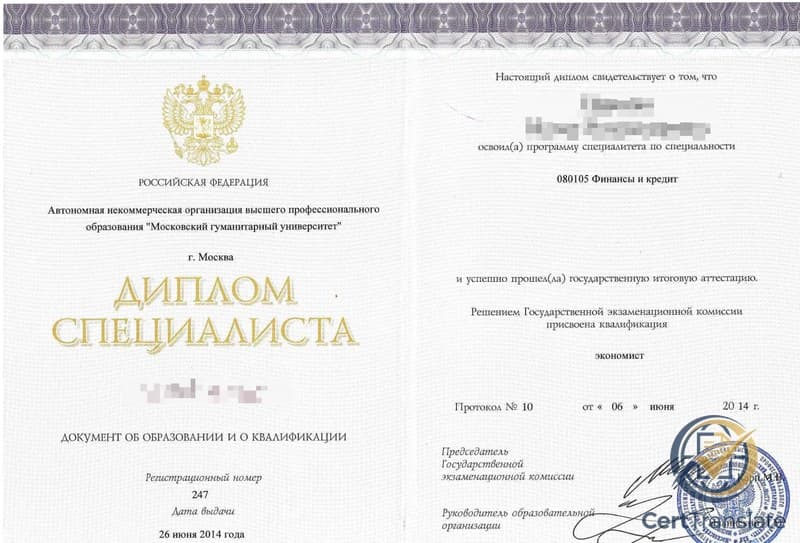
Renamed institution
Each era’s institutional name was kept exactly as printed on the Russian diploma and tied together in a translator note.
Read the caseBefore you order
Upload every page you have. We will identify the issuing system and era before work starts and flag an incomplete set.
Modern records follow a standardized ЗАГС format on security paper: full name with patronymic, parents, act-record number, and the issuing office. Romanization must follow your passport — ICAO rules, not GOST defaults.
Send the annotation or correction pages too — «Повторное» reissue stamps and later entries are part of the record.
Pre-1991 records may be handwritten, reference ministries that no longer exist, or carry republic-era office names. We keep the original institutional wording exactly as printed and add a context note where it helps the reviewer.
Kazakh and Belarusian certificates often appear in Russian or bilingual form with a ZAGS-style structure. We keep the country of issue clear so a Russian-language record is never misread as issued in Russia.
How it works
Upload once. We check the files and confirm the total before payment. Then our team translates, reviews, and certifies the complete package.
Send a PDF, scan, or phone photo. Include annotation pages, correction entries, reissue stamps, and a passport name page when available.
Names, dates, the patronymic, romanization against the passport, ZAGS office wording, and every stamp and handwritten entry are checked against the source.

Request corrections free. Once approved, receive the source scan, full English translation, and signed and stamped Certificate of Translation Accuracy.

One physical page means one billed page.
No 250-word cap and no dense-page rebilling.
Certified price
$24.95/ page
No payment until file review
Client reviews
Olga S.
Chicago, IL
“My Russian birth certificate had a patronymic that older translations spelled differently from my passport. CertTranslate matched the romanization to my passport and USCIS accepted the packet without questions.”
Russia · Birth certificate
Romanization matched
Dmitry V.
Portland, OR
“My Soviet-era birth record referenced a ZAGS office that no longer exists. They translated everything exactly as printed and added a small note about the office history. The immigration officer had no issue with it.”
Soviet era · ZAGS record
Accepted with office note
Anya K.
Brooklyn, NY
“I needed my Kazakh birth certificate translated from Russian for my green card application. They kept the registry format intact and matched my name spelling to my passport. Delivered in under 24 hours.”
Kazakhstan · Russian-language record
Delivered under 24 hours
Questions before ordering
If your document does not match one of these situations, send it anyway. Support replies in 15–30 minutes during support hours.
The certified translation is priced per physical page. A typical one-page certificate costs one page, even when the page contains more than 250 words.
Most one- to three-page orders are delivered within 24 hours after we receive clear scans. If the record includes handwritten Soviet-era entries, correction pages, or bilingual republic forms, we confirm the delivery window before work begins.
The delivery includes your source-document scan, a complete English translation, and a signed and stamped Certificate of Translation Accuracy. If a receiving authority rejects the translation for a translation-related reason, we revise it free. If it is still rejected, we refund the translation cost.
Yes. We handle modern Russian ZAGS certificates, Soviet-era records with republic references, and Russian-language certificates issued in Kazakhstan, Belarus, and other former Soviet states.
We can usually work from scans with stamps, embossing, handwriting, or slightly faded print. If a name, date, seal, or registry number is too weak to read safely, we ask for a better image rather than guessing.
Yes. You can review the completed translation and request unlimited free corrections before certification. If USCIS later requests a translation-related change, we correct the certified file at no charge.
No. We bill the physical page you upload, never a 250-word unit. A dense one-page certificate remains one billed page.
We render the patronymic faithfully and position it consistently with how your passport and U.S. forms handle the name. A dropped or misplaced patronymic is a common cause of identity-mismatch questions.
The spelling in your passport. Russian passports use ICAO transliteration, while older records may use GOST or ad-hoc spellings — we reconcile them so one person’s name does not read as two.
As ethnicity, not citizenship. Soviet and Russian forms often carry both «гражданство» (citizenship) and «национальность» (ethnicity) as separate fields, and we keep the two distinct so the reviewer reads each correctly.
USCIS generally requires certification, not notarization. Notarization remains available when a court, embassy, or another receiving authority asks for it.
Most frequent problems we correct
These are the recurring issues we see in Russian civil-record packets and in translations clients ask us to review.
Our check: Russian passports use ICAO transliteration; older and Soviet-era records may use GOST or ad-hoc spellings. We cross-check the source against the passport so one person’s name does not read as two.
Our check: We render the patronymic faithfully and position it so it stays compatible with the passport and U.S. forms, preventing identity-mismatch RFEs.
Our check: We keep the original institutional wording exactly as printed and add a context note if helpful, so the translation matches the source document.
Our check: We note the country of origin when a Russian-language registry format could otherwise be misread as issued in Russia.
The standard behind these checks
AcceptReady™ is CertTranslate's published standard for certified translations: complete word-for-word translation, mirrored page layout, signed and stamped Certificate of Accuracy on letterhead, and matched to the receiver's published requirements.
How to check each one yourselfChecked before certification. If an authority later requests a translation-related correction, revisions remain free.
Start my translationCommon filing contexts
Russian birth certificates most often appear in family-based USCIS packets, but the same certified package may also be requested by a court, school, or benefits agency.
The key is consistency: names, patronymics, and dates should line up with the passport and the rest of the supporting documents.
Parentage and patronymics connect the beneficiary to the petitioner in the family-based packet.
The certified English translation proves identity and parentage; romanization is matched to the passport.
Soviet-era records are reconciled with modern documents into one consistent identity chain.
The certified English version replaces the Cyrillic original wherever the reviewer works in English.
Document glossary
Common terms you may see on a Russian-language birth record and how they appear in the certified English translation.
Reference library
Guidance and source links last rechecked .
Ready when you are
Upload every page you have — including annotation pages and correction entries. We will confirm the document type, page count, price, and delivery time before you pay.
No payment until file review
