




What does it mean when the other spouse's data is blank on a Russian divorce certificate?
TL;DRA Russian divorce certificate (свидетельство о расторжении брака) issued by Pervouralsk ZAGS carried full personal data only for the wife — the bearer of this copy — while the husband's date-of-birth, citizenship, nationality, and place-of-birth fields were blank. We rendered every empty field as '[Blank in original]' and added a Translator's Note explaining that post-2018 FGIS ЕГР ЗАГС practice issues each ex-spouse a copy with full data for the bearer only. The translation was delivered for a USCIS family-based filing.
Case Specifications
- Document
- Divorce certificate
- Foreign Name
- Свидетельство о расторжении брака
- Country
- Russia
- Languages
- Russian → English
- Submitted To
- USCIS
What We Received
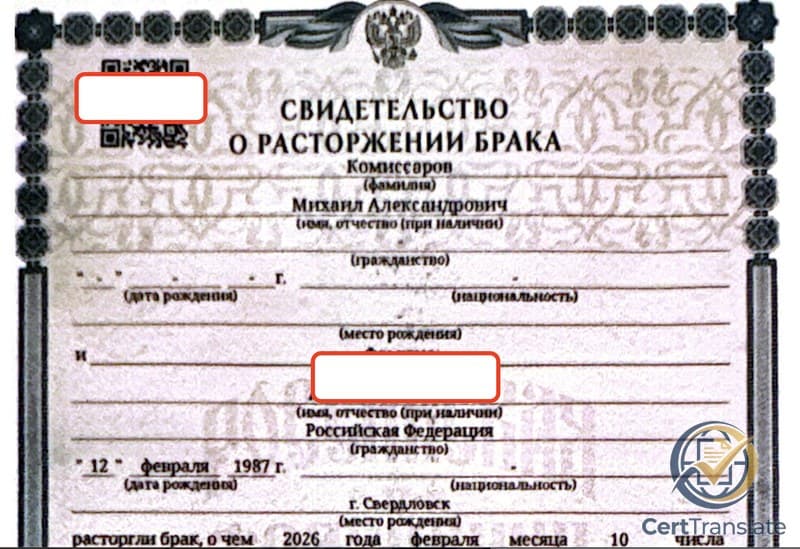
A client submitted a Russian Свидетельство о расторжении брака (Divorce Certificate) printed on watermarked Goznak security paper and issued by Civil Registry Department [Otdel ZAGS] No. 96600032 of the City of Pervouralsk, in the Office of Civil Status Acts Registration of Sverdlovsk Region. The form is the post-2018 FGIS ЕГР ЗАГС state template — Russia's centralized civil-registry system — with an embedded QR code in the upper-left corner that links to the Federal Tax Service verification portal.
The certificate was issued to the wife on February 10, 2026. The wife's personal-data block (Anastasia Olegovna Fomina; born February 12, 1987 in Sverdlovsk; citizenship: Russian Federation) is fully populated. The husband's block (Mikhail Aleksandrovich Komissarov) shows only his surname, given name, and patronymic — the date-of-birth, citizenship, nationality, and place-of-birth fields are all blank. The certified translation was needed for a USCIS family-based filing.
Why This Required Special Handling
On a US-issued vital record, blank fields normally signal incomplete information — and incomplete information triggers Requests for Evidence. A USCIS adjudicator unfamiliar with Russian civil-registry practice may read the husband's empty fields the same way and pause the file pending clarification. A literal translation that simply leaves the value lines empty, or that omits the field labels entirely, looks indistinguishable from a translation oversight.
Russian post-2018 ZAGS practice for court-ordered divorces issues each ex-spouse their own copy of the certificate. The form template carries fields for both spouses, but full personal data is populated only for the bearer of that particular copy — here, the wife. The husband's matching copy, when he comes to ZAGS to collect it, will have his data fully populated and her block partial. The blank fields are a privacy and data-minimization choice by the registry, not a defect in the document.
The certificate also chains three distinct dates that must be kept in their correct chronological roles: the underlying Justice of the Peace ruling of September 16, 2025; the date of marriage termination on November 6, 2025 (the operative dissolution date under Russian Family Code Art. 25); and the date the divorce act was registered by ZAGS on February 10, 2026. A USCIS officer reviewing remarriage eligibility on a marriage-based petition needs to know which of the three dates is the legal dissolution date.
How We Handled It
We rendered every empty field on the husband's block as '[Blank in original]' — the marker we use whenever ink is absent on the source, distinct from '[Illegible]' which signals ink that cannot be read. This makes the absence-of-data structurally visible to the reviewer rather than buried in white space.
We then added a numbered Translator's Note on the certification page explaining the issuing convention.
"In the husband's personal-data block, the fields for date of birth, citizenship, nationality, and place of birth are blank in the original. Under Russian ZAGS practice for court-ordered divorces, each ex-spouse receives their own copy of the certificate, and the personal-data block is fully populated only for the spouse to whom that copy is being issued. The blank fields reflect the registry's issuing convention rather than a defect or omission in the source document."

For the act registration number, we transcribed the full 21-digit FGIS ЕГР ЗАГС sequence (130269660003200038007) digit-for-digit, without internal grouping or formatting — the centralized registry treats the number as a single sequence and any added separators would diverge from the source. The series identifier 'III-АИ' was rendered 'III-AI' under BGN/PCGN Russian transliteration: the Roman numeral III remains Roman, and the Cyrillic letters А and И transliterate to A and I. The QR code in the upper-left corner was described as '[QR Code]' without content extraction — it is a verification artifact for the registry's lookup portal, not translatable data.
For the three dates, we labeled each one in its operative role: the Justice of the Peace ruling of September 16, 2025 by Court Precinct No. 3 of the Nizhneserginsky Judicial District of Sverdlovsk Region; the marriage-termination date of November 6, 2025; and the act-registration / certificate-issuance date of February 10, 2026. The Russian-language phrasing of the registration date in the original ('2026 года февраля месяца 10 числа' — 'in the year 2026, in the month of February, on the 10th day') was rendered in equivalent English long form to keep the source register intact, with the conversion documented in a Translator's Note.
We preserved the ZAGS office code 96600032 exactly as printed, accompanied by the bracketed transliteration '[Otdel ZAGS]' on the institutional name so a Russian-speaking reviewer can match the English rendering against the Federal Tax Service registry portal. The round official seal in the lower-left bears the Russian Federation coat of arms with peripheral inscription partially obscured by overlap with the form text — described in brackets at its location, with a Translator's Note flagging the partial illegibility.
The Outcome
The certified translation was delivered to the client for inclusion in their USCIS family-based filing, with Translator's Notes covering the blank-field convention, the BGN/PCGN transliteration, the date-format conversion, and the partially illegible peripheral seal text.
Each Translator's Note positions a feature of the original Russian form as a registry-design choice rather than a translation gap, so the adjudicator's review path is clear when comparing the English translation against the source.
What This Means for You
Blank fields for the non-bearer spouse on a Russian divorce certificate are a registry-design feature of the post-2018 FGIS ЕГР ЗАГС system, not a defect in the document. A certified translation should mark every blank field explicitly as '[Blank in original]' and include a Translator's Note explaining the ZAGS issuing convention so a reviewer does not read the structure as missing information.
Have a similar situation?
We handle Russian ZAGS divorce certificates and other post-Soviet civil records regularly.
Related Cases & Resources
Sources & References
- How to Respond to a Request for Evidence (RFE)·USCIS·Verified 2026-06-12
Explore the Hub
All identifying information has been removed from document images. Case details are shared with client permission. No personal data is stored or displayed on this page.