




What does (E.F.) mean after the signing official's name on a Norwegian birth certificate?
TL;DRA Norwegian fødselsattest (birth certificate) issued by Skattekontoret Oslo carried the abbreviation (E.F.) — etter fullmakt, Norwegian for "by authorization" — after the registrar's printed name, indicating a delegated clerk had signed on the named official's behalf. We retained (E.F.) verbatim in the signature block and added a Translator's Note explaining the abbreviation, so a USCIS adjudicator could interpret the signature without guessing. The certified translation was delivered for the client's USCIS filing.
Case Specifications
- Document
- Birth certificate
- Foreign Name
- Fødselsattest
- Country
- Norway
- Languages
- Norwegian → English
- Submitted To
- USCIS
What We Received
A client submitted a Norwegian birth certificate (fødselsattest) issued in Oslo in February 2010, on the standard RF-1411B electronic-edition form. The document carries the Norwegian coat of arms at the top, printed field labels in Bokmål (Etternavn / Fornavn / Mellomnavn / Fødselsdato / Personnummer / Kjønn / Fødested / Foreldrenes navn), a round purple ink stamp from Skattekontoret Oslo, and a single handwritten signature in the right-hand block — under the printed registrar's name and immediately followed by the parenthetical abbreviation (E.F.).
The <a href="/documents/birth-certificate">certified birth certificate translation</a> was needed for the client's <a href="/immigration/uscis">USCIS filing</a>. (E.F.) is the only element on the document that a non-Norwegian-speaking reader cannot interpret from context, and it is the element most often mistranslated by translators unfamiliar with Norwegian administrative practice.
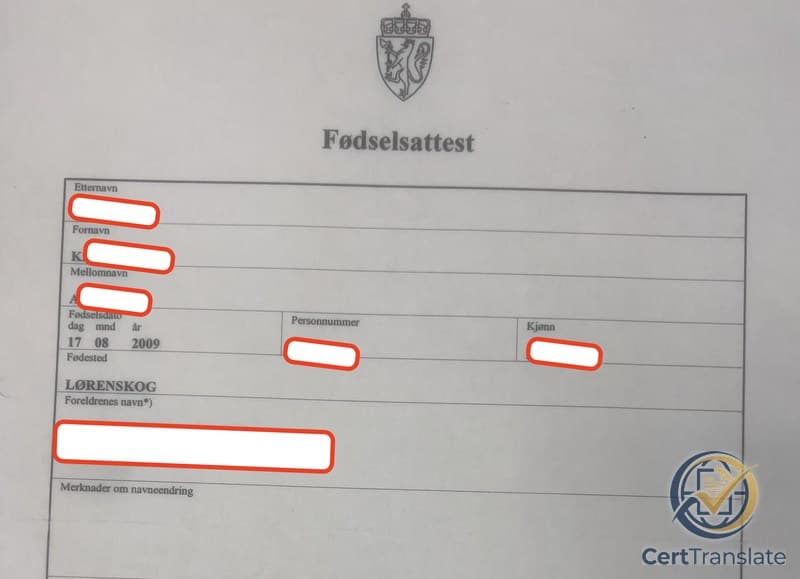
Why (E.F.) Cannot Be Dropped, Left As-Is, or Guessed At
(E.F.) stands for <em>etter fullmakt</em> — Norwegian for "by authorization" or "by proxy." It is placed after a printed official's name on Norwegian official documents (birth, marriage, and death certificates, tax assessments, register extracts) to indicate that the certificate was signed by a delegated clerk under the named official's authority, not by the named official personally. The distinction matters: the document is still valid and still issued by Skattekontoret, but the actual signing hand is not the person whose name is printed below the line.
A <a href="/guides/what-is-certified-translation">certified translation must be complete and accurate</a>: every word on the document must be accounted for. A translator who silently drops (E.F.) fails completeness. A translator who leaves "(E.F.)" untranslated leaves a US adjudicator looking at a foreign abbreviation with no English-language meaning on the page — exactly the kind of unexplained element that triggers an RFE. A translator who guesses at an English equivalent — "(B.P.)" for "by proxy," or "(P.P.)" for <em>per procurationem</em>, or simply rewriting the line as "on behalf of" — substitutes their own administrative shorthand for the original's, which is not what a certified translation is allowed to do.
How We Handled It
We rendered the right-hand signature block in three lines, mirroring the structure of the original: an italicized "/s/ Lena Carlsen" representing the handwritten signature, then the printed registrar's name in block letters — "LENA CARLSEN (E.F.)" — exactly as it appears on the Norwegian original, with (E.F.) retained verbatim. Below the signature block, the caption "Signature of official and name in block letters" was translated from the original's Norwegian caption (Tjenestemannens underskrift og navn med blokkbokstaver).
We then added a numbered entry to the Translator's Notes section on the certificate page of the translation: "The abbreviation '(E.F.)' following the official's name stands for 'etter fullmakt' (Norwegian for 'by authorization' / signed by proxy). The abbreviation has been retained as in the original." Two related conventions on the same document received the same treatment: the round purple seal at the lower portion of the document was described in brackets as <code>[STAMP: TAX OFFICE OSLO — Round seal bearing the National Coat of Arms of Norway]</code>, with a separate Translator's Note recording the original Norwegian text (SKATTEKONTORET OSLO); and the dates in the original (17 08 2009 and Oslo, 03.02.2010) were rendered with the month written out (August 17, 2009; Oslo, February 3, 2010), with the original day-month-year format noted.
"The abbreviation "(E.F.)" following the official's name stands for "etter fullmakt" (Norwegian for "by authorization" / signed by proxy). The abbreviation has been retained as in the original."

The Outcome
The certified translation was delivered to the client and forwarded with their USCIS packet. The (E.F.) abbreviation, the Skattekontoret seal, and the day-month-year dates were all present and explained in the Translator's Notes — and the <a href="/immigration/uscis">USCIS-formatted certification</a> made clear that every element of the Norwegian original had been accounted for.
Norwegian fødselsattest documents issued through Skattekontoret routinely carry the (E.F.) marker because the certificates are produced by clerks under the authority of a named senior official. We use the same retain-and-explain approach on every Norwegian birth, marriage, and tax-register document where the marker appears.
What This Means for You
A Norwegian official document signed (E.F.) is a valid, fully-signed certificate — the abbreviation simply records that a delegated clerk signed under the named official's authority. A certified translation that retains the abbreviation verbatim and adds a Translator's Note explaining etter fullmakt gives the receiving authority the full meaning of the signature block without inventing a substitute abbreviation that does not exist in standard US certified-translation practice.
Have a similar situation?
We handle Norwegian fødselsattest, vigselattest, dødsattest, and other Skattekontoret-issued official documents with (E.F.) signatures, embossed coats of arms, and day-month-year dates regularly.
Related Cases & Resources
Sources & References
- Meet Translation Requirements·USCIS·Verified 2026-06-28
Explore the Hub
Documents
Immigration
Accepted By
All identifying information has been removed from document images. Case details are shared with client permission. No personal data is stored or displayed on this page.