




What do you do when a birth certificate has handwritten notes added to the margin years after it was issued?
TL;DRA Ukrainian birth certificate (свідоцтво про народження) from the Kherson region carried a handwritten ink annotation in the margin of the inner right page — a domestic passport number and date added years after the 2000 record, apparently by a registry clerk when the holder first received an internal passport. We reproduced the annotation exactly, preserved its position, and added a Translator's Note identifying it as a later addition. The certified translation was delivered for the client's USCIS filing.
Case Specifications
- Document
- Birth certificate
- Foreign Name
- Свідоцтво про народження
- Country
- Ukraine
- Languages
- Ukrainian → English
- Submitted To
- USCIS
What We Received
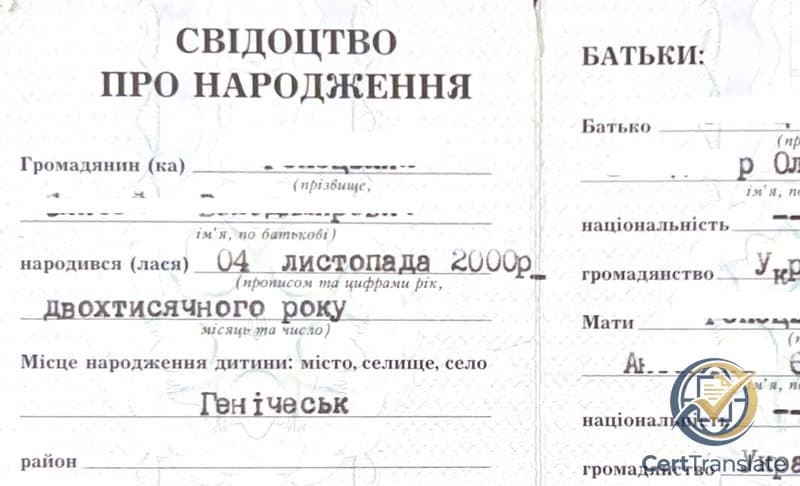
A client submitted a Ukrainian birth certificate (свідоцтво про народження) issued in the Kherson region in December 2000. The document is a passport-style booklet: a front cover with the national emblem, and a two-page inner spread carrying the typewritten record of birth, parents' details, registration information, a round ink stamp, and the registrar's signature.
In the upper right corner of the inner right page — above the printed "PARENTS" field — a later hand had added a three-line ink annotation reading <code>Паспорт 000303043</code> / <code>26.01.17</code> / <code>пед. 6520</code>. The ink, handwriting, and position indicated this was added long after the original 2000 record, apparently at the time the holder received their first internal Ukrainian passport. The <a href="/documents/birth-certificate">certified birth certificate translation</a> was needed for the client's <a href="/immigration/uscis">USCIS filing</a>.
Why a Standard Translation Approach Doesn't Work
A post-Soviet civil-status booklet is not a single-event document. Ukrainian and other former-Soviet registries routinely add handwritten annotations to the inside of a birth certificate booklet when later life events are registered — most commonly the issuance of a domestic passport at age sixteen or seventeen. These annotations are not separate documents; they live in the margin of the birth certificate itself, sometimes without a stamp, sometimes without a clear date, and often with agency-specific abbreviations that are not standard Ukrainian.
For a certified translation, this creates three problems at once. First, the annotation is not part of the original typewritten record, so collapsing it into the main body would misrepresent the document. Second, dropping it is not an option either — a <a href="/guides/what-is-certified-translation">certified translation must reproduce everything visible on the source page</a>, including handwritten additions. Third, the abbreviations used in such annotations (here, "пед.") are not in any standard Ukrainian dictionary and cannot safely be guessed at.
How We Handled It
We rendered the main typewritten record normally — child's name, date and place of birth, parents, registration entry number, issuance date, stamp, and signature — in a clean portrait layout. The handwritten margin annotation was then placed at the end of the translated record in its own bracketed block, labeled as a handwritten addition and positioned to reflect where it appears on the original page. The text was transliterated and translated literally, with no attempt to expand or interpret the abbreviation: <em>[Handwritten in ink in the upper right margin of the inner right page: "Passport 000303043 26.01.17 ped. 6520"]</em>.
Two smaller decisions supported the translation's defensibility. The booklet's front cover — national emblem, the word "Україна," and the title "Свідоцтво про народження" — was described at the top of the translation as a visual element rather than omitted. And the two "національність" (ethnicity) fields for the parents, both left blank in the original with a dash, were rendered as <code>[Blank in original — marked with a dash]</code> rather than silently dropped. In post-Soviet civil documents, the distinction between ethnicity and citizenship is substantive, and leaving the blank visible matters for any adjudicator familiar with these forms.
"The handwritten annotation in the upper right margin of the inner right page is a later addition, apparently entered when a domestic Ukrainian passport was issued to the holder. It reads in the original: "Паспорт 000303043 26.01.17 пед. 6520". The abbreviation "пед." is not a standard Ukrainian institutional abbreviation; it has been retained in transliterated form ("ped.") in the translation without interpretation."

The Outcome
The certified translation was delivered to the client, who forwarded it with their USCIS packet. The document was accepted without a translation-related Request for Evidence.
Handwritten marginal annotations on post-Soviet civil booklets — Ukrainian, Russian, Belarusian, Kazakh, Moldovan — come up regularly in our <a href="/languages/ukrainian">Ukrainian translation work</a>. Most are either a passport-issuance reference (as here) or a marriage/name-change cross-reference. In every case we use the same approach: reproduce faithfully, position accurately, label as handwritten, and note in the Translator's Certification that the annotation is a later addition.
What This Means for You
A handwritten note added to your birth certificate after issuance is part of the document and must be translated, not ignored. A certified translation that reproduces the annotation exactly — in its original position, marked as handwritten, with an accompanying Translator's Note identifying it as a later addition — shows the receiving authority exactly what is on the page and removes the most common reason a translation gets questioned on review.
Have a similar situation?
We handle post-Soviet civil-status booklets with handwritten margin annotations regularly — birth, marriage, and work-record booklets.
Related Cases & Resources
Sources & References
- Meet Translation Requirements·USCIS·Verified 2026-05-25
Explore the Hub
Certified Translation
Documents
Languages
Immigration
Accepted By
All identifying information has been removed from document images. Case details are shared with client permission. No personal data is stored or displayed on this page.