




Do you have to translate the marginal annotations on an Italian birth certificate?
TL;DRAn Italian birth certificate extract (estratto per riassunto di atto di nascita) carried four marginal annotations. They recorded the holder's two marriages and two divorces, added over several decades. We translated every annotation in full, not just the birth entry, because in Italian civil records the margin is part of the certified document. The certified translation was delivered for the client's marriage filing abroad.
Case Specifications
- Document
- Birth certificate
- Foreign Name
- Estratto per riassunto di atto di nascita
- Country
- Italy
- Languages
- Italian → English
- Submitted To
- Foreign civil registry (marriage)
What We Received
A client submitted an Italian birth certificate extract (estratto per riassunto di atto di nascita). It came from a municipal civil registry, a comune, in Italy.
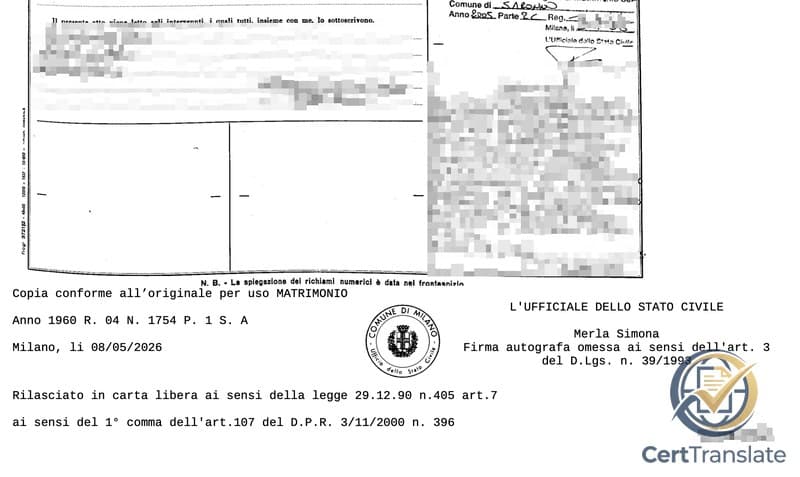
Most of the page was the original birth entry. The margin carried four separate annotations, added years after the birth. They recorded the holder’s two marriages and two divorces.
The job was a certified Italian birth certificate translation, needed for a marriage matter abroad.
Why This Required Special Handling
In Italian civil law, the birth record is the master civil-status document. Later life events are written into its margin. Marriages, divorces, and name changes are added there as marginal annotations (annotazioni a margine).
So the margin becomes a running record of the person’s civil status. A translator cannot keep the birth entry and skip the margin. Every annotation is part of the certified document.
A certified translation has to render the whole document, not only the part that looks most relevant. A receiving authority may compare the margin against the person’s marriage and divorce records.
How We Handled It
We translated all four marginal annotations in full. Each became its own labeled block, in the order it appears on the page.
We kept the Italian registry terms — comune, trascrizione, scioglimento — and gave the English meaning on first use. Months were spelled out, so day and month could not be swapped.
One detail on these records is easy to miss. An Italian act states the day the birth was reported as well as the day of birth, and the two are often different. We rendered each date in its own role, so neither was mistaken for the other.
"The margin of this birth record carries four later annotations recording the holder's marriages and divorces. Each annotation has been translated in full and kept in the order it appears in the original. Italian civil-status terms (comune, trascrizione, scioglimento) are given with their English meaning on first use. The original records both the date the birth was reported and the date of birth; each is rendered in its own role. Where faded ink on the oldest entry could not be read with certainty, the passage is marked [illegible] rather than reconstructed."

Italian civil-registry records are routine on our certified Italian translation desk. We treat the margin as part of the document every time, because that is what it is.
The Outcome
The certified translation was delivered for the client’s marriage filing. Every marginal annotation appeared in the translation, in the same order as the original.
We handle Italian civil records — birth, marriage, and divorce — the same way each time. The marginal annotations are translated in full, never summarized or dropped.
What This Means for You
On an Italian birth certificate, the margin is part of the record. If your extract has marginal annotations, they belong in the translation.
A certified birth certificate translation that carries every annotation protects you when the receiving authority compares the margin against your other documents. Ask for the full record, not just the birth section.
Have a similar situation?
We translate Italian civil-status records — birth, marriage, and divorce certificates, with every marginal annotation rendered in full — for foreign registries, USCIS, and Italian dual-citizenship filings.
Related Cases & Resources
Sources & References
- Meet Translation Requirements·USCIS·Verified 2026-07-30
Explore the Hub
All identifying information has been removed. Case details are shared with client permission. No personal data is stored or displayed on this page.