




How do you translate foreign place names that appear in Cyrillic on a Ukrainian-language source document?
TL;DRA Ukrainian Embassy in Lisbon issued a certificate of registration as a citizen of Ukraine (довідка про реєстрацію особи громадянином України) for a child born in Portugal. The document referenced Portuguese place names — Alcabideche and Cascais — in their Cyrillic-transliterated forms (Алкабідеш, Кашкайш). We restored the original Portuguese spellings rather than re-romanizing from the Cyrillic, and added a Translator's Note documenting the back-transliteration. The certified translation was delivered for the family's USCIS filing.
Case Specifications
- Document
- Embassy-issued citizenship registration certificate
- Foreign Name
- Довідка про реєстрацію особи громадянином України
- Country
- Ukraine (issued abroad)
- Languages
- Ukrainian → English
- Submitted To
- USCIS
What We Received
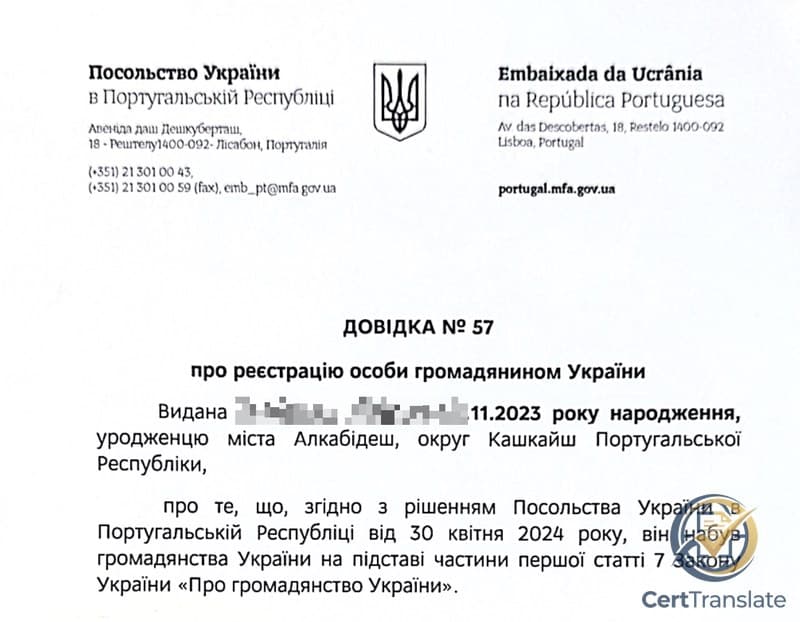
A client submitted a Ukrainian Embassy certificate confirming that a child born in Portugal had been registered as a citizen of Ukraine. The document — довідка про реєстрацію особи громадянином України — was issued in Lisbon. It uses bilingual letterhead: Ukrainian on the left and Portuguese on the right. The certificate referenced the child's place of birth in Cyrillic transliteration: Алкабідеш, in the district of Кашкайш.
This is not a birth certificate. It is an embassy-issued evidence document. It functions as the bridge between a Portuguese civil-registry birth record and a future Ukrainian passport. The <a href="/translate/ukrainian-birth-certificate">Ukrainian birth and citizenship document translation</a> was needed for the family's <a href="/immigration/uscis">USCIS filing</a>.
Why a Standard Transliteration Approach Fails
When place names from a third country appear on a Cyrillic-script document, a translator who works only from the Cyrillic produces a phonetic Latin rendering. Алкабідеш becomes "Alkabidesh" and Кашкайш becomes "Kashkaish." Neither spelling exists in Portuguese records, on Portuguese maps, or in any database an adjudicator would consult.
A round-trip transliteration — Portuguese → Cyrillic → Latin — almost never recovers the original Latin spelling. The phonetic mapping is lossy in both directions. If the English translation says "Alkabidesh" while the underlying Portuguese birth certificate says "Alcabideche," an adjudicator scanning the packet for consistency will flag the mismatch.
The certified translation must show place names the way they appear on the underlying Portuguese records — not as a double-transliteration artifact. <a href="/immigration/uscis">USCIS translation requirements</a> expect a faithful rendering that lets the reader compare names across the applicant's document set without explanation.
How We Handled It
We identified each Cyrillic-spelled foreign place name in the document. The original Portuguese spelling was then confirmed against the relevant geographic authority. Alcabideche is a freguesia of the Cascais municipality, in the Lisbon metropolitan area. Both names were restored to their Portuguese forms in the English translation — "Alcabideche" and "Cascais" — rather than transliterated phonetically from the Cyrillic.
The bilingual letterhead was preserved as a two-column layout. The Portuguese institutional name (Embaixada da Ucrânia na República Portuguesa) was kept in its Portuguese form, since it is the embassy's own official identifier. Personal names followed standard <a href="/guides/what-is-certified-translation">certified-translation transliteration practice</a>: the surname was rendered per BGN/PCGN. The given name appears in dative case in the original Ukrainian; it was rendered in its nominative-equivalent English form.
A Translator's Note in the certification block documented the place-name back-transliteration. The note lets an adjudicator compare the English translation to the underlying Portuguese birth certificate and see consistent spellings on both documents.
"The Portuguese place names "Алкабідеш" and "Кашкайш" appear in the Ukrainian source in Cyrillic transliteration. They have been restored in this translation to their original Portuguese spellings — "Alcabideche" and "Cascais" — to match the underlying Portuguese birth certificate referenced in this document and the spellings used in official Portuguese geographic records."

The Outcome
The certified translation was delivered to the client and forwarded with the USCIS packet. The document set was accepted without a translation-related Request for Evidence.
We've handled this back-transliteration pattern on several Ukrainian embassy documents over the past year. The pattern shows up most often on certificates issued from Portuguese- and Spanish-speaking jurisdictions. In each case, restoring the original native spelling avoids the document-mismatch flag that a phonetic re-romanization would create.
What This Means for You
Foreign place names on a Cyrillic-script document should appear in the English translation in their original native spelling — not a phonetic Latin rendering of the Cyrillic. A short Translator's Note explaining the back-transliteration ties the translation to the underlying foreign-language records. This prevents a spelling mismatch from being read by an adjudicator as a translation error.
The same principle applies in reverse. If a US document is being translated into Ukrainian or Russian, the place names should be left in their original Latin spelling. Cyrillicizing them sets up the same lossy round trip in the other direction.
Have a similar situation?
We handle Ukrainian embassy and consular documents — citizenship registrations, passport-issuance certificates, civil-status confirmations issued abroad — regularly.
Related Cases & Resources
Sources & References
- Meet Translation Requirements·USCIS·Verified 2026-07-17
- BGN/PCGN Romanization System for Ukrainian·U.S. Board on Geographic Names·Verified 2026-07-17
Explore the Hub
Certified Translation
Documents
Languages
Immigration
Accepted By
All identifying information has been removed. Case details are shared with client permission. No personal data is stored or displayed on this page.