




How do you translate a U.S. I-20 into Spanish when half the form is made of legal citations and agency acronyms that don't exist in Spanish?
TL;DRA Colombian F-1 student at a U.S. university needed his Form I-20 translated from English into Spanish for presentation to a financial sponsor abroad — the reverse of the direction most certified translations flow. We rendered the form's labels, instructions, and attestations into natural Spanish while keeping every U.S. legal citation (8 CFR references, visa class "F-1", SEVIS, CIP program codes) verbatim in English, because those identifiers have no meaning if translated. A single Translator's Note documented the scope (page 1 of a 3-page form, as received).
Case Specifications
- Document
- Form I-20 (Certificate of Eligibility for Nonimmigrant Student Status)
- Country
- United States
- Languages
- English → English
- Submitted To
- Client's home country (Spanish-speaking jurisdiction)
What We Received
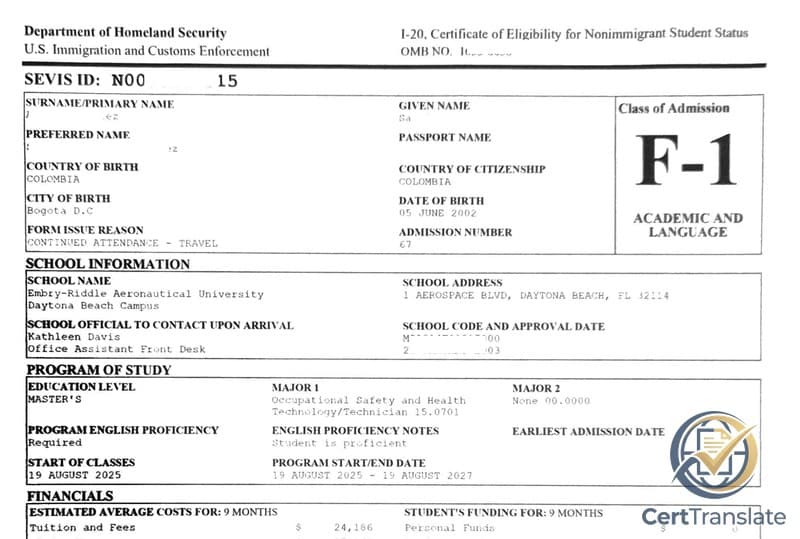
A client submitted page 1 of a U.S. Department of Homeland Security / ICE Form I-20, the Certificate of Eligibility for Nonimmigrant Student Status issued to F-1 academic students. The student is a Colombian national pursuing a Master's at a U.S. university; the form had been issued by the school's Designated School Official (DSO) and signed by the student a few weeks before his planned travel.
He needed a <a href="/languages/spanish">certified Spanish translation</a> to present to his financial sponsor in Colombia. Unlike the typical flow — foreign documents translated into English for U.S. agencies — this was a U.S. federal form translated into Spanish for use outside the United States.
The PDF provided contained only page 1 of 3 (the form's footer reads "Page 1 of 3"). The client confirmed that page 1 was what the sponsor had requested.
Why a Federal Form Can't Be Translated Line-for-Line
The I-20 is not a narrative document. It is a structured federal form whose content is roughly half natural-language instructions and attestations (which should be translated) and half U.S. legal and administrative identifiers (which must not be). The two have to be handled differently in the same document, which is the core of this case.
Elements that had to stay verbatim in English include the visa class code "F-1" and its sub-category "ACADEMIC AND LANGUAGE", the SEVIS ID and Admission Number, the DHS-assigned school code, the U.S. Department of Education CIP code <code>15.0701</code> attached to the major, the regulatory citations <code>8 CFR 214.2(f)(6)</code> and <code>8 CFR 214.3(g)</code>, the named agencies "Department of Homeland Security" and "U.S. Immigration and Customs Enforcement", and the OMB Control Number. None of these have Spanish equivalents — they are identifiers in U.S. federal databases.
Elements that had to be translated into natural Spanish include the form's field labels, the School Attestation paragraph signed by the DSO, the Student Attestation paragraph signed by the F-1 student, and the financial section headings and line items. Translating a CFR citation into Spanish, or rendering "F-1" as a descriptive Spanish phrase, would make the document useless for its intended purpose — the sponsor abroad needs to match the identifiers on the translation to the identifiers on the English original and on the visa in the <a href="/immigration/student-visa">student's passport and visa</a>.
How We Handled It
We rebuilt page 1 of the I-20 in Spanish as a visually faithful mirror of the original — same header block, same student-information grid with the F-1 class-of-admission panel on the right, same SCHOOL INFORMATION / PROGRAM OF STUDY / FINANCIALS / ATTESTATION layout, same footer. Every label was rendered in natural Spanish; every identifier was kept verbatim.
Specific choices: "Class of Admission: F-1, ACADEMIC AND LANGUAGE" → "Clase de Admisión: F-1, ACADÉMICO Y DE IDIOMA" (the code F-1 stayed as-is; the category label was translated because it is descriptive). "CONTINUED ATTENDANCE — TRAVEL" → "ASISTENCIA CONTINUA — VIAJE". "Occupational Safety and Health Technology/Technician 15.0701" → "Tecnología/Técnico en Seguridad y Salud Ocupacional 15.0701" (the CIP code 15.0701 was preserved exactly). The DSO's job title was kept in English; institutional job titles are part of the signatory's identity and should not be paraphrased.
Dollar amounts ($24,186, $17,162, $42,648) were kept with U.S. comma-thousands notation, since the values are denominated in U.S. dollars. Dates in the form body were rendered in standard Spanish prose form (<code>05 JUNE 2002</code> → <em>5 de junio de 2002</em>; <code>22 December 2025</code> → <em>22 de diciembre de 2025</em>). The handwritten date in the student's signature block (<code>01/02/2026</code>) was preserved verbatim in square brackets, because a translator should not reinterpret handwriting on a signed attestation. Blank fields in the form (Passport Name, Earliest Admission Date, Remarks, the entire Parent/Guardian row) were marked <em>[En blanco en el original]</em> — the standard certified-translation convention for a blank source field.
"Nota del traductor: El original, según su pie de página, es un formulario de 3 páginas; únicamente se recibió y tradujo la página 1."

The Outcome
The certified Spanish translation of page 1 of the I-20 was delivered to the client the same day, formatted as a faithful visual mirror of the original DHS/ICE form with the translator's certification on a second page. The client confirmed the sponsor accepted it without follow-up questions.
We handle reverse-direction certified translations (U.S. federal forms, diplomas, birth certificates issued in the United States) into Spanish on a regular basis — most often for student-visa holders whose sponsors, banks, or consulates abroad need a local-language version of a U.S. document.
What This Means for You
A U.S. federal form translated into Spanish is not a word-for-word conversion. The parts that exist to be read by a human — labels, instructions, attestations — should be rendered in natural Spanish; the parts that are U.S. legal or administrative identifiers — visa class codes, SEVIS numbers, CFR citations, CIP codes, agency acronyms — must be preserved verbatim so the sponsor, bank, or consulate abroad can verify them against the original.
Have a similar situation?
We handle reverse-direction cases — U.S. federal forms, diplomas, birth certificates translated into Spanish for use abroad — regularly.
Related Cases & Resources
Sources & References
- Form I-20 — Certificate of Eligibility for Nonimmigrant Student Status·U.S. Immigration and Customs Enforcement (ICE)·Verified 2026-05-29
Explore the Hub
All identifying information has been removed from document images. Case details are shared with client permission. No personal data is stored or displayed on this page.