



Does a Puerto Rican diploma still need an English translation if Puerto Rico is part of the United States?
TL;DRAn Associate in Nursing diploma (Asociado en Enfermería) issued in Spanish by National University College in Bayamón, Puerto Rico needed a certified English translation for a mainland U.S. licensing file, even though Puerto Rico is a U.S. territory. We rendered the ceremonial Spanish text in natural U.S. English, preserved the Latin institutional motto, and verified the graduate's name letter by letter from the blackletter display typeface. The certified translation was delivered for the client's mainland credential review.
Case Specifications
- Document
- Associate in Nursing diploma
- Foreign Name
- Diploma de Asociado en Enfermería
- Country
- United States (Puerto Rico)
- Languages
- Spanish → English
- Submitted To
- Mainland U.S. licensing / credential review
What We Received
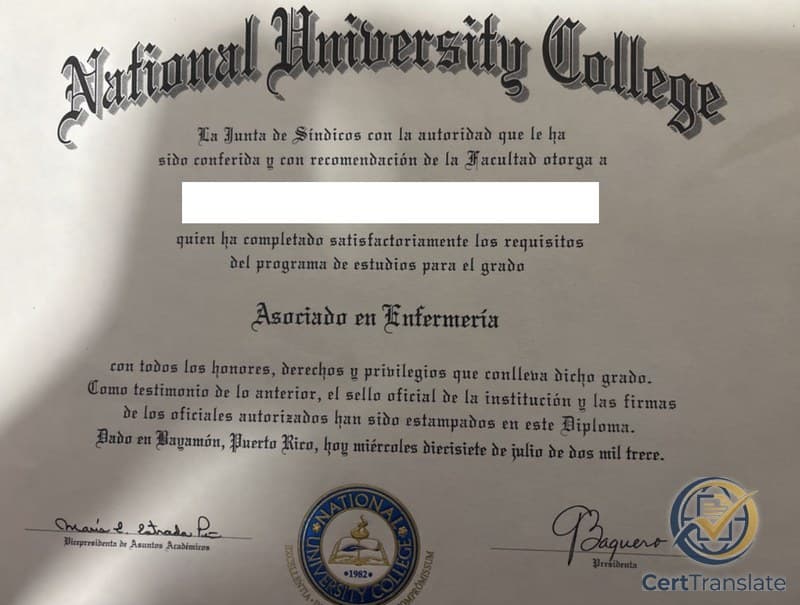
A client submitted a Puerto Rican Associate in Nursing diploma (Diploma de Asociado en Enfermería) issued by National University College in Bayamón, Puerto Rico. The diploma is entirely in Spanish — ceremonial academic Spanish, in fact, with a blackletter display typeface on both the institution name and the graduate's name.
The certified Spanish to English translation was needed for a mainland U.S. licensing file. The client had assumed, reasonably, that because Puerto Rico is a U.S. territory the document would be accepted as-is — only to be asked for an English translation by the reviewing agency.
Why This Required Special Handling
The core translation problem is not the Spanish itself — standard Spanish academic language poses no difficulty. The problems sit in the details: the blackletter typeface on the graduate's name (common on U.S. and Puerto Rican diplomas) is genuinely hard to read and the single most frequent source of name transcription errors on certified diploma translations. Letters that look straightforward when printed in a normal typeface — the "a" vs. "o" distinction, or an "r" vs. "v" — require letter-by-letter cropping and verification when rendered in gothic script.
A second layer: the date is spelled out in ceremonial words rather than digits ("hoy miércoles diecisiete de julio de dos mil trece"). A literal English translation must preserve that ceremonial register without silently converting the spelled-out form to a purely numeric date — diplomas traditionally retain the long form.
A third layer: the degree name. "Asociado en Enfermería" must be rendered as "Associate in Nursing" — using the academic-discipline form standard in U.S. university catalogs — not "Associate in Infirmary" or other literal renderings. This is a recurring pitfall when the Spanish noun has a literal English cognate that would be wrong in the academic context.
Finally, the seal carries a Latin institutional motto (EXCELLENTIA • INTEGRITAS • COMPROMISSUM) around the outer ring. Latin institutional mottos are part of the seal's identity and are retained in Latin, not paraphrased into English.
How We Handled It
We reproduced the diploma in U.S. Letter landscape orientation — matching the original's dimensions — with the same block structure: institution name at the top, ceremonial paragraph conferring the degree, the graduate's name set apart, the degree itself set apart, the closing ceremonial paragraph, the issuance location and date, and the three-column signature row with the institutional seal in the center.
Names were verified from high-resolution crops of the blackletter text, read letter by letter rather than pattern-matched. The degree line was rendered as "Associate in Nursing" per U.S. academic catalog convention. The Latin motto on the seal was retained in Latin and described in brackets within the seal notation. The two handwritten signatures were described with legibility qualifiers — the fully printed titles ("Vice President for Academic Affairs," "President") were translated literally from "Vicepresidenta de Asuntos Académicos" and "Presidenta."
The ceremonial date was rendered in natural U.S. English while preserving the long ceremonial form: "this Wednesday, the seventeenth day of July, two thousand thirteen." The Translator's Notes section documents the ceremonial date rendering, the partial illegibility of the two handwritten signatures, and the institutional context for readers unfamiliar with Puerto Rican higher education.
"The issuance date in the original is spelled out in words in ceremonial diploma style ("hoy miércoles diecisiete de julio de dos mil trece"); the translation preserves that ceremonial wording. The corresponding Gregorian date is July 17, 2013. The two signatures at the bottom of the diploma are handwritten: the surname of the Vice President for Academic Affairs reads "María L. Estrada" followed by an additional surname rendered as a calligraphic flourish that is not fully legible in the scan; the President's signature shows a legible surname "Baquero" preceded by a stylized initial letter that is not unambiguously identifiable. The Latin institutional motto on the seal — EXCELLENTIA • INTEGRITAS • COMPROMISSUM — is retained in Latin, as is standard for institutional mottos."

Keeping the translation a faithful visual mirror of the original matters for this document class: a mainland reviewer who has never seen a Puerto Rican diploma before should be able to hold both documents side by side and see the same layout in both languages. It is a small detail with a large effect on credibility — the translation looks like the diploma it translates, not like a retyped summary.
The Outcome
The certified English translation was delivered to the client for inclusion in their mainland U.S. credential review file. The layout mirror, the precise degree rendering ("Associate in Nursing"), and the explicit Translator's Notes together give the reviewing agency a translation that reads naturally in English and maps field-for-field onto the Spanish original.
Puerto Rican diplomas are a steady share of our Spanish diploma translation volume — the "it's already part of the U.S., why do I need a translation" reaction is close to universal among first-time applicants, and we've handled diplomas from NUC, Universidad de Puerto Rico, Inter American University, Pontifical Catholic University of Puerto Rico, and Ponce Health Sciences University using the same layout-faithful approach.
What This Means for You
A Puerto Rican diploma issued in Spanish still needs a certified English translation for most mainland U.S. purposes — licensing boards, credential evaluators, employers, and federal agencies review documents in English and do not treat Puerto Rican Spanish-language credentials as an exception.
A layout-faithful certified translation that preserves institutional names, degree titles in their U.S. academic form, and ceremonial date formulas — with Translator's Notes for any handwritten or decorative elements — gives the reviewing agency everything it needs to process the credential without follow-up questions.
Have a similar situation?
We translate Puerto Rican diplomas, transcripts, and certifications for mainland U.S. licensing and credential review regularly.
Related Cases & Resources
Sources & References
- Nursing Licensure — National Council of State Boards of Nursing·NCSBN·Verified 2026-05-26
Explore the Hub
All identifying information has been removed from document images. The graduate's name has been masked. Case details are shared with client permission. No personal data is stored or displayed on this page.