




How do you translate a Japanese vehicle export certificate (輸出抹消仮登録証明書) for U.S. Customs and DMV titling?
TL;DRA U.S.-bound JDM vehicle owner needed the Japanese 輸出抹消仮登録証明書 (Export Deregistration Certificate) translated for U.S. Customs and DMV titling. The form is a bilingual landscape grid with embedded MLIT codes, Reiwa and Heisei era dates, and an Owner row stacked directly above a masked User row. We mirrored the grid, preserved the masked "***" User fields verbatim, converted era dates to Gregorian, and noted every bracketed code, seal, and watermark in the Translator's Certification.
Case Specifications
- Document
- Vehicle Export Deregistration Certificate (輸出抹消仮登録証明書)
- Foreign Name
- 輸出抹消仮登録証明書
- Country
- Japan
- Languages
- Japanese → English
- Submitted To
- U.S. Customs and Border Protection / state DMV
What We Received
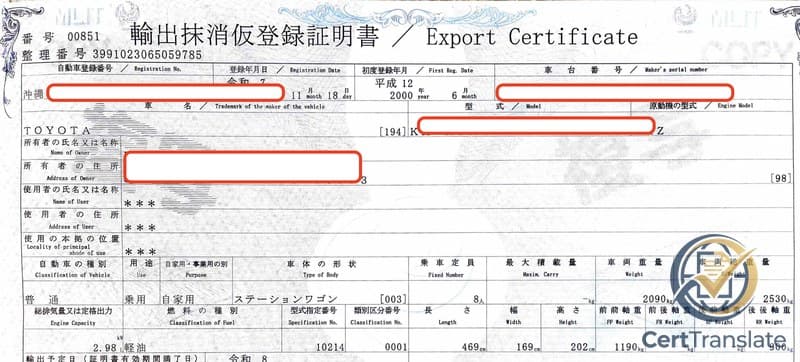
A client submitted a Japanese 輸出抹消仮登録証明書 — the official Export Deregistration Certificate issued by a District Transport Bureau under Japan's Ministry of Land, Infrastructure, Transport and Tourism (MLIT). The certificate documents that a registered Japanese vehicle has been formally deregistered from the Japanese road registry for the purpose of export, and is the controlling document U.S. Customs and Border Protection reviews on entry. The vehicle was a roughly twenty-year-old Toyota SUV with a 1KZ-series diesel engine, registered in Okinawa.
The translation was needed for two downstream filings: U.S. Customs entry paperwork (CBP Form 7501 supporting documentation) and the eventual state DMV title application once the vehicle cleared Customs. Both require an English version of every text element on the source — a <a href="/languages/japanese">certified Japanese translation</a> where nothing on the original is left in Japanese.
Why This Required Special Handling
Three properties of the source make this document harder than it looks at a glance.
First, the form is bilingual on the label side — every field is printed with the Japanese kanji label and an English label underneath it ('自動車登録番号 / Registration No.', '車台番号 / Maker's serial number'). That looks helpful, but it is also a trap: it gives the translator the false sense that nothing needs to be translated because the English is already there. The values themselves, the era dates, the stamp text, and the remarks paragraph are entirely in Japanese, and the printed English labels sometimes do not match the literal kanji ('Maker's serial number' sits over 車台番号, which is the vehicle chassis number — a different concept from an engine serial number). A translator who treats the English labels as the translation will produce a confused mapping.
Second, the Owner row (所有者) and User row (使用者) sit directly stacked, with three more 'use' rows (Address of User, Locality of Principal Abode of Use) immediately below. On this certificate, the Owner rows were filled with the registrant's name and APO address, and all three User rows were printed with '***' — the Japanese registrar's way of indicating that the legal owner and the day-to-day user are the same person and the user fields are intentionally suppressed. Visually scanning down the column, the eye lands on the only filled name in the lower half of the block and pattern-matches it to the nearest field label, which is the User label. That is exactly how earlier draft translations of this same certificate ended up listing the registrant as the User and leaving the Owner fields blank — a substantive error, because U.S. Customs and the receiving DMV both treat the Owner field as the legal owner of the vehicle for title transfer.
Third, the certificate carries Japanese-system data that has to be carried over verbatim: era dates (令和7年 = Reiwa 7 / 2025; 平成12年 = Heisei 12 / 2000), MLIT classification codes printed in square brackets ([194] before the model designation, [003] for the body type), and a 'COPY' (見本) diagonal watermark across the entire page. None of these can be silently normalized or dropped; CBP officers and state DMV clerks cross-reference them against the vehicle's chassis plate and against the export entry record.
How We Handled It
We built the translation as a single landscape page that mirrors the source's grid layout — same row order, same column groupings, bilingual stacked headers in each cell (Japanese label on top, English label below) — so a Customs officer or DMV clerk can lay the translation alongside the original and check each value position-for-position. Mirroring the source layout is not a stylistic choice on a registry form; it is the lowest-friction way for a downstream reviewer to verify completeness.
For the Owner/User block, we reproduced both rows in their source order and preserved the masked User fields exactly as printed — '*' — rather than collapsing them or rewriting them as 'N/A' or '[Blank]'. The Owner row was filled with the registrant's name and APO address (<code>CAMP BUTLER FPO 98773 [98]</code>, with the bracketed <code>[98]</code> MLIT regional code retained verbatim). The Translator's Certification then includes a numbered note stating that the User fields are masked as '*' in the source and that the Owner fields carry data, so an adjudicator does not have to infer which side of the block is which.
Era dates were written in Japanese era notation alongside the Gregorian equivalent on first use (e.g., 'Reiwa 7 (2025), November 18', 'Heisei 12 (2000), June'), with the conversion convention recorded in a Translator's Note. Bracketed MLIT codes ([194], [003], [98]) were kept verbatim in place and explained in a note rather than translated or moved to a glossary. Stamps and watermarks were marked with explicit <code>[STAMP: …]</code> blocks containing English text — the MLIT emblem, the District Transport Bureau Director-General seal, and the diagonal 'COPY (見本)' watermark across the page. The same completeness standard underpins the <a href="/guides/certificate-of-accuracy">certificate of accuracy</a> we sign at the end of the file.
"The original is a single landscape page issued by a District Transport Bureau under Japan's Ministry of Land, Infrastructure, Transport and Tourism (MLIT). Japanese era dates have been converted to the Western (Gregorian) calendar — Reiwa 7 = 2025; Reiwa 8 = 2026; Reiwa 4 = 2022; Heisei 12 = 2000 — with the original era notation retained alongside. U.S. customary unit equivalents (lb, cu in, ft) have been added in parentheses next to each metric value at the client's request (1 kg ≈ 2.20462 lb; 1 cm ≈ 0.3937 in; 1 km ≈ 0.62137 mi; 1 L ≈ 61.0237 cu in), so the source metric values remain the primary verifiable numbers. Fields shown as '***' (asterisks) in the source — Name of User, Address of User, and Locality of Principal Abode of Use — are reproduced as they appear on the original document; the Name of Owner and Address of Owner fields are filled in. The dash '—' in axle-weight and maximum-carrying-weight fields indicates that no value was printed in the source for those fields. Bracketed code numbers [194], [003], and [98] are MLIT classification/specification codes printed alongside the respective fields in the source and have been reproduced verbatim. The document bears a diagonal 'COPY' (見本) watermark across the entire page; multiple official seals and QR codes/barcodes are also present and have been described in [STAMP] blocks. The prefecture/issuing-office name 'Okinawa' (沖縄) has been translated from kanji. Proper names appearing in Latin script in the source are reproduced verbatim."

The Outcome
The certified translation was delivered to the client in both DOCX and PDF, formatted as a landscape page mirroring the original grid plus a portrait-friendly Translator's Certification at the end. Every text element on the source — title block, vehicle data grid, Owner/User rows, classification grid, engine and axle weights, scheduled export date, the 備考 (Remarks) paragraph, mileage readings, the District Transport Bureau Director-General attribution, and all stamps and watermarks — appears in English in the translation. No portion of the source remains in Japanese.
What This Means for You
A Japanese Export Deregistration Certificate (輸出抹消仮登録証明書) for a JDM import to the U.S. has to be translated as a complete mirror of the original — not just the obvious fields like make, model, and chassis number, but also the era dates, the MLIT classification codes in brackets, the masked Owner/User rows in their source order, and every stamp and watermark. If your translator omits the bracketed codes, normalizes the '***' user fields, or treats the bilingual English labels on the form as the finished translation, U.S. Customs or your state DMV is likely to come back with questions before they accept the title transfer. A <a href="/languages/japanese">certified Japanese translation</a> that preserves the source's grid layout makes that downstream review fast and unambiguous.
Have a similar situation?
We translate Japanese vehicle export deregistration certificates and related JDM-import paperwork into English for U.S. Customs entry and state DMV titling.
Related Cases & Resources
Sources & References
- Importing a Motor Vehicle·U.S. Customs and Border Protection (CBP)·Verified 2026-07-03
- Ministry of Land, Infrastructure, Transport and Tourism (MLIT) — English portal·Government of Japan·Verified 2026-07-03
Explore the Hub
All identifying information has been removed from the document image. The registrant's name, vehicle registration number, chassis number, and Reference No. are not disclosed in the case text. Case details are shared with client permission. No personal data is stored or displayed on this page.