



How do you translate the SEP electronic-title XML block on a Mexican diploma?
TL;DRA Mexican licenciatura diploma had its SEP TituloElectronico XML block printed on page 2 — tag names, identifiers, and Base64 cryptographic signatures that prove the diploma is genuine when validated against the SEP SIGED registry. The certified translation preserved tags and Base64 strings verbatim, translated only the Spanish-language attribute values in brackets, and explicitly marked the long X.509 certificate string as truncated. The diploma and its accompanying Acta de Titulación were delivered for U.S. credential evaluation.
Case Specifications
- Document
- Mexican licenciatura diploma + Acta de Titulación
- Foreign Name
- Título de Licenciada en Derecho + Acta de Titulación
- Country
- Mexico
- Languages
- Spanish → English
- Submitted To
- U.S. credential evaluation
What We Received
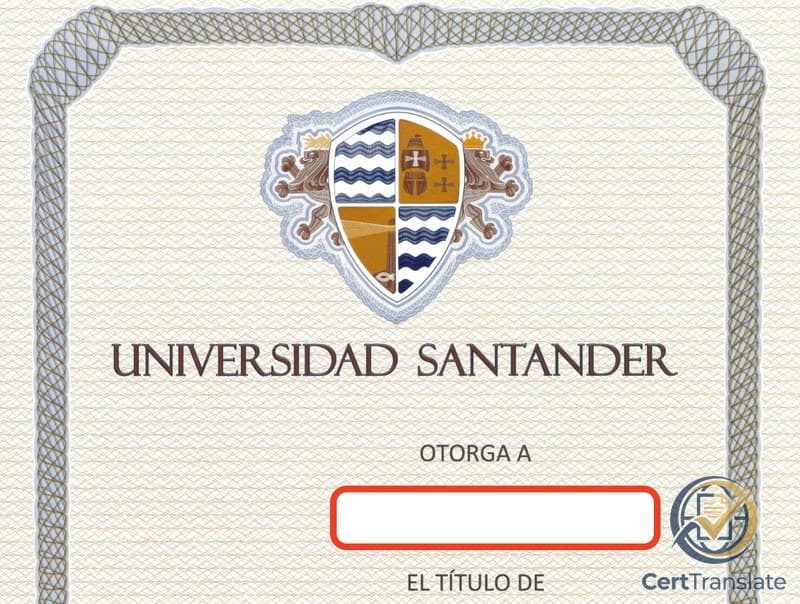
A client submitted a two-page Mexican <a href="/documents/diploma">licenciatura diploma</a> issued by Universidad Santander (a private university operating in Jalisco under federal RVOE) — a Título de Licenciada en Derecho con Acentuación en Investigación y Docencia — together with a separate Acta de Titulación documenting the credential committee meeting and the modality of titulación. Page 1 of the diploma was the human-readable certificate. Page 2 was, in effect, a print-out of the SEP TituloElectronico XML record from the SIGED system: tag names like <code>FirmaResponsable</code> and <code>Autenticacion</code>, attribute identifiers (CURP, cveInstitucion, cveCarrera, numeroRvoe, folioDigital, noCertificadoResponsable, noCertificadoAutoridad), and Base64-encoded cryptographic signatures (sello, certificadoResponsable, selloTitulo, selloAutenticacion). The translation was needed for U.S. credential evaluation as part of a <a href="/languages/spanish">Spanish-to-English certified translation</a> package.
Why This Required Special Handling
The XML block is the diploma's authenticity proof. Since the 2018 SIGED rollout, Mexican electronic titles are signed by the awarding institution and counter-signed by SEP, and the resulting XML record — including the Base64 signatures — is what a credential evaluator round-trips against the SEP registry to confirm the diploma is genuine. The strings have byte-exact value, not lexical value: a single character substitution invalidates the signature.
A certified translation has to be 'complete and accurate', and it has to be readable. Those two requirements pull in different directions on a page like this. Treating the XML as text to be translated would corrupt the cryptographic payload and produce a document that fails authentication. Silently dropping the XML would fail the completeness requirement and make the translation visibly shorter than the original. And mechanically retyping a 1,000-character Base64 X.509 certificate from a small-print PDF introduces OCR-style errors that a credential evaluator would notice.
There is no established convention in U.S. credential evaluation for how to render this block in a target-language translation. Each translator has to make a defensible call and document it in a Translator's Note — exactly the kind of decision a <a href="/guides/certificate-of-accuracy">certificate of accuracy</a> is supposed to cover.
How We Handled It
We treated the XML block as machine-readable content rather than natural-language text. Tag names (TituloElectronico, FirmaResponsables, FirmaResponsable, Institucion, Carrera, Profesionista, Expedicion, Antecedente, Autenticacion) were preserved verbatim. Attribute names (curp, idCargo, cargo, abrTitulo, cveInstitucion, nombreInstitucion, cveCarrera, nombreCarrera, fechaInicio, fechaTerminacion, idAutorizacionReconocimiento, autorizacionReconocimiento, numeroRvoe, fechaExpedicion, idModalidadTitulacion, modalidadTitulacion, folioDigital, fechaAutenticacion) were preserved verbatim. Identifier values (CURP, certificate numbers, RVOE number, folioDigital UUID, ISO 8601 dates) were preserved verbatim because they are machine-readable, not translated.
Where an attribute value was Spanish-language prose — for example, <code>nombreCarrera="LICENCIATURA EN DERECHO, CON ACENTUACIÓN EN INVESTIGACIÓN Y DOCENCIA"</code> — we kept the original value inside the XML block and added the English rendering in brackets in the same line, so a reader can see both without breaking the XML structure.
Base64 signature strings were handled in two tiers. The shorter ones — <code>sello</code>, <code>selloTitulo</code>, <code>selloAutenticacion</code> — were transcribed in full from the source. The long X.509 <code>certificadoResponsable</code> string runs to over a thousand characters of small print and is the public certificate, not a unique signature; we abbreviated it with the literal marker <code>[Base64 certificate truncated for readability]</code> at the omission point and noted in the certification page that the authoritative source of these cryptographic values is the SEP electronic-title record itself.
On page 1 we rendered 'Licenciada en Derecho, con Acentuación en Investigación y Docencia' as 'Bachelor of Laws, with Concentration in Research and Teaching' — the closest U.S. equivalent of the Mexican five-year licenciatura, with the female-form ending preserved by context — and explained 'RVOE' (Reconocimiento de Validez Oficial de Estudios) in a Translator's Note. The Acta de Titulación rendered the modality of titulación as 'COURSEWORK MODALITY' with the original term <code>["CURSO"]</code> retained in brackets, because <em>aprobó conforme a CURSO</em> is a registry formula, not a sentence.
"Page 2 of the diploma source contains an XML electronic-title data block (TituloElectronico). Tag names, attribute names, and identifiers have been preserved verbatim because they are machine-readable, not natural-language text. The long Base64-encoded value of the 'certificadoResponsable' attribute has been abbreviated with an explicit '[Base64 certificate truncated for readability]' marker; the 'sello', 'selloTitulo', and 'selloAutenticacion' signature strings are reproduced in full and may contain minor OCR-style discrepancies due to the small print on the original. The authoritative source of these cryptographic values is the SEP electronic-title record itself."

The Outcome
The certified translation was delivered as two DOCX/PDF deliverables — the diploma (with page 1 in human-readable English and page 2 reproducing the XML block under the conventions above) and the Acta de Titulación — each with a signed Translator's Certification page documenting the date-format conversions, the rendering of 'Licenciada en Derecho', the RVOE explanation, the verbatim XML preservation rule, and the explicit truncation marker on the X.509 certificate string. The credential evaluator can re-validate the diploma against SIGED on the original Spanish file and read the credential in English on the translation.
What This Means for You
A certified translation of a Mexican electronic diploma has to leave the SEP TituloElectronico XML block intact — tag names, attribute names, identifiers, and Base64 signatures preserved verbatim — and translate only the Spanish-language attribute values in brackets. Mechanical retyping of long X.509 certificate strings from small-print PDFs is error-prone and not the translation's job; an explicit truncation marker, with the SEP registry named as the authoritative source, is honest and auditable. If you are submitting a Mexican licenciatura, maestría, or doctorado for U.S. credential evaluation, run the file against a <a href="/guides/document-translation-checklist">document translation checklist</a> first — the XML block is part of the document, not formatting noise.
Have a similar situation?
We translate Mexican licenciatura, maestría, and doctorado credentials — including SEP electronic-title XML blocks and Acta de Titulación protocols — for U.S. credential evaluation, state licensing boards, and USCIS petitions.
Related Cases & Resources
Sources & References
- SIGED — Consulta de Títulos Electrónicos (Mexican Secretariat of Public Education)·Secretaría de Educación Pública (SEP), Mexico·Verified 2026-06-16
Explore the Hub
Certified Translation
Documents
Languages
All identifying information has been removed from document images. Case details are shared with client permission. No personal data is stored or displayed on this page.