




How do you keep two birth certificates from different states translated consistently in the same packet?
TL;DRTwo members of one family filed their Mexican birth certificates (actas de nacimiento) in the same USCIS packet. The certificates came from different states — Veracruz and the State of Mexico — so they cited different civil-code articles and different registry authorities. We translated both against one shared glossary, so every common civil-registry label reads identically across the two documents while each certificate keeps its own legal citations. Both were delivered as a consistent set.
Case Specifications
- Document
- Birth certificate (set of two)
- Foreign Name
- Acta de Nacimiento (×2)
- Country
- Mexico
- Languages
- Spanish → English
- Submitted To
- USCIS family-based filing (supporting records)
What We Received
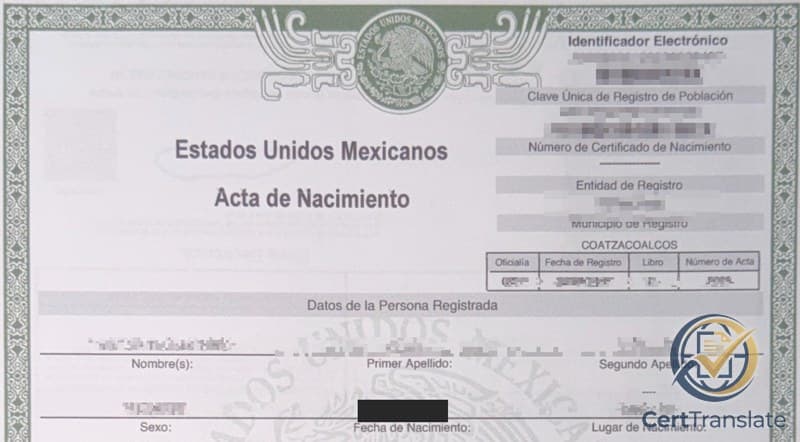
Two members of the same family asked us to translate their Mexican birth certificates for one USCIS filing. Both are one-page digital actas de nacimiento. Both use the modern electronic Civil Registry format, with a CURP, a QR code, and an electronic-signature block. On their own, each is routine certified birth certificate translation work.
The two certificates were issued in different Mexican states. One is from Veracruz. The other is from the State of Mexico (Estado de México). Each state Civil Registry writes its certification clause differently. The packet needed both documents to read as a matching set. That is the core of our consistent Spanish birth-certificate translation across a family filing.
Why This Required Special Handling
USCIS reviews a filing as one packet. An adjudicator reads the documents together. When two birth certificates translate the same Spanish phrase two different ways, the packet looks inconsistent. One rendering of "fracción" might be "Section" and another "paragraph." One rendering of "Doy fe" might be "I so certify" and another "In witness whereof." Each is defensible alone. Side by side, they undercut each other.
The difficulty here is that the two source documents genuinely differ. Veracruz cites Articles 670 and 680 of its Civil Code. The State of Mexico cites Articles 3.1 and 3.7 of a different Civil Code. The issuing authorities differ too. One clause names a Secretariat of Government; the other names the Civil Registry. The translator has to keep each document's real citations while holding the shared vocabulary identical. Our USCIS translation requirements guide explains why this consistency matters.
How We Handled It
We built one glossary before translating either document. Every shared civil-registry label was fixed to a single English term. "Fracción" is "Section" in both. "Doy fe" is "I so certify" in both. "Datos de Filiación" is "Parentage Information" in both. "Oficialía" is "Registry Office" in both. "Entidad de Registro," "Municipio de Registro," and "Fecha de Registro" map to "Registration Entity," "Registration Municipality," and "Registration Date" in both.
Each document kept its own legal citations exactly. The Veracruz certificate cites its Articles 670 and 680, plus Article 35, Section IX, of the Internal Regulations of the Secretariat of Government. The State of Mexico certificate cites its Articles 3.1 and 3.7, plus Article 6, Section XXXVI, and Article 39 of the Internal Regulations of the Civil Registry. We did not flatten these into one shared citation. They are different statutes, and they stay different.
We also kept the issuing authorities distinct. "Secretaría de Gobierno" is the State of Veracruz's Secretariat of Government. It is not the federal Ministry of the Interior (Gobernación). Rendering it as "Secretariat of the Interior" would name the wrong body. A final cross-document pass checked every shared term, every month name, and both certification clauses against the glossary.
"These two certified translations are of Mexican birth certificates (actas de nacimiento) issued by two different state Civil Registries — the State of Veracruz and the State of Mexico. They were translated as a set against one English glossary, so the shared civil-registry terminology is identical across both documents: "fracción" = "Section," "Doy fe" = "I so certify," "Datos de Filiación" = "Parentage Information," "Oficialía" = "Registry Office." Each certificate's distinct legal citations are preserved as written. "Secretaría de Gobierno" (Veracruz) is rendered "Secretariat of Government," the state executive secretariat — not the federal Ministry of the Interior (Gobernación)."

The Outcome
Both certified translations were delivered together for the family's USCIS filing. The shared terminology is identical across the two documents. Each certificate's own legal citations stay intact.
We use one glossary for every multi-document family packet now. When two birth certificates land in the same filing, they leave as a matching set. See our document translation checklist for the consistency steps we run.
What This Means for You
Consistency across a packet matters as much as accuracy within a single document. If you are filing more than one foreign-language document in the same case, have them translated together against one glossary. Two birth certificates from different states will cite different laws — that is normal. The English terminology for the parts they share should still match word for word. Our Spanish translation services keep family packets consistent.
Have a similar situation?
We translate Mexican birth certificates (actas de nacimiento) — and full family document sets — into English for USCIS family-based filings, green-card petitions, and university admissions. Multiple documents in one packet are translated against a shared glossary so the terminology matches across every page, while each document keeps its own registry citations. $24.95/page, delivered in 24 hours.
Related Cases & Resources
Sources & References
- USCIS — Meet Translation Requirements·U.S. Citizenship and Immigration Services·Verified 2026-07-15
Explore the Hub
Certified Translation
Documents
Languages
Immigration
Accepted By
All identifying information has been removed from this case study and from the document image. The registered parties' names, dates of birth, CURPs, the certificate and electronic-identifier numbers, the parents' names, and the electronic-signature hash strings are masked or not displayed. Case details are shared with client permission. No personal data is stored or displayed on this page.