




Can a certified translation add a parent's date of birth or surname to a US birth certificate when the source doesn't show it?
TL;DRAn Illinois short-form birth certificate translation was needed in Spanish for a Mexican consulate dual-citizenship filing. The parents' rows carried integer ages (20, 23) in a 'Date of Birth or Age at Time of Birth' field — no dates. The client asked us to add DOBs and full Mexican-convention surnames they had verified separately. We translated strictly what was on the source, documented the field structure in a Translator's Note, and advised on documents the consulate accepts for missing fields.
Case Specifications
- Document
- Birth certificate (short form) with Hague Apostille
- Country
- United States
- Languages
- English → English
- Submitted To
- Mexican consulate (registro de doble nacionalidad / dual citizenship)
What We Received
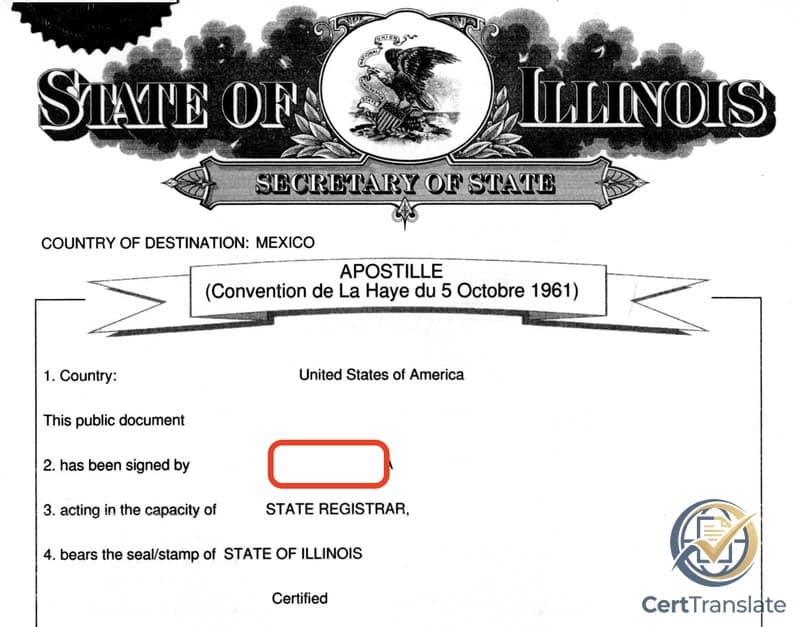
A client submitted an Illinois 'Certification of Birth Record' (single-page short form, issued by the IDPH Division of Vital Records in Springfield) with a Hague Apostille from the Illinois Secretary of State, country of destination Mexico, and asked for a certified English-to-Spanish birth certificate translation for a Mexican consulate filing — registro de doble nacionalidad.
Both parents were Mexican-born. The form's parents' block uses a single 'DATE OF BIRTH OR AGE AT TIME OF BIRTH' field per parent — the registrar may enter either — and on this certificate that field contained the integer ages 20 (mother) and 23 (father). No actual date of birth was recorded for either parent. The client wrote to us separately with the parents' full Mexican-convention paternal-plus-maternal surnames and their verified dates of birth, and asked us to include them in the translation so the consulate would have what it wanted.
Why This Required Special Handling
Mexican consulates registering doble nacionalidad expect the foreign-issued birth certificate to show each parent's full name and date of birth — these are the fields that link the bearer to the parents on the Mexican registry side. US short-form certificates often do not show this. Several US states, Illinois among them, use a single 'date of birth or age at time of birth' field that the registrar may fill either way; on this 1981 IDPH form, both parents' rows were filled with age. The client knew the consulate would want more and sent us the missing data — the parents' Mexican-convention paternal+maternal surnames and DOBs verified against the parents' own documents.
A certified translation is a faithful rendering of what the source contains. A translator cannot add fields, expand short-form names, or correct the source, even when the client has supplied data the translator believes accurate. Inserting client-supplied surnames or dates makes the translation no longer match the document the apostille certifies — the consulate compares the translation against the apostilled source on its own desk, and any divergence reads as a translation error, not a helpful expansion.
The parents' name fields were the same shape of problem in miniature. The source listed 'MARTHA ZIZUMBO' on the mother's line and 'ROSELLO CORTEZ' on the father's — single surnames each. The client had supplied 'Martha Zizumbo Soto' and 'Rosello Cortez Martinez' — full Mexican-convention paternal-plus-maternal forms. Adding the maternal surnames to the translation, even with the client's confirmation, would create the same source-vs-translation mismatch (see our name mismatch guide) and would not survive consular review.
How We Handled It
We translated the form exactly as printed. The 'DATE OF BIRTH OR AGE AT TIME OF BIRTH' rows were rendered with their full Spanish label ('FECHA DE NACIMIENTO O EDAD AL MOMENTO DEL PARTO') and the integer values '20' and '23' in the mother's and father's cells respectively, with no date of birth inserted in either place. The name fields rendered 'MARTHA ZIZUMBO' and 'ROSELLO CORTEZ' — no second surname added. The Hague Apostille was rendered with the 1961 Convention's standard Spanish wording on the ten numbered lines (1. País / 2. ha sido firmado por / 3. quien actúa en calidad de / etc.).
A Translator's Notes section on the certificate-of-accuracy page documented the field structure and the date-format conversions, so a Spanish-reading consular officer can see at a glance what is and is not on the source. The notes do not editorialise about whether the client's separately supplied data is correct.
"Translator's Notes: (1) The original document is in English; this translation is into Spanish for use in Mexico. (2) Numeric dates on the source ('12/16/2025', '03/27/2026', '10/02/1981') have been rendered in full Spanish form ('16 de diciembre de 2025', '27 de marzo de 2026', '2 de octubre de 1981') to avoid the DD/MM/AAAA vs MM/DD/AAAA ambiguity. (3) On both parent rows, the source field 'DATE OF BIRTH OR AGE AT TIME OF BIRTH' contains an integer age (Mother: 20, Father: 23) rather than a date of birth; this translation preserves the field exactly as printed. (4) The parents' names appear on the source exactly as: 'MOTHER/PARENT'S NAME PRIOR TO FIRST MARRIAGE/CIVIL UNION: MARTHA ZIZUMBO' and 'FATHER/PARENT'S CURRENT LEGAL NAME: ROSELLO CORTEZ'. No additional surnames are present in the source and none have been added. (5) The third page of the original is a security backing sheet with tactile holographic state seals and an authenticity-test text block; textual content has been translated and visual elements are described in brackets."

After delivery we wrote separately to the client about the consular packet: the parents' own Mexican actas de nacimiento (cleanest, since the maternal surname and DOB are primary-source data on each), INE / IFE cards, or the parents' marriage certificate are the documents that typically fill the gap. None of this advice appears inside the translation — translators do not give consular guidance in a certified document — but it belongs in the client communication around the order.
The Outcome
The certified Spanish translation was delivered with the source rendered exactly as printed — integer ages on the parents' rows, single-surname names in the parents' name fields, the Hague Apostille reproduced in its bilingual Spanish form, and the security backing page translated in full. The accompanying Translator's Notes made the field structure of the source legible to a Spanish-reading consular officer.
We have applied the same approach on every US short-form birth certificate translation where a parent field is left in 'age' rather than 'date' form, on every Illinois, California, Texas, and New York certificate where the client has separately supplied additional parent data, and on every reverse-direction filing for Mexican consular dual citizenship.
What This Means for You
A certified translation reproduces the source — it cannot add a parent's date of birth, expand a single-surname name field into a paternal-plus-maternal form, or fill in any other field the registrar left in age form, blank, or short. If a Mexican consulate's doble nacionalidad packet needs information not on your US birth certificate, the translator is not the right place to add it; the parents' own Mexican actas de nacimiento, INE / IFE cards, or marriage certificate are the documents the consulate accepts as primary-source evidence.
Have a similar situation?
We translate US birth certificates with Hague apostilles into Spanish for Mexican consulates regularly — including short-form certificates that list parents' age instead of date of birth, certificates with single-surname parent name fields, and certificates accompanied by an apostille whose ten numbered lines need to be rendered in their bilingual Spanish form.
Related Cases & Resources
Sources & References
- Convention Abolishing the Requirement of Legalisation for Foreign Public Documents (Apostille Convention, 1961)·Hague Conference on Private International Law (HCCH)·Verified 2026-06-09
Explore the Hub
Certified Translation
Documents
Languages
Immigration
All identifying information has been removed from document images. Case details are shared with client permission. No personal data is stored or displayed on this page.