




How do you translate a trilingual apostille without duplicating the English labels already in the original?
TL;DRA Spanish criminal record certificate and its Hague Convention apostille were needed for university admission in China. The apostille's trilingual field labels — Spanish, English, and French — meant that translating the Spanish labels would duplicate the English text already present. We preserved the original label structure, translated only the field values, transcribed seal text with bracketed English translations, and reproduced the certificate's color-coded summary table. Both documents were delivered with detailed Translator's Notes.
Case Specifications
- Document
- Criminal record certificate + apostille
- Foreign Name
- Registro Central de Penados / Apostilla (Convention de La Haye)
- Country
- Spain
- Languages
- Spanish → English
- Submitted To
- University admission (China)
What We Received
A client submitted two documents for certified translation: a Spanish criminal record certificate (Registro Central de Penados) and its accompanying Hague Convention apostille. Both were issued by Spain's Ministry of the Presidency, Justice and Relations with the Cortes (Ministerio de la Presidencia, Justicia y Relaciones con las Cortes).
The criminal record certificate contains a color-coded header table where "No Constan" (No Records Found) is highlighted on a dark background, "Persona Física" (Natural Person) appears in red, and dates are color-accented — visual formatting that carries semantic meaning about the certificate's result.
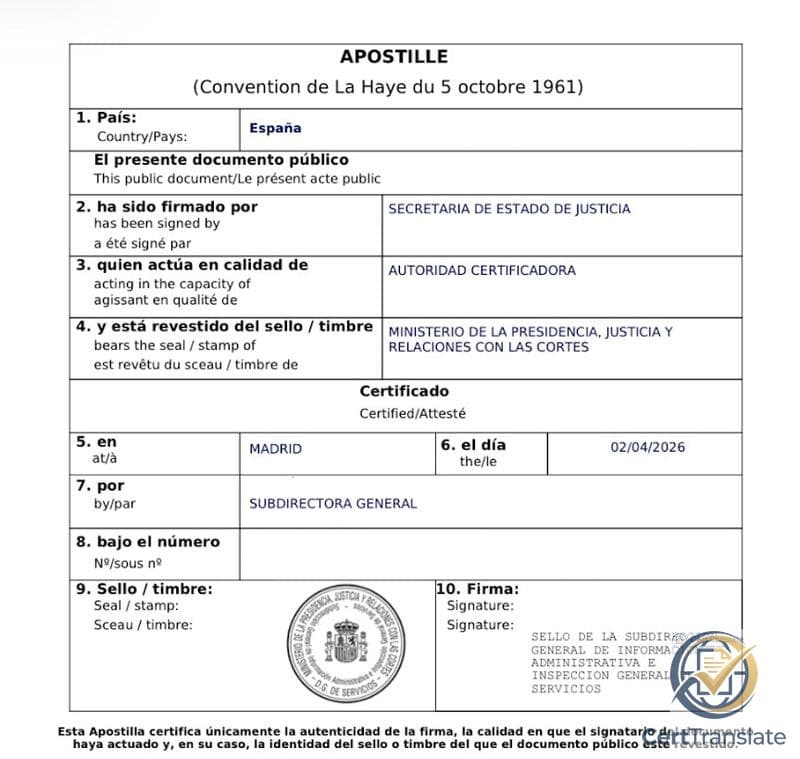
The apostille follows the standardized Hague Convention format with every field label printed in three languages: Spanish (primary), English, and French. The field values are in Spanish only. The certified translation was needed for university admission in China.
Why This Required Special Handling
The apostille presents a structural translation problem. Each field has a numbered Spanish label, followed by the same label in English and French. For example, "Sello / timbre:" translates to "Seal / stamp:" — which is identical to the English sub-label already printed on the next line. Translating the Spanish labels produces duplicate English text throughout the document.
If you remove the original English sub-labels to avoid duplication, you're omitting content from the original. If you translate the Spanish labels, the result looks like a formatting error. The translator needs to recognize that apostille labels are standardized convention elements, not content requiring translation.
The seal text on the apostille reads "MINISTERIO DE LA PRESIDENCIA, JUSTICIA Y RELACIONES CON LAS CORTES — D.G. DE SERVICIOS" in Spanish. Providing only the English translation makes it impossible for a reviewer to verify that the translated seal matches the original — a concern when the document is being verified by a Chinese university with its own authentication process.
The criminal record certificate's color-coded table poses a separate problem. A text-only translation listing "Positive / Negative / No Records Found" without visual distinction doesn't convey which result applies. The original uses color to make "No Records Found" immediately obvious.
How We Handled It
For the apostille labels, we preserved the original trilingual structure exactly. The Spanish label stays as the primary (bold, numbered), the English and French sub-labels stay in italic below. Only the field values were translated, with the original Spanish preserved and the English translation added in brackets.
"Translator's Note (Apostille): 1. The original apostille is a trilingual document (Spanish, English, and French). The field labels already appear in all three languages; the field values have been translated from Spanish into English. The disclaimer section at the bottom appears in three language blocks — the Spanish block has been translated into English, the English and French blocks have been preserved verbatim. 2. The date 02/04/2026 in the original is in DD/MM/YYYY format and has been rendered as April 2, 2026. 3. "SUBDIRECTORA GENERAL" has been translated as "Deputy Director General." The feminine form "-a" in the original indicates the officeholder is female. 4. The document is electronically signed. The seal described in field 9 is a digital reproduction of the official seal of the Ministry."

For the seal, we transcribed the original Spanish text as it physically appears, then added the English translation in parentheses within bracket notation: "[SEAL: MINISTERIO DE LA PRESIDENCIA, JUSTICIA Y RELACIONES CON LAS CORTES — D.G. DE SERVICIOS — (Ministry of the Presidency, Justice and Relations with the Cortes — D.G. of Services) — with coat of arms of Spain]."
For the criminal record certificate, we reproduced the color scheme from the original header table — dark blue for "European Union," dark red for "Spain," and contrasting backgrounds for the applicable result. Dates in DD/MM/YYYY format were rendered as Month DD, YYYY to eliminate ambiguity.
The certificate's Translator's Note documented the date format conversion, clarified "NIE" (Número de Identidad de Extranjero — Foreigner Identity Number), noted a typographical error in the original where "china" appeared in lowercase, and confirmed the document was electronically signed with no handwritten signatures or physical stamps.
The Outcome
Both certified translations — the criminal record certificate and the apostille — were delivered to the client for submission to the university in China. The Translator's Notes for each document provide full transparency about the trilingual handling, seal transcription, date format conversion, and color reproduction.
This is the first case where we applied this specific trilingual apostille approach for Chinese university admission. The technique for preserving Hague Convention apostille labels without duplication applies to any apostille from any Spanish-speaking country.
What This Means for You
A Hague Convention apostille with trilingual labels should not be translated label-by-label — doing so produces duplicate English text that looks like a formatting error. The professional approach is to preserve the original label structure and translate only the field values, with clear Translator's Notes explaining the method. For documents with color-coded formatting that carries meaning, ask your translator to reproduce the visual structure — a text-only translation may not convey which result applies.
Have a similar situation?
We handle apostilles and multilingual government documents regularly.
Related Cases & Resources
Sources & References
- Hague Convention Abolishing the Requirement of Legalisation for Foreign Public Documents·HCCH·Verified 2026-05-21
Explore the Hub
Languages
All identifying information has been removed from document images. Case details are shared with client permission. No personal data is stored or displayed on this page.