



Why does a Colombian birth certificate show a registration date years after the birth?
TL;DRA Colombian Registro Civil de Nacimiento was inscribed in June 2022, fifteen years after the 2007 birth. A Notes-field annotation explained why: the record corrects and substitutes an earlier 2007 serial through a public deed (escritura pública). We translated the substitution note in full. We added a Translator’s Note explaining the Colombian correction-by-public-deed mechanism. The certified Spanish-to-English translation was delivered for the client’s USCIS filing.
Case Specifications
- Document
- Birth certificate
- Foreign Name
- Registro Civil de Nacimiento
- Country
- Colombia
- Languages
- Spanish → English
- Submitted To
- USCIS
What We Received
A client submitted a Colombian Registro Civil de Nacimiento (civil birth registration). It was issued by a notary office in Itagüí, Antioquia.
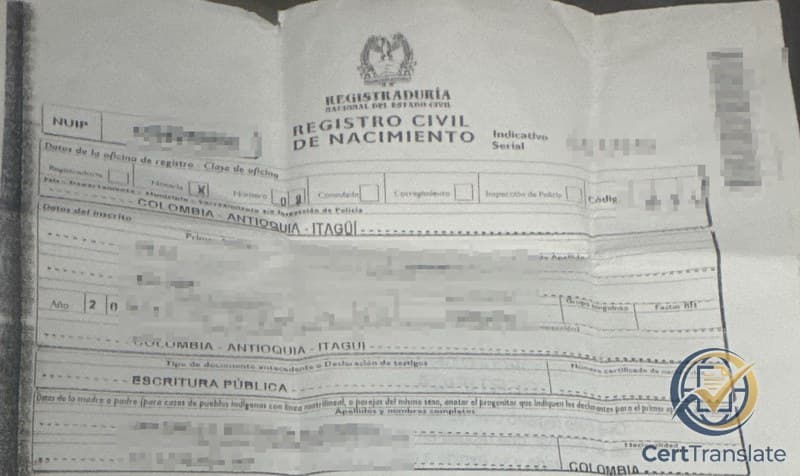
The inscription date printed on the form is June 2022. The birth it records occurred in February 2007. The redacted image below shows the form, with the Escritura Pública antecedent visible.
The fifteen-year gap is not an error. The Espacio para Notas (Notes field) at the foot of the form explains it. The client needed a certified Colombian birth certificate translation for a U.S. immigration filing.
Why This Required Special Handling
A U.S. reviewer expects a registration date close to the birth date. A 2022 entry for a 2007 birth can read as a late or altered record. The Notes field resolves the doubt — but only in Spanish.
The note states two things. The record comes from an earlier 2007 serial. It also substitutes that serial through a correction made by public deed (escritura pública).
Under Colombian practice, a civil-registry entry can be corrected by public deed. The notary then enters a corrected registration that replaces the prior one. The earlier serial is superseded, not duplicated.
USCIS translation requirements ask for every element of the source to appear in the translation. The substitution note has to be rendered in full, and it has to read clearly to anyone reviewing the file as accepted by USCIS.
How We Handled It
We translated every field of the form. We mirrored its boxed layout: registrant, parents, declarant, witnesses, registration date, and the Notes field. Blank fields were marked "[Blank in original]" rather than skipped.
The Notes-field annotation was rendered in full. We kept the registrar’s own wording and the all-caps notes convention. The serial and public-deed numbers were preserved in the delivered translation; they are redacted only in this public case.
The translated annotation read, in structure: "Book 238 — Comes from serial [number], dated March 2007. The aforesaid is substituted by means of correction of registration by public deed (E.P.) [number] of June 2022, of this Notary Office." The antecedent-document field was rendered as "Public Deed" (Escritura Pública).
A Translator’s Note on the certification page closed the loop. It explained the Colombian correction-by-public-deed mechanism in plain English, so the later inscription date reads as a correction date and not a second birth.
"The Espacio para Notas (Notes Space) at the foot of the original states that this registration “comes from” an earlier serial number dated March 14, 2007, and substitutes it “by means of correction of registration by public deed” (mediante corrección de registro por escritura pública), recorded as E.P. 01367 of June 2, 2022. Under Colombian civil-status practice (Decree 1260 of 1970 and related notarial regulations), an error or omission in a birth registration may be corrected through a notarial public deed (escritura pública); the notary then enters a corrected registration that supersedes the earlier one. The later inscription date (June 4, 2022) is the date of this corrected entry, not a second birth event. The antecedent document type for this registration is recorded on the form as “Escritura Pública” (Public Deed)."

Two layout details carried through as well. The right margin of the original is pre-printed "ORIGINAL PARA LA OFICINA DE REGISTRO"; we reproduced it as a labeled marginal note.
The form carries three overlapping notarial seals: one acting notary’s and two of the authorizing notary. We described each in brackets, marking the partly overprinted seal as partially illegible.
The Outcome
The certified translation was delivered for the client’s certified translation for USCIS filing. The full substitution note appeared on the body pages. The correction-by-public-deed explanation appeared on the certification page.
We use the same approach for any Colombian record that carries a corrección-de-registro note. The registrar’s wording stays visible. A Translator’s Note explains the mechanism so a reviewer is not left guessing.
What This Means for You
A registration date years after your birth does not mean your Colombian birth record is wrong. A Colombian notary can correct a civil-registry entry by public deed and issue a replacement record. A certified translation that reproduces the Notes-field annotation — with a Translator’s Note on the mechanism — lets a U.S. reviewer read both serials as one history.
Have a similar situation?
We translate Colombian civil-registry records that carry a corrección-de-registro or substitution note, with the registrar’s own wording preserved and the mechanism explained in a Translator’s Note.
Related Cases & Resources
Sources & References
- Meet Translation Requirements·USCIS·Verified 2026-07-27
- Registraduría Nacional del Estado Civil·Registraduría Nacional del Estado Civil (Republic of Colombia)·Verified 2026-07-27
- Decree 1260 of 1970 — Statute of Civil Status in Colombia·Republic of Colombia — SUIN-Juriscol·Verified 2026-07-27
Explore the Hub
Certified Translation
Documents
Languages
Immigration
Accepted By
All identifying information has been removed. Case details are shared with client permission. No personal data is stored or displayed on this page.