




What do you do when an Afghan birth card's handwriting is too cursive, but you already translated the same family's other documents?
TL;DRAn Afghan family's third Birth Registration Card had handwritten Dari fields too cursive to read from the page alone. The father's and grandfather's names on the new card were the same people who appeared on two earlier sibling translations completed that month for this family. Those prior translations anchored the recurring names directly. A short family confirmation covered the card-specific fields, and the certified translation was delivered for K-12 school enrollment.
Case Specifications
- Document
- Birth Registration Card (Afghan civil-registry, distinct from Tazkera)
- Foreign Name
- Kart-e Sabt-e Veladat (کارت ثبت ولادت)
- Country
- Afghanistan
- Languages
- Pashto, Dari (Persian) → English
- Submitted To
- K-12 school enrollment
What We Received
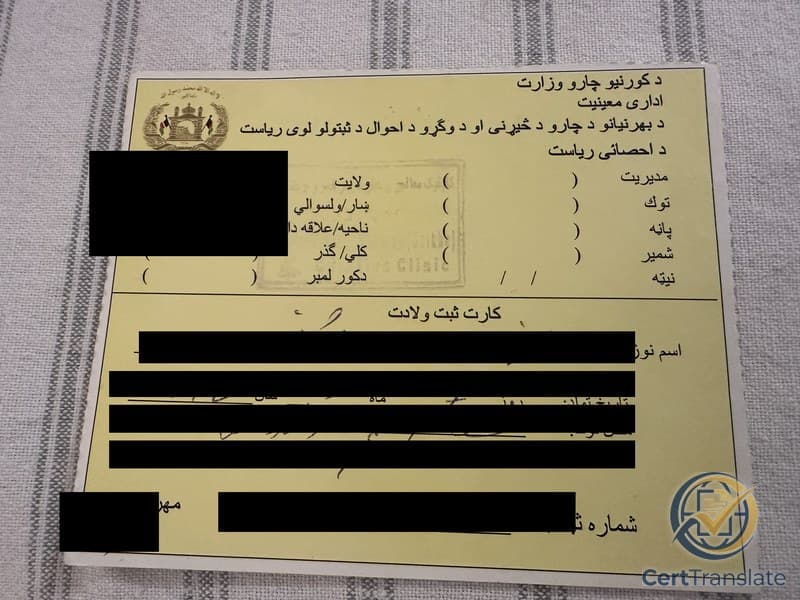
An Afghan family submitted a third Birth Registration Card (کارت ثبت ولادت, Kart-e Sabt-e Veladat) issued by the Islamic Republic of Afghanistan's Ministry of Interior Affairs. Registration No. 114, year 1392 SH. The certified Afghan birth certificate translation in Dari was needed for K-12 school enrollment.
We had already translated and certified two other Birth Registration Cards for the same family that month — one per older sibling. The new card carried the same Pashto headings, the same Islamic Republic emblem, and the same hospital ink-stamp style as the prior two.
The handwriting on the new card was cursive Dari in ballpoint pen, similar in script but distinctly less legible than the siblings' cards. Three fields admitted more than one plausible reading at the word level on the page alone.
Why This Required Special Handling
A certified birth-certificate translation must reproduce the source document faithfully. A translator does not get to pick between two plausible readings of a handwritten word and call it final.
On this card the within-document anchors were limited. None of the pre-printed text duplicated the bearer's name or the parental names. A fresh single-document approach would have flagged all three fields as ambiguous and asked the family to confirm each one.
That approach works, but it duplicates work the family had already done for the older siblings. It also ignores the strongest cross-document anchor available — the prior certified translations themselves, which name the same two parents with confirmed Latin spelling.
How We Handled It
The two prior sibling translations had already documented the recurring fields. The father's name (Mohammad Amini) and the grandfather's name (Mohammad Amin) appear on every Afghan civil-registry document this family produces. Their Latin spelling was confirmed by the family during the earlier orders.
We anchored both names on the new card to the prior translations rather than reading them fresh from the page. The slash-separated father / grandfather convention used in the Afghan field format was preserved unchanged across all three cards.
For the fields the siblings could not anchor, we sent one short confirmation message to the family. These were the upper-section administrative entries (filled in on this card with district-level location data; blank on the older siblings' cards) and the place of birth. The card-specific values came back the same day.
"The father's and grandfather's names on this card match those on two prior certified translations completed for the same family the same month and are reproduced from those confirmed values. The upper-section administrative fields and the place of birth were confirmed directly with the family. The Solar Hijri date of birth (7 / 3 / 1392) corresponds to May 2013 in the Gregorian calendar. The state emblem on the card is the Islamic Republic of Afghanistan emblem in use from 2004 to 2021, which independently places the document in this period."

Other handling on the card was carried over verbatim from the sibling translations for consistency. The Pashto header stack (Ministry of Interior Affairs, Administrative Deputy, General Directorate for the Inspection of Foreigners' Affairs and Registration of Population Records, Statistics Directorate) was rendered with the same wording. The round Public Health Sadr Hospital-style ink stamp partially overlapping the upper grid was described with the same legibility qualifier as before.
The Outcome
The certified translation was delivered with anchored names, a family-confirmed place of birth, and a Translator's Note recording the source of each value. The family now has three certified Birth Registration Card translations from us, all naming the same parents identically — exactly the cross-document consistency a USCIS-compliant translation and a school registrar both expect.
Sibling-set anchoring is not a shortcut around the source page; it is a stronger form of verification than a single-document reading. The recurring parent names are stable facts about the family, confirmed once and reused with citation.
What This Means for You
If your family has multiple civil-registry documents from siblings or relatives, mention any prior certified translations when you submit a new one. A translator who has the prior set on hand can anchor recurring names directly. That confines confirmation requests to fields genuinely unique to the new document — fewer questions for you, more consistency across the set.
Have a set of Afghan family documents to translate?
We translate Afghan Birth Registration Cards, Tazkeras, and other Pashto and Dari civil-registry documents for school enrollment, USCIS filings, and credential evaluation. Recurring family names stay consistent across a sibling or multi-document set.
Related Cases & Resources
Sources & References
- Meet Translation Requirements·USCIS·Verified 2026-07-17
Explore the Hub
Certified Translation
Documents
Immigration
All identifying information has been removed from document images. Case details are shared with client permission. No personal data is stored or displayed on this page.