




What do you do when handwritten names on an Afghan birth card cannot be read from the page?
TL;DRAn Afghan Birth Registration Card (Kart-e Sabt-e Veladat) had three handwritten Dari fields that could not be read letter-by-letter from the page: the newborn name, the father / grandfather name pair, and the month digit of the Solar Hijri date of birth. A short family-confirmation message, relayed through a U.S. church volunteer, corrected one name pair entirely and shifted the date of birth from August 2018 to January 5, 2019.
Case Specifications
- Document
- Birth Registration Card (Afghan civil-registry, distinct from Tazkera)
- Foreign Name
- Kart-e Sabt-e Veladat (کارت ثبت ولادت)
- Country
- Afghanistan
- Languages
- Pashto, Dari (Persian) → English
- Submitted To
- K-12 school enrollment
What We Received
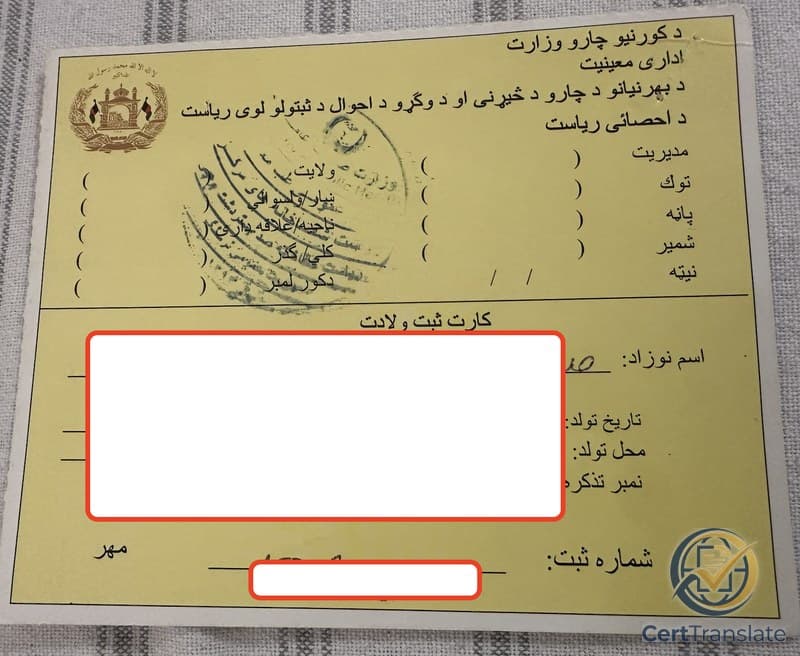
A family submitted an Afghan Birth Registration Card (کارت ثبت ولادت, Kart-e Sabt-e Veladat) issued by the Islamic Republic of Afghanistan's Ministry of Interior Affairs — registration No. 12930, year 1397 SH. The certified Dari to English translation was needed for K-12 school enrollment in the United States.
The card combines pre-printed Pashto headings on the upper half (a 5×2 administrative form-field grid, blank on this card) with handwritten Dari entries on the lower half: newborn name, father / grandfather, day-month-year of birth, place of birth, and Tazkera reference codes.
The handwriting was cursive Dari in ballpoint pen. Individual strokes were legible, but three fields admitted more than one plausible reading at the word level — and these were not edge cases. They were the newborn's name, the father / grandfather names, and the month of birth.
Why This Required Special Handling
A certified birth-certificate translation must match the source document character by character. A translator does not get to pick between two plausible readings of the same handwritten word and call it final. The standard approach when a handwritten entry is ambiguous is to cross-reference within the same document, then against another civil-registry document from the same person, and only then fall back to a confirmation channel with the bearer.
On this card the within-document anchors were limited. The pre-printed Pashto headings were unambiguous and clarified the form's layout, but no pre-printed text duplicated the bearer's name or the father's name anywhere on the card. There was no second civil-registry document on hand for cross-reference, and the family had not (yet) provided a Tazkera or passport with the names in Latin script.
The state emblem on the card — Shahada, mihrab, two crossed Afghan flags within a wheat-sheaf wreath, with the year 1298 (Afghan independence, 1919 CE) at the base — is the Islamic Republic of Afghanistan emblem in use from 2004 to 2021. That alone fixed the year of issuance as 1397 SH (2018–2019 CE) and ruled out an earlier candidate reading of 1347 SH (1968–1969 CE). But the month digit, the newborn name, and the parental names had no such within-document anchor.
How We Handled It
Instead of issuing the translation with three “best interpretation” notes, we prepared a five-line customer-confirmation summary listing each candidate reading and asked the family to confirm or correct each field directly.
The summary was sent through the family's U.S. navigator — a volunteer from their sponsoring church. The responses came back the same day. The newborn's gender was confirmed female and the Latin spelling fixed at the family's preferred form. The father / grandfather pair was corrected to “Mohammad Amini / Mohammad Amin” — the second name entirely different from our reading, the kind of correction no amount of staring at cursive Persian-script handwriting will produce reliably. The month digit was corrected from ۵ (5) to ۱۰ (10), shifting the Gregorian equivalent of the date of birth from approximately August 2018 to January 5, 2019.
The certified translation was re-issued with the confirmed values and a Translator's Note recording the Gregorian correspondence (15 / 10 / 1397 SH = January 5, 2019), the emblem-based dating of the document to the Islamic Republic period (2004–2021), and the Afghan father's-name / grandfather's-name convention used in the slash-separated field.
"Three handwritten Dari fields on the source card — the newborn name, the father / grandfather name pair, and the month digit of the Solar Hijri date of birth — admitted more than one plausible reading from the page alone. The values rendered in this translation reflect direct confirmation from the bearer's family, relayed through their U.S. navigator on May 18, 2026. The Solar Hijri date of birth (15 / 10 / 1397) corresponds to January 5, 2019 CE in the Gregorian calendar. The state emblem on the card is the Islamic Republic of Afghanistan emblem (2004–2021), which independently places the document in this period. The pre-printed Pashto upper section (Directorate, Province, Tok, Pana, Number, City/District, Sub-district/Area, Village/Quarter, Date, House Number) and the Tazkera reference codes (ص / ج / ع — page, volume, entry) were left blank on the original form."

Other handling on the same card: the round ink stamp partially overlapping the form-field grid was described with the legible central inscription صحت عامه (Public Health) retained and the rim text marked partially illegible, appearing to be from the Ministry of Public Health, Sadr Hospital. Pashto header line 3 — “General Directorate for the Inspection of Foreigners' Affairs and Registration of Population Records” — is the actual consolidated Afghan Ministry of Interior directorate covering both functions, not a transcription error.
The full correction cycle (initial QA pass → confirmation summary out → family response back → re-issue) took under a day, the normal turnaround for a certified single-page birth-certificate translation when a customer confirmation is requested. The destination was K-12 enrollment, where the receiving registrar needs the names to match the family's other resettlement paperwork — exactly the consistency the family confirmation produced.
The Outcome
The certified translation was delivered with confirmed names, the Gregorian equivalent of the date of birth, and the standard CertTranslate certification block — ready for submission to the receiving school's registrar. The Translator's Note records that the values come from direct family confirmation rather than translator inference, giving the registrar a clean audit trail.
Customer-side confirmation is a normal tool in certified translation, usually used silently — one or two questions to disambiguate a name. On this case the confirmation was structured (a five-line summary covering every uncertain field at once) and the channel indirect (relayed through a community volunteer). That structure is what produced a fix on three fields rather than a partial fix on one.
What This Means for You
Handwritten cursive Dari on an Afghan civil-registry document does not have to be read by inference alone. A short structured confirmation with the bearer — or with whoever is helping the bearer navigate U.S. paperwork — covers every uncertain field in one round trip, and the certified translation that comes back carries confirmed values rather than “best interpretation” notes that a school or agency reviewer will see and question.
Have an Afghan civil-registry document to translate?
We translate Afghan Birth Registration Cards, Tazkeras, and other Pashto and Dari civil-registry documents for school enrollment, USCIS filings, and credential evaluation. Handwritten fields are confirmed with the bearer or their navigator when the source page does not resolve them on its own.
Related Cases & Resources
Sources & References
- Meet Translation Requirements·USCIS·Verified 2026-06-20
Explore the Hub
Certified Translation
Documents
Immigration
All identifying information has been removed from document images. Case details are shared with client permission. No personal data is stored or displayed on this page.