



What should you do when each side of your document lists a different name?
TL;DRA Somali secondary education certificate listed "Sarah" on the English side and "Zahra" on the Arabic side — two entirely different first names on the same official document. We translated both versions and included a Translator's Note documenting the name discrepancy, making clear it existed in the original and was not a translation error. The certified translation was delivered for the client's USCIS immigration filing.
Case Specifications
- Document
- Secondary education certificate
- Foreign Name
- Shahaadada Waxbarashada Dugsiga Sare / شهادة إتمام الدراسة الثانوية
- Country
- Somalia
- Languages
- Somali, Arabic, English → English
- Submitted To
- USCIS
What We Received
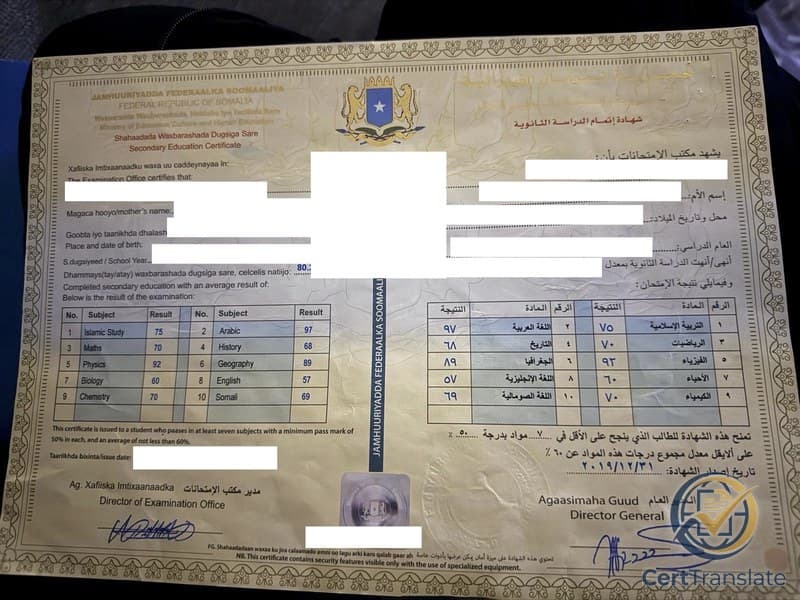
A client submitted a Somali secondary education certificate (Shahaadada Waxbarashada Dugsiga Sare / شهادة إتمام الدراسة الثانوية) issued by the Federal Republic of Somalia. The document is trilingual — Somali and English on the left side, Arabic on the right.
The student's name on the Somali/English side reads "Sarah Abdikani Farah." The Arabic side reads "زهرة عبدالقني فرحان" — which transliterates to "Zahra Abdulqani Farhan." The surname differences ("Abdikani" vs. "Abdulqani," "Farah" vs. "Farhan") are standard Somali-to-Arabic transliteration variants. But the first names — "Sarah" and "Zahra" — are completely different names.
The certified translation was needed for a USCIS immigration filing.
Why This Required Special Handling
For a standard bilingual document, best practice is to translate the content once into English and note the bilingual nature in a Translator's Note. But when both sides contain materially different information — specifically, a different first name — translating only one side means the adjudicator never sees the discrepancy.
If USCIS compares the translation against the Arabic side (which they can have reviewed independently), they find a name that appears nowhere in the English translation. That looks like an omission — and omissions trigger Requests for Evidence.
The translator cannot decide which name is "correct." Both appear on the same government-issued document. The challenge is presenting both versions accurately without making the translation look like it contains an error.
This situation is distinct from a typical name mismatch, where the same name is spelled differently due to transliteration. Here, "Sarah" and "Zahra" are two separate names — this is a substantive discrepancy in the original document, not a romanization variant.
How We Handled It
We translated the substantive content once into English, using the Latin-script spelling from the Somali/English side ("Sarah Abdikani Farah") as the primary rendering — since this is the form already in English on the original document.
We then documented the Arabic-side variant in a detailed Translator's Note.
"The student's name appears differently across the two sides of the document. The Somali/English side reads "Sarah Abdikani Farah," while the Arabic side reads "زهرة عبدالقني فرحان" (Zahra Abdulqani Farhan). The first names "Sarah" and "Zahra" are distinct names. The surname variants "Abdikani/Abdulqani" and "Farah/Farhan" reflect different transliteration conventions for the same Somali names. Both forms are preserved in the translation as they appear in the original."

This approach gives the USCIS adjudicator full visibility into the discrepancy while making clear it exists in the source document — not in the translation.
The document was provided as phone photographs rather than a scan. We combined the front and back images into a single PDF for filing. The reverse side contained authentication stamps from the Ministry of Foreign Affairs and the Ministry of Education's Examinations & Certifications Office. Some handwritten entries within the authentication stamp were partially illegible due to ink quality — documented in an additional Translator's Note.
The Outcome
The certified translation was delivered to the client for inclusion in their USCIS filing. The Translator's Note provides full transparency about the name discrepancy, positioning it as a feature of the original document rather than a translation issue.
This is the first case we've encountered where a Somali trilingual certificate contained two entirely different first names (not just transliteration variants). Surname differences between Somali Latin script and Arabic script are common and handled routinely.
What This Means for You
A certified translation with a detailed Translator's Note that preserves both name versions and explains the discrepancy is the standard professional approach when an official document lists different names on different sides. Do not assume a translator should just "pick one" — especially when one side is in Arabic and the other in a Latin-script language. The goal is transparency: show the USCIS adjudicator exactly what the original says, on both sides, and let the record speak for itself.
Have a similar situation?
We handle bilingual and trilingual documents with name discrepancies regularly.
Related Cases & Resources
Sources & References
- How to Respond to a Request for Evidence (RFE)·USCIS·Verified 2026-05-20
Explore the Hub
All identifying information has been removed from document images. Case details are shared with client permission. No personal data is stored or displayed on this page.