




How do you translate a DD/MM/YYYY expiration date on a foreign driver's license so it can't be misread in English?
TL;DRA Bolivian driver's license listed dates in the country's DD/MM/YYYY convention, and the expiration value '11/05/2028' could be misread as November 5, 2028 by a U.S. reader who assumed MM/DD/YYYY. We rendered every date in unambiguous English long-form (May 11, 2028; January 14, 2025; November 15, 1990) and documented the conversion in a Translator's Note that preserved the original numerals. The certified translation was delivered with no field a DMV or USCIS adjudicator could read two different ways.
Case Specifications
- Document
- Driver's license (plastic ID card, two-sided)
- Foreign Name
- Licencia de conducir — Categoría P
- Country
- Plurinational State of Bolivia
- Languages
- Spanish → English
- Submitted To
- U.S. state DMV / USCIS supporting ID
What We Received
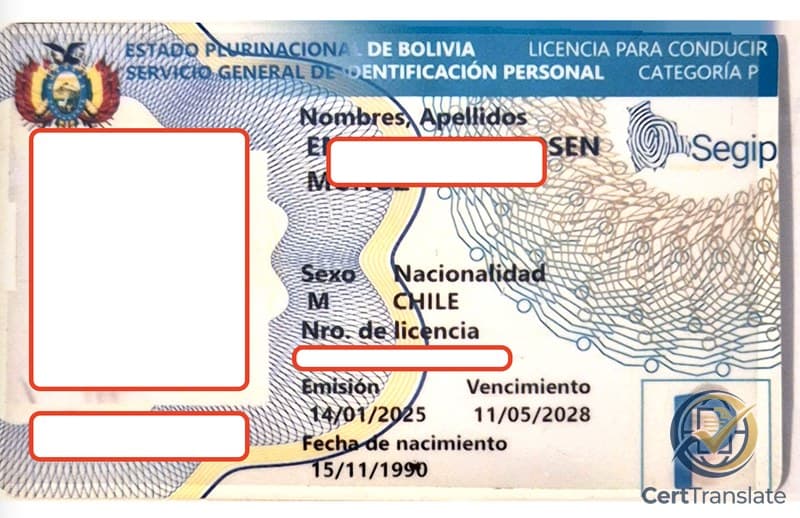
A client submitted both sides of a plastic Bolivian driver's license (Category P) issued by Segip — the country's General Service of Personal Identification. The card listed three dates in the Bolivian DD/MM/YYYY convention: issuance 14/01/2025, expiration 11/05/2028, and date of birth 15/11/1990. The translation was needed as a <a href="/documents/drivers-license">certified driver's license translation</a> for a U.S. state DMV license-exchange filing, with a parallel USCIS use as supporting ID evidence.
Two of those three dates are unambiguous in either reading (no month is the 14th or the 15th), but the expiration value '11/05/2028' is a string in which each of the first two numbers is a valid month — and that is the field most likely to be read in isolation.
Why This Required Special Handling
Bolivia, like most of Latin America and Europe, writes dates as DD/MM/YYYY. The United States is the global outlier with MM/DD/YYYY, and a U.S. clerk reading '11/05/2028' on a foreign ID will almost always default to November 5, 2028 unless the document tells them otherwise. The translator's job on a foreign ID is to make sure no field on the English version can be read two different ways — and that obligation flows directly from the <a href="/guides/uscis-translation-requirements">USCIS 'complete and accurate' standard</a> the translator certifies to at the end of the file.
On a driver's license the expiration date is decisive. State DMVs use it to determine whether a foreign license is currently valid for in-state driving and for license-exchange eligibility; USCIS uses it the same way when an ID is offered as supporting evidence on a filing. A six-month error on a single date — May 11 read as November 5 — can flip the answer to either question. The <a href="/guides/certificate-of-accuracy">certificate of accuracy</a> the translator signs makes leaving an ambiguous numeric date in the English translation a problem the translator owns, not the reader.
Leaving dates in DD/MM/YYYY format in the English translation, even with the numerals matching the source exactly, does not satisfy that standard — the numerals are accurate but the meaning is not unambiguously English.
How We Handled It
We rendered every date on the card in the unambiguous English long-form 'Month DD, YYYY': issuance '14/01/2025' → 'January 14, 2025'; expiration '11/05/2028' → 'May 11, 2028'; date of birth '15/11/1990' → 'November 15, 1990'. The same conversion was applied on both the front side and the back side of the card, where the issuance and expiration dates are reprinted under the category description.
We then included a <a href="/guides/certificate-of-accuracy">Translator's Note</a> at the end of the certified translation that named the source convention, listed the original numeric values verbatim, and stated the English equivalents alongside them. This serves two purposes: a DMV or USCIS adjudicator can verify the conversion against the source numerals without having to know Bolivian date conventions, and the file itself is auditable — if anyone challenges the rendering of May 11 vs November 5, the basis is in writing on the same page.
Two adjacent decisions on the same card followed the same logic. The Spanish category description on the back ('Automóviles de uso particular con capacidad para hasta 7 personas') was fully translated as 'Automobiles for private use with a capacity of up to 7 persons' rather than left in Spanish in brackets — a clerk reading the English file should not have to know what 'particular' means in Bolivian licensing nomenclature. The abbreviation 'Grupo S.' on the back was expanded as 'Blood group' rather than transcribed, on the same principle: nothing on the English side should require Spanish to decode.
"All dates in the original document are written in DD/MM/YYYY format (Bolivian convention) and have been rendered in the unambiguous 'Month DD, YYYY' form in English. Original values: Issuance 14/01/2025 → January 14, 2025; Expiration 11/05/2028 → May 11, 2028; Date of Birth 15/11/1990 → November 15, 1990. 'Segip' (Servicio General de Identificación Personal / General Service of Personal Identification) is the Bolivian government agency that issues identification documents and driver's licenses; the name has been retained as it appears. The original is a plastic ID card containing security guilloche patterns, a photograph of the licensee, a fingerprint graphic, the Bolivian coat of arms, and a QR code, none of which can be reproduced in text; their presence is indicated in brackets. 'Grupo S.' abbreviates 'Grupo Sanguíneo' (Blood Group)."

The Outcome
The certified translation was delivered to the client in DOCX format with both sides of the card translated as one continuous document and a '— Back Side —' marker between them. Every date on the English version reads as a single month — May 11, 2028 — with the original numeric value preserved in the Translator's Note for audit. No field on the translation can be read two different ways.
What This Means for You
If your foreign driver's license — or any foreign ID — uses the DD/MM/YYYY date convention, the English translation should not leave that convention in place: every date belongs in long-form 'Month DD, YYYY' so that a DMV or USCIS adjudicator cannot read the expiration as a different month. Before you file, check the translation against a <a href="/guides/document-translation-checklist">document translation checklist</a>: if any date on the English version still reads as 'DD/MM/YYYY' or 'MM/DD/YYYY' numerals alone, it is not yet a finished certified translation.
Have a similar situation?
We translate foreign driver's licenses and IDs end-to-end — every date in unambiguous English, every field readable without the source language.
Related Cases & Resources
Sources & References
- Meet Translation Requirements·USCIS·Verified 2026-06-21
Explore the Hub
Documents
Languages
Accepted By
All identifying information has been removed from document images. Case details are shared with client permission. No personal data is stored or displayed on this page.