




How should an 1892 Greek birth certificate with a Julian-calendar date and handwritten Katharevousa cursive be translated for USCIS?
TL;DRA handwritten 1892 Greek civil-registry birth record from Samos was dated to the Julian calendar (Greece adopted the Gregorian in 1923) in long-form ordinal Katharevousa, with cursive proper names not fully legible and a modern 2024 'certified true photocopy' stamp on the same page. We preserved the Julian phrasing verbatim, performed no Gregorian conversion, marked uncertain readings as '[Illegible],' and translated the 2024 stamp in full. The certified translation was delivered for the family's USCIS filing.
Case Specifications
- Document
- Birth certificate (civil registry act of birth)
- Foreign Name
- Ληξιαρχική Πράξη Γεννήσεως
- Country
- Greece
- Languages
- Greek → English
- Submitted To
- U.S. immigration filings (USCIS)
What We Received
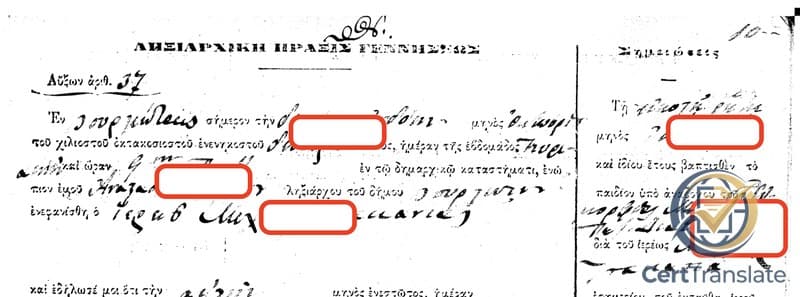
A family submitted a single-page Greek civil registry act of birth (Ληξιαρχική Πράξη Γεννήσεως) recorded in the village of Vourliotes, on the island of Samos, on October 18, 1892, and asked for a certified Greek birth certificate translation for a U.S. immigration filing. The body of the act was written by hand in Katharevousa Greek — the formal register used by Greek civil-registry offices in the 19th century — in cursive script of the period.
The same page also carried a continuation block recording the baptism, and, on the lower right, a modern (March 7, 2024) rectangular 'CERTIFIED TRUE PHOTOCOPY' stamp from the Civil Registry Office of the Municipality of Eastern Samos, a round official wet seal of the Hellenic Republic naming the same office, and the printed name and title of Mayor Paraskevas E. Papageorgiou. The body of the original 1892 act records the date in long-form ordinal Katharevousa: 'on the eighteenth of the month of October of the one thousand eight hundred ninety-second year.' Several proper names — the registrar, the witnesses, the godfather's surname, the day of the baptism, and the day of the week — were not fully legible in the cursive of the period.
Why This Required Special Handling
Greece adopted the Gregorian calendar in 1923. Any Greek civil-registry record dated before then is therefore a Julian-calendar record. A translator cannot simply re-stamp '18 October 1892' onto the page in figures: converting to a Gregorian equivalent is a forensic determination about which calendar was in force, not a translation decision, and silently doing so erases a calendar-system fact a U.S. adjudicator would not otherwise see.
The mid-19th-century Katharevousa cursive adds a second layer. Several proper names — the registrar, the witnesses, the godfather's surname — could not be deciphered with certainty. Per USCIS translation requirements, a certified translation must be complete and accurate: a translator who supplies a 'best guess' for an unreadable name is not producing an accurate translation, and one who silently omits the text is not producing a complete one.
A third layer is the modern 2024 'certified true photocopy' stamp from the Eastern Samos Municipality and the round wet seal on the same physical page. Stamps and seals are translated in full and in English on USCIS submissions, so the 21st-century certifying chain has to read cleanly alongside the 19th-century record.
How We Handled It
We preserved the long-form ordinal phrasing of the date verbatim in English — 'on the eighteenth of the month of October of the one thousand eight hundred ninety-second year' — rather than normalising it to '18/10/1892.' A Translator's Note recorded that the phrasing reflects the source as written and that the underlying calendar is Julian; no Gregorian conversion was performed.
Every uncertain cursive reading was marked. Names that could not be deciphered were rendered as bracketed '[Illegible]'; where a partial reading was possible, we used '[Illegible: possibly Diamantis]' so the form of the partial reading is visible without presenting a guess as a fact. The two readings the family confirmed against their own records — the place of registration ('Vourliotes') and the mother's first name ('Patra') — were rendered as confirmed, with a Translator's Note recording that they were verified by the family rather than read from the cursive alone.
The modern 2024 certifying chain on the lower right was translated in full: the rectangular 'CERTIFIED TRUE PHOTOCOPY' stamp with its 'Ref. No.: 157' and 'Samos, March 7, 2024' fields, the round wet seal naming 'HELLENIC REPUBLIC — MUNICIPALITY OF EASTERN SAMOS — CIVIL REGISTRY OFFICE,' and the printed name and title of Mayor Paraskevas E. Papageorgiou. The handwritten registry-book page number '10' in the top right corner was noted for completeness, since it is a continuation of the Vourliotes registry-book pagination rather than a field of the act itself.
"The date of registration appears in the original as 'the eighteenth of the month of October of the one thousand eight hundred ninety-second year' (October 18, 1892); this corresponds to the Julian calendar in use in Greece at the time, and no conversion to the Gregorian calendar has been performed. Several proper names — the registrar, the witnesses, the godfather's surname, and the day of the baptism — could not be read with certainty from the mid-19th-century handwritten cursive and have been marked '[Illegible]' or, where partial reading was possible, '[Illegible: possibly ...]'. The place of registration ('Vourliotes,' a village on the island of Samos with a Saint John the Theologian parish) and the mother's first name ('Patra') were confirmed by the family of the document holder. The lower right portion of the page contains a modern (March 7, 2024) rectangular certification stamp from the Civil Registry Office of the Municipality of Eastern Samos certifying the document as a true photocopy, together with a round official wet seal of the same municipality and the printed name and title of the Mayor; the contents of these stamps and seals have been transcribed and translated within the body of the translation."

The Outcome
The certified translation was delivered with the long-form Julian-calendar phrasing preserved verbatim, every uncertain cursive name marked '[Illegible]' or '[Illegible: possibly ...],' the two family-confirmed readings (Vourliotes; Patra) recorded as confirmed in a Translator's Note, and the modern 2024 Eastern Samos certifying chain translated in full alongside the 19th-century act.
We apply the same approach on every pre-1923 Greek civil-registry record from the Julian-calendar period, and on every 19th- or early-20th-century handwritten European registry record where partial illegibility and a modern certifying chain coexist on the same page.
What This Means for You
A pre-1923 Greek civil-registry record should be translated with its long-form ordinal date phrasing preserved verbatim and the underlying Julian calendar identified in a Translator's Note, without any silent conversion to the Gregorian calendar. Handwritten cursive proper names that cannot be read with certainty must be marked '[Illegible]' rather than guessed at, and any modern certifying chain (a 'certified true photocopy' stamp, a wet seal, a mayor's printed name) on the same page must be translated in full alongside the historical record.
Have a similar situation?
We translate Greek civil-registry documents — including pre-1923 Julian-calendar birth, marriage, and death certificates, 19th- and early-20th-century handwritten Katharevousa records, and modern certified-true-photocopy issuances of historical acts — for USCIS filings and U.S. state vital-records offices regularly.
Related Cases & Resources
Sources & References
- Meet Translation Requirements·USCIS·Verified 2026-06-09
Explore the Hub
Certified Translation
Documents
Languages
Immigration
Accepted By
All identifying information has been removed from document images. Case details are shared with client permission. No personal data is stored or displayed on this page.