




How do you translate a Colombian birth registration that names a parish record as proof of birth?
TL;DRA 1977 Colombian Registro Civil de Nacimiento was issued by Notary Office Twenty-Two of Bogotá on the basis of an 'Acta Parroquial' (Catholic parish baptismal record), not a medical certificate. The civil registry named the parish record as the source of the birth claim. We preserved that source in the certified translation, identified it as 'Parish Record' in English, and added a Translator's Note explaining the pre-1980s Colombian convention. The translation was delivered for a USCIS family-based filing.
Case Specifications
- Document
- Birth certificate — pre-1980s Colombian Registro Civil de Nacimiento
- Foreign Name
- Registro Civil de Nacimiento — Notaría Veintidós de Bogotá
- Country
- Colombia
- Languages
- Spanish → English
- Submitted To
- USCIS family-based filing (supporting record)
What We Received
A client submitted a one-page Colombian Registro Civil de Nacimiento. The document was issued in July 1977 by Notary Office Twenty-Two of Bogotá. The notary certified the same document as a true copy in May 2019. It records a birth from April 1974. The packet was needed for a USCIS family-based filing, the same kind of work covered by our Colombian Spanish birth certificate translation service.
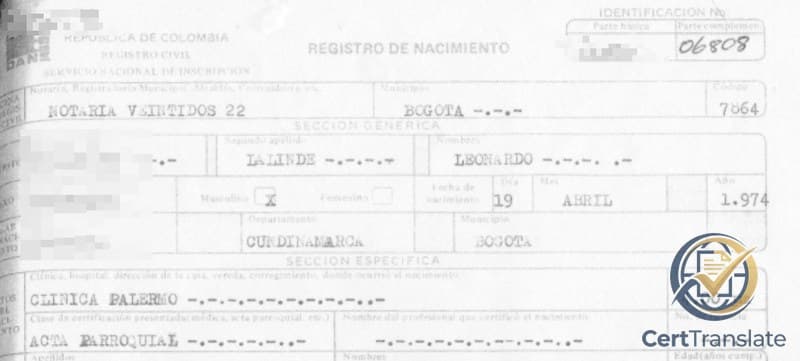
Inside the form's SPECIFIC SECTION, one field tells the story. The field is labeled 'Clase de certificación presentada (médica, acta parroquial, etc.)' — type of certification presented (medical, parish record, etc.). It was filled in with 'ACTA PARROQUIAL'. The professional-name and license-number fields next to it were left blank. No medical certificate was on file. The parish record was the named source for the birth claim.
Why This Required Special Handling
Before the 1980s, Colombian civil registries routinely accepted a Catholic parish baptismal record ('acta parroquial') as proof of birth when no hospital paperwork was available. The pre-1980s notarial Registro Civil de Nacimiento form had a dedicated field for this source. Modern Colombian forms from the Registraduría Nacional del Estado Civil collapsed that field and rely on hospital records. A translator who has only seen recent Colombian birth certificates would not expect the parish-record convention.
A literal translation that drops the 'acta parroquial' reference would break the registry's evidentiary chain. So would a paraphrase that re-labels the field as 'medical certificate'. The notary did not certify a medical fact in 1977. The notary certified that a parish record existed and named the birth. USCIS expects the source of a registry entry to read on the English-side page exactly as the source named it.
The form carries a few more pre-1980s Colombian conventions a modern translator may miss. Filler dashes ('-.-.-.-') cancel every unused field on the typewritten form. A narrow vertical column down the left edge prints the section labels (Madre, Padre, Denunciante, Testigo). A 2019 validation stamp cites Decrees 1250 of 1972 and 279 of 1974 — the Colombian Civil Registry archival rules. Each of these needs its own decision on the English side.
How We Handled It
We translated the SPECIFIC SECTION certification-type field as 'ACTA PARROQUIAL (Parish [baptismal] Record)'. The original Spanish stays on the page; the English identification sits in parentheses. The field label was rendered as 'Type of certification presented (medical, parish record, etc.)' so a US reader can see what the field is for. The professional-name and license-number cells next to it were marked '[Blank in original]'.
The 2019 validation stamp was transcribed verbatim. The cited decrees were expanded on the English side: 'Decree 1250 of 1972, Articles 25 and 165; Decree 279 of 1974, Article 1.' These are real Colombian civil-registry archival rules and a US receiver may want to look them up.
The filler dashes that fill every unused field on the printed form were omitted from translation values. A Translator's Note explains the omission — they are typewriter artifacts with no semantic content. Fields that were entirely blank (both witness blocks) are flagged as such rather than reproduced as empty tables. The form's left-margin section labels (Madre, Padre, Denunciante, Testigo) are partially illegible in the scan. We used them as English section headers (MOTHER, FATHER, INFORMANT) and documented their source in the same Translator's Note.
"This certified translation is of a pre-1980s Colombian 'Registro Civil de Nacimiento' (Civil Birth Registration) issued in 1977 by Notaría Veintidós de Bogotá and certified as a true copy by the same office in 2019. In the SPECIFIC SECTION, the field 'Clase de certificación presentada (médica, acta parroquial, etc.)' was filled in with 'ACTA PARROQUIAL' and is rendered here as 'ACTA PARROQUIAL (Parish [baptismal] Record)'. Before the 1980s, Colombian civil registries routinely accepted a Catholic parish baptismal record as proof of birth when no medical certificate was on file. The validation stamp on the certified copy cites Decree 1250 of 1972 (Articles 25 and 165) and Decree 279 of 1974 (Article 1), which govern Colombian Civil Registry archives. The repeated dash-and-period sequences ('-.-.-.-') printed on the form are typewriter filler used to cancel unused space; they have been omitted from translation values, and fields entirely blank on the original are marked '[Blank in original]'. The narrow vertical column on the left edge of the form prints the section labels (Madre, Padre, Denunciante, Testigo, Fecha de Inscripción); several of these labels are partially illegible in the scan, and they have been used to identify the English-side section headers (MOTHER, FATHER, INFORMANT)."

The Outcome
The certified translation was delivered for the client's USCIS family-based filing. The 'ACTA PARROQUIAL' source, the 1972 and 1974 decree citations, and the pre-1980s notarial structure all read as separate elements on the English-side page.
We have used the same parish-record-preserved approach for every pre-1980s Colombian notarial birth registration since 2024. Modern Colombian birth certificates from the Registraduría Nacional del Estado Civil follow a different format. They do not carry the 'acta parroquial' option in the certification-source field.
What This Means for You
If your Colombian birth certificate is from before the early 1980s and was issued by a Notaría rather than the Registraduría, it may name a parish record as the source of birth proof. A certified translation should keep that source as 'Acta Parroquial' with an English identification. Do not collapse it into the generic 'medical certificate' field. Ask the issuing Notaría or the Registraduría for a modern reissue if your receiver expects the current Colombian format. See our Spanish translation services for related work.
Have a similar situation?
We translate Colombian birth certificates — both pre-1980s notarial issuances and modern Registraduría Nacional del Estado Civil records — into English for USCIS family-based filings, K-1 fiancé petitions, Social Security applications, and state DMV use. Pre-1980s conventions (acta parroquial source, notarial validation stamps citing 1972 and 1974 decrees, filler-dash typewriter artifacts) preserved on the English side with a clear Translator's Note. $24.95/page, delivered in 24 hours.
Related Cases & Resources
Sources & References
- Registraduría Nacional del Estado Civil — Civil Registry of Colombia·Registraduría Nacional del Estado Civil — Government of Colombia·Verified 2026-07-16
Explore the Hub
Certified Translation
Documents
Languages
Immigration
Accepted By
All identifying information has been removed from this case study. The registered party's name, the parents' names, the C.C. (Cédula de Ciudadanía) numbers, the declarant's mailing address, and the notary's personal signature are not displayed. Case details are shared with client permission.