





How do you translate a Ukrainian passport when the serial number is perforated and the registration stamp is handwritten?
TL;DRA Ukrainian internal passport (паспорт громадянина України) contained a dot-matrix perforated serial number and a 1991 handwritten residence registration stamp with a partially legible street name in Cyrillic cursive. We transcribed the perforated serial by examining each dot cluster under magnification, translated the bilingual Ukrainian/Russian headings once into English, and flagged the partially legible handwritten entries in the Translator's Notes. The certified translation was delivered for the client's USCIS immigration filing.
Case Specifications
- Document
- Internal passport (booklet-format)
- Foreign Name
- Паспорт громадянина України
- Country
- Ukraine
- Languages
- Ukrainian, Russian → English
- Submitted To
- USCIS
What We Received
A client submitted photographs of two spreads from a Ukrainian internal passport — the booklet-format document that was the primary national ID in Ukraine before biometric ID cards replaced it. The passport was issued in the late 1980s and carried entries from the early 1990s.
The photograph page contained standard biographical fields — surname, given name, patronymic, date of birth, place of birth — printed in a mix of Ukrainian and Russian. But the serial number at the top of each page was not printed or stamped. It was perforated through the paper as a dot-matrix pattern: series МЕ, number 328156.
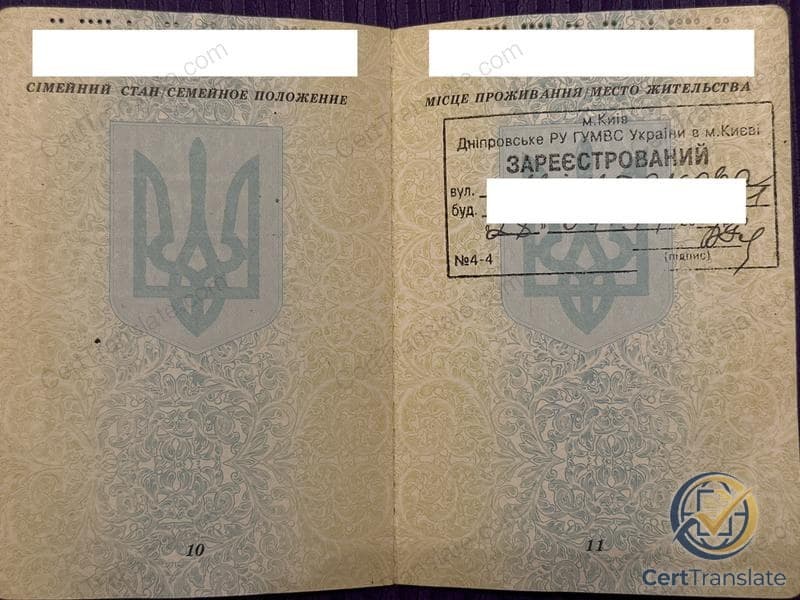
The residence registration page (page 11) carried a rectangular ink stamp from the Dniprovskyi District Department of the Ministry of Internal Affairs in Kyiv. Inside the stamp, the street name, building number, apartment number, and date were filled in by hand. The certified passport translation was needed for a USCIS immigration filing.
Why This Required Special Handling
Perforated serial numbers are unique to the Soviet and post-Soviet passport format. Unlike printed or stamped numbers, perforations are physical holes punched through the page — they have no ink, no color, and are only visible when light passes through at the right angle. In a photograph (as opposed to a scan), this makes individual digits ambiguous. A "3" can look like an "8"; a "5" can look like a "6."
The translator must transcribe the serial number accurately because USCIS adjudicators compare it against the client's other documents. A single wrong digit means the translation does not match the passport — which can trigger a Request for Evidence.
The second challenge was the handwritten registration stamp. Soviet-era ink stamps used a standard pre-printed form with blank lines that clerks filled in by hand. After 30+ years, the ink has faded and the Cyrillic cursive — never easy to read — becomes genuinely ambiguous. The street name required letter-by-letter analysis. Experienced Ukrainian translators routinely encounter this with older internal passports.
How We Handled It
For the perforated serial number, we examined each digit cluster by adjusting image brightness and contrast digitally, then cross-referenced the result against the same perforation visible on both pages of the spread. The serial number read consistently as МЕ 328156 across all visible instances.
For the bilingual headings (Ukrainian on top, Russian below — standard for pre-2016 passports), we translated the content once into English. Each heading pair communicates the same field label in two languages; duplicating both in the translation would be redundant and confusing for the adjudicator.
For the handwritten registration stamp, we transcribed every legible field: city (Kyiv), issuing authority (Dniprovskyi District Department of the Main Department of the Ministry of Internal Affairs of Ukraine in Kyiv), building number (5), apartment number (71), and date (April 28, 1991). The street name, written in Cyrillic cursive, was identified as Milchakova Street through letter-by-letter analysis.
Where any handwritten entry remained uncertain after analysis, we noted it in the Translator's Notes section rather than guessing — the Translator's Note is the professional mechanism for flagging legibility issues without compromising the translation's accuracy.
The Outcome
The certified translation was delivered to the client for inclusion in their USCIS filing. Every field in the passport — including the perforated serial number and the handwritten registration entries — was accounted for in the translation, with legibility qualifiers noted where applicable.
Ukrainian internal passports of this era are still commonly submitted for U.S. immigration because many Ukrainians who arrived in the 1990s and 2000s have never replaced them with biometric ID cards. We handle multiple booklet-format Ukrainian passports each month.
What This Means for You
A certified translation of an older Ukrainian internal passport requires more than language competence — it requires the ability to read perforated serial numbers, decode 30-year-old Cyrillic handwriting, and know which bilingual headings are redundant. If your passport has a dot-matrix perforation or a faded registration stamp, make sure your translator flags any uncertain readings in a Translator's Note rather than silently guessing. USCIS values transparency over perfection.
Have a similar situation?
We translate Ukrainian internal passports — including older booklet-format documents with perforated serials and handwritten stamps.
Related Cases & Resources
Sources & References
- USCIS Policy Manual — Document Requirements·USCIS·Verified 2026-05-23
Explore the Hub
All identifying information has been removed from document images. Case details are shared with client permission. No personal data is stored or displayed on this page.