




How do you translate a medical document when even doctors struggle to read the handwriting?
TL;DRA handwritten Ukrainian medical consultation report (консультаційне заключення) contained diagnoses and prescriptions in extremely cursive physician shorthand that was nearly impossible to read. The translator's initial interpretation differed from a medical professional's independent reading — the key diagnosis could have been enterocolitis, cholelithiasis, or ischemic bowel disease depending on letter interpretation. After medical verification, the document was translated using the clinically confirmed reading, with Translator's Notes documenting every ambiguous section and the verification process.
Case Specifications
- Document
- Medical consultation report
- Foreign Name
- Консультаційне заключення
- Country
- Ukraine
- Languages
- Ukrainian → English
- Submitted To
- USCIS
What We Received
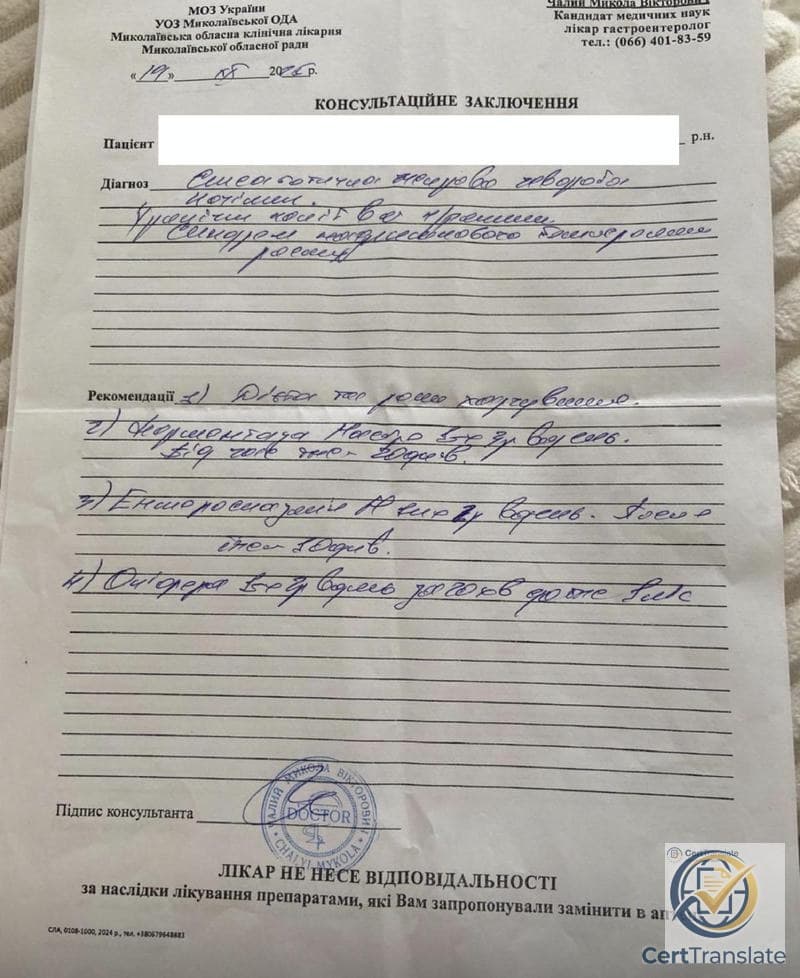
A client submitted a medical consultation report (консультаційне заключення) issued by a hospital in the Mykolaiv region of Ukraine. The document is a pre-printed hospital form with all clinical content — diagnoses, examination findings, and medication prescriptions — filled in by hand by the attending physician.
The handwriting is extremely cursive, compressed, and uses non-standard medical abbreviations. The first diagnosis line could plausibly be read as "enterocolitis," "symptomatic cholelithiasis," or "ischemic bowel disease" depending on how individual Cyrillic letters are interpreted. The medication names in the recommendations section are written in shorthand that does not correspond to any standard pharmaceutical notation.
The certified translation was needed for the client's immigration filing with USCIS.
Why This Required More Than a Standard Translation
A certified translation requires translating exactly what a document says. But when the handwriting is ambiguous enough that the same line yields three different medical diagnoses, the translator has no safe default. Guessing wrong on a diagnosis in a certified medical translation could have real consequences — an immigration authority, insurance company, or medical provider relying on the translation would be working with incorrect clinical information.
Marking every unclear word as "[Illegible]" is technically defensible but renders the translation useless. The client paid for a translation, not a page of bracketed placeholders. The challenge is producing a reliable translation of content that a single reader cannot reliably interpret alone.
This goes beyond a typical handwritten document legibility issue. With most handwritten records, a skilled translator familiar with the language and script can work through the cursive. Medical shorthand adds a second layer of difficulty — even if you can read the letters, you need clinical context to know which drug name or diagnosis the abbreviation refers to.
How We Handled It
After the initial reading produced one interpretation of the diagnoses, we brought in an independent medical professional to review the handwritten text. The medical professional's reading differed from the translator's — and was more clinically coherent.
The key diagnosis remained ambiguous even after the second opinion. Based on the initial Cyrillic letter "І" and the characteristic stroke pattern, the medical professional interpreted it as "Ішемічна хвороба кишечника" (ischemic bowel disease). A question mark in the original appears to reflect the physician's own diagnostic uncertainty — a preliminary or differential diagnosis, not a confirmed one.
The medication names — which were virtually unreadable in isolation — were identified through the medical review as Fermentase, Enterospasmil, and Omeprazole. Without clinical knowledge of what drugs are typically prescribed alongside an ischemic bowel diagnosis, these abbreviations would have been untranslatable.
We translated the document using the medically verified reading and documented the entire interpretive process across seven Translator's Notes.
"The physician's handwriting is highly cursive and abbreviated, making reliable transcription difficult in several sections. The interpretation of the handwritten diagnoses and medication names was assisted by an independent medical professional review. The first diagnosis is written in highly ambiguous cursive. Based on the initial letter "І" and the characteristic stroke pattern, it has been interpreted as "Ішемічна хвороба кишечника" (Ischemic bowel disease). The question mark in the original appears to indicate the physician's diagnostic uncertainty or a preliminary/differential diagnosis. The medication names — Fermentase, Enterospasmil, and Omeprazole — were identified with the assistance of a medical professional. Verification with the prescribing physician's office is recommended."

We also included the physician's direct contact number from the document stamp, so the receiving party can verify the prescriptions independently if needed.
The Outcome
The certified translation was delivered with complete Translator's Notes documenting every ambiguous section and the medical verification process. The client confirmed the translation accurately captured the document's content.
Handwritten Ukrainian medical documents come up regularly in our practice. Most are difficult but manageable for a translator experienced with Ukrainian medical terminology. This case was unusually challenging — the handwriting was bad enough that a qualified translator and a medical professional were both needed to produce a defensible reading.
I was worried no one would be able to read this — even I couldn't make out what the doctor wrote. They took the time to actually verify the diagnoses with a medical specialist. The translation came back with everything clearly explained.
What This Means for You
A certified translation of a handwritten medical document requires more than language fluency — it requires the ability to interpret physician shorthand that may be ambiguous even to native speakers. When a document contains diagnoses or prescriptions that cannot be reliably read by a single translator, an independent medical review is the professional standard. The result is a translation with Translator's Notes that are transparent about what was ambiguous, how it was resolved, and where to verify — which is exactly what USCIS and other authorities expect.
Have a similar situation?
We handle illegible handwritten medical documents regularly — including cases that require independent medical verification.
Related Cases & Resources
Explore the Hub
Documents
Languages
Immigration
All identifying information has been removed from document images and text. The patient's name, dates, document numbers, and physician's identifying details have been masked. Case details are shared with client permission. No personal data is stored or displayed on this page.