




How do you translate two Russian transcripts from different universities for a single student?
TL;DRA client needed certified translations of two Russian academic transcripts (spravki ob obuchenii) from two different universities — one federal, one private — documenting a transfer after expulsion. The transcripts used different form structures, different grading systems (numeric grades vs. pass/fail only), and the second document contained a misspelled institution name. Both were translated with consistent terminology across 86 combined disciplines, and Translator's Notes documented the typo and format differences.
Case Specifications
- Document
- Academic transcript (spravka ob obuchenii)
- Foreign Name
- Справка об обучении (о периоде обучения)
- Country
- Russia
- Languages
- Russian → English
- Submitted To
- Credential evaluation / university admission
What We Received
The client submitted two Russian academic transcripts (spravki ob obuchenii). The first was issued by a federal state university of telecommunications in Saint Petersburg — a 54-discipline transcript covering a distance-learning program in Infocommunication Technologies. The student had been expelled after nearly five years of study, before completing final state examinations or a graduation thesis.
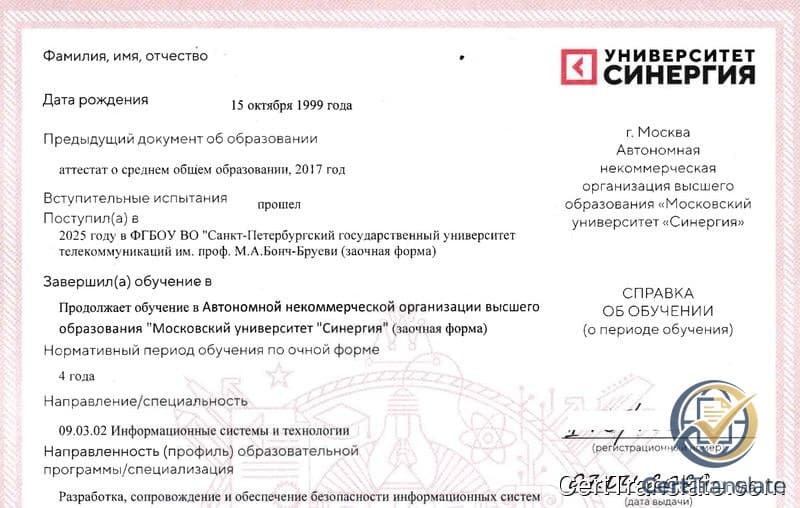
The second transcript was issued by a private university in Moscow, where the student had transferred and was currently enrolled in an Information Systems and Technologies program. This document listed 32 disciplines completed so far.
Both documents were needed for credential evaluation and potential transfer of credits to a foreign institution. The Russian to English translation needed to present both transcripts as a coherent academic record — not two unrelated documents.
Why This Required Special Handling
The first challenge was layout. The federal university used a two-column page-one layout — student data and coursework on the left, institutional header and signatures on the right — with a four-column grades table on the reverse. The private university used a completely different form: a single-column front page with a three-column table on the reverse. Reproducing each layout accurately in the translations was essential so the evaluator could compare them against the originals.
The second challenge was grading consistency. The federal transcript used four grade levels: "отлично" (excellent), "хорошо" (good), "удовлетворительно" (satisfactory), and "зачтено" (passed/credited). The private transcript used the same Russian terms but in a simpler structure with no hour breakdowns per discipline — only credit units. The translator needed consistent English renderings across both documents so the evaluator would not mistake terminology differences for grading-system differences.
The third challenge was a typographical error in the second document. The private university misspelled the name of the federal university — truncating "Bonch-Bruevich" to "Bonch-Bruevi," dropping the final letter. Silently correcting this would mean the translation no longer matches the original. Reproducing it without comment would look like a translator error.
How We Handled It
We translated both transcripts using identical English terminology for all shared concepts — grade names, degree types, form field labels — so the evaluator sees one consistent academic vocabulary across both documents. "Зачтено" is rendered as "passed" in both. "Направление/специальность" is "Program/specialty" in both. This eliminates any confusion about whether the two universities use different systems.
For the 86 combined discipline names, we used standard US academic-catalog conventions: "Высшая математика" becomes "Higher Mathematics," "Теория вероятностей и математическая статистика" becomes "Probability Theory and Mathematical Statistics," and so on. Where disciplines appeared on both transcripts under slightly different names, we ensured the translations reflected the actual Russian text rather than artificially harmonizing them.
The layouts were reproduced to match each original: the federal transcript as a two-column first page with a four-column table, the private transcript as a single-column first page with a three-column table.
"In the "Admitted in" section, the name of the federal institution appears in the original as "М.А.Бонч-Бруеви" — missing the final letter "ч" of the correct form "Бонч-Бруевич" (Bonch-Bruevich). This is a typographical error in the original document. The translation reproduces the original spelling."

Both documents contained handwritten entries — registration numbers and dates of issue — which were transcribed and noted as handwritten in the translation. The federal transcript also carried three illegible signatures (Rector, Director, Secretary) and a round official seal, all documented with legibility qualifiers per certified translation standards.
The Outcome
Both certified translations were delivered to the client as a matched pair. The consistent terminology across documents means an evaluator can read them as one continuous academic record — 54 disciplines at the first institution, 32 at the second — without needing to reconcile different translation styles.
Russian university transfers involving expulsion and re-enrollment are not uncommon. We handle multiple spravki ob obuchenii each month. The key is treating linked documents as a set, not as isolated orders.
What This Means for You
Linked academic transcripts from multiple Russian universities should be translated together by the same translator to ensure consistent terminology across all documents. A credential evaluator comparing two transcripts that use different English terms for the same Russian grade will flag the inconsistency — even if both translations are individually correct. When your documents contain typos or errors in the original, a Translator's Note documenting the discrepancy is standard professional practice and protects both the translator and the applicant.
Have a similar situation?
We translate Russian academic transcripts regularly — including multi-document transfer cases.
Related Cases & Resources
Explore the Hub
All identifying information has been removed from document images. Case details are shared with client permission. No personal data is stored or displayed on this page.