



What do you do when a registrar's handwritten N and H look like the same letter on a birth certificate?
TL;DRA Senegalese Extrait du Registre de Naissance was completed in handwriting that drew capital N and capital H identically, producing two impossible readings: "THIEHABA SECK" for the place of birth and "ALASSAHE" for the father's first name. We resolved both by cross-reference to the printed letterhead of the same form (which spells the commune as "THIENABA"), rendered them as "THIÉNABA SECK" and "ALASSANE," and documented the original handwritten forms in a Translator's Note for the client's USCIS filing.
Case Specifications
- Document
- Birth certificate
- Foreign Name
- Extrait du Registre de Naissance
- Country
- Senegal
- Languages
- French → English
- Submitted To
- USCIS
What We Received
A client submitted a Senegalese Extrait du Registre de Naissance (Extract from the Birth Register) issued by the Civil Registry of the Commune of Thiénaba (Centre Secondaire), in the Arrondissement of Thiénaba, Thiès Region. The certified birth certificate translation was needed for a USCIS filing.
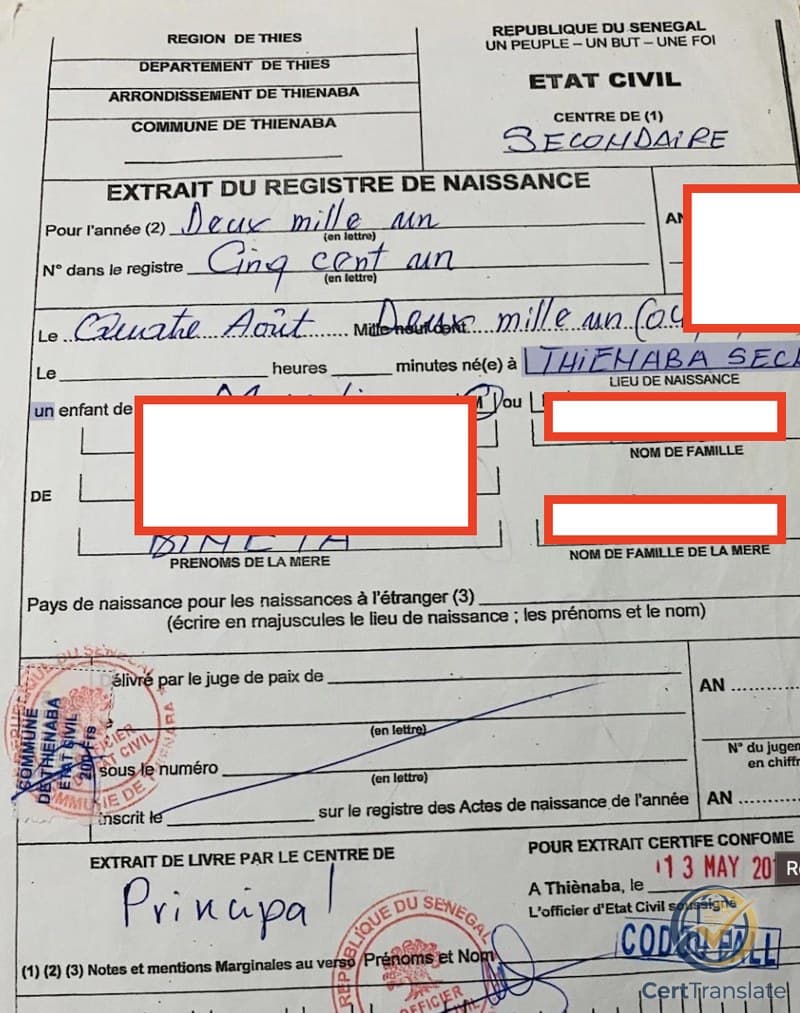
The form is a pre-printed Senegalese civil-registry sheet — registry entry No. 501 of 2001, child born on 4 August 2001, certified extract issued on 13 May 2016 by Civil Registry Officer Codou Fall. The handwritten entries are made in clear, deliberate capitals — the writer is not careless. But the same writer draws capital N and capital H as the same shape: two vertical strokes joined by a horizontal bar.
The result is that the place-of-birth field reads literally as "THIEHABA SECK" and the father's-first-name field reads literally as "ALASSAHE." Neither is a real Senegalese name.
Why This Required Special Handling
USCIS requires a certified French-to-English translation to be a complete and accurate rendering of the source document. "Complete and accurate" sets up a real tension when a handwritten entry is graphically clear but linguistically nonsense: a translator who silently "corrects" the entry has substituted their own reading for the source; a translator who transcribes the literal nonsense has produced an accurate translation of an unreadable form.
There is no second document to reach for — the client did not supply a passport, an ID card, or a parental record. The standard cross-document name-consistency check that civil-registry translators use for USCIS-bound packets is not available here.
What is available is the rest of the same document. The pre-printed letterhead at the top of the form spells the commune four separate times in unambiguous typeset capitals: "REGION DE THIES," "DEPARTEMENT DE THIES," "ARRONDISSEMENT DE THIENABA," "COMMUNE DE THIENABA." The fourth letter of the place name is a typeset "N" with no ambiguity. That is the cross-reference key.
How We Handled It
We rendered the handwritten place of birth as "THIÉNABA SECK" — Seck being a known sub-locality within the Commune of Thiénaba — because the same form's printed letterhead establishes the spelling "THIÉNABA" beyond doubt. By implication the writer's middle glyph is "N," not "H." Once the writer's glyph identity is fixed at "N" for that field, it is fixed for the whole document.
We then applied the same identity to the father's first name and rendered "ALASSAHE" as "ALASSANE" — the standard Senegalese form of the name. We did not introduce a guess; we applied a finding already established within the four corners of the same document.
Both renderings are documented in a single combined Translator's Note. The note states the writer's glyph identity, lists the two affected fields, and gives the literal handwritten reading and the rendered reading for each. A USCIS adjudicator who compares the original side-by-side with the translation can verify the basis of each decision in seconds.
"The handwriting on the form does not graphically distinguish between capital "N" and capital "H": both letters are drawn as two vertical strokes joined by a horizontal bar. This affects two handwritten entries. (a) The place of birth is handwritten as "THIEHABA SECK," but the printed letterhead of the same document (REGION OF THIÈS, DEPARTMENT OF THIÈS, ARRONDISSEMENT OF THIÉNABA, COMMUNE OF THIÉNABA) uses the spelling "THIÉNABA" with an unambiguous printed "N." The handwritten entry has accordingly been rendered as "THIÉNABA SECK" (a known locality within the Commune of Thiénaba). (b) The father's first name is handwritten as "ALASSAHE" and has been rendered as "ALASSANE," the standard Senegalese form of the name. The original handwritten readings are noted here."

Two further translation notes accompanied the certification block. The original birth date, written numerically as "04/08/2001" in French DD/MM/YYYY format, was rendered as "August 4, 2001" — the unambiguous US written form. The entire central section of the form (Justice of the Peace, judgment number, registration date and year) is blank and crossed through with a single diagonal line in the original; rather than enumerating each empty field, the translation reproduces the section once with the note "[The entire central section above is blank and crossed through with a single diagonal line in the original.]"
The signatory's name appears as a blue rectangular name stamp reading "CODOU FALL" with a free-form handwritten signature overlaid on top. The translation describes the two elements separately — "[STAMP, blue, in box: CODOU FALL]" followed by "[Handwritten signature overlay]" — to make clear that the printed name is a stamp, not a signature.
The Outcome
The certified translation was delivered to the client for inclusion in their USCIS filing. The Translator's Note provides full visibility into the handwriting ambiguity and shows that each rendered name follows from a verifiable feature of the source — not from translator preference.
Cross-referencing a handwritten ambiguity against the printed letterhead of the same document is a routine technique for francophone West African civil-registry forms, where the pre-printed body of the form carries far more typeset reference text than a typical US vital-records sheet. We have applied the same printed-letterhead cross-reference on Senegalese, Ivorian, Cameroonian, and Burkinabè birth-certificate extracts — the printed reference is almost always available somewhere on the form.
What This Means for You
A handwritten letter on a foreign civil-registry document does not have to be guessed at when the same document also carries the same word in print. A certified translation that resolves the ambiguous handwritten letter against the printed letterhead of the same form, and documents the basis of the decision in a Translator's Note, gives a USCIS adjudicator the audit trail needed to accept the rendering as accurate rather than improvised.
Have a similar situation?
We translate handwritten French civil-registry documents from Senegal and other francophone African countries with USCIS-grade Translator's Notes regularly.
Related Cases & Resources
Sources & References
- Meet Translation Requirements·USCIS·Verified 2026-06-04
Explore the Hub
Certified Translation
Documents
Languages
Immigration
Accepted By
All identifying information has been removed from document images. Case details are shared with client permission. No personal data is stored or displayed on this page.